
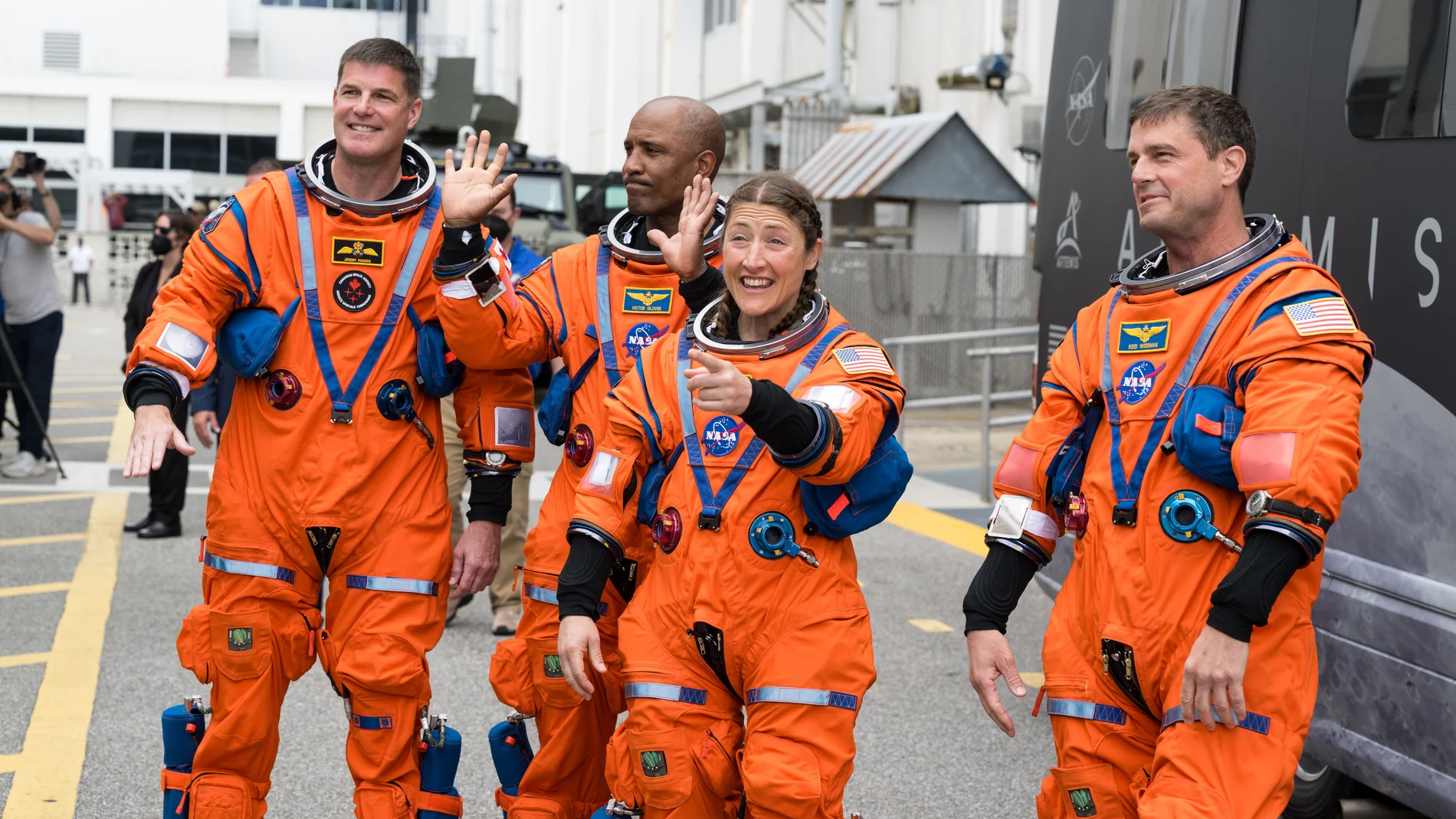
Tonight, Reid Wiseman, Victor Glover, Christina Koch and Jeremy Hansen They will most likely make history. If no incidents occur such as those that prevented the attempts to launch Artemis II In February and March, the four astronauts will fly to the Moon and arrive the furthest distance a human being has ever been from planet Earth. One may think that a feat of this type must be well paid, but in reality not so much.
Beyond the annual salary, which we go into below, carrying out a mission like Artemis II hardly changes their salary. NASA does not have a hazard bonus, nor a bonus for reaching the Moon, nor payment for overtime.although they will spend most of the ten days of the mission working.
A year ago, The New York Times addressed this issue following the astronaut case Suni Williams and Butch Wilmorewho were forced to remain in the International Space Station 278 days longer than expected after the capsule Starliner who took them there had problems that led NASA to dispense with her for her return.
Williams and Wilmore were treated the same as any other federal employee who takes a trip to a neighboring state. Since astronauts have transportation, accommodation and food covered, there are no per diems for any of these concepts, as if they would have on the ground.
The only extra they receive is a daily allowance for ‘minor expenses’ which, as explained to the media Jimi Russellspokesperson for the NASA Space Operations Mission Directorateis from 5 dollars a day. This means that Williams and Wilmore received $1,430 each for his 278 extra days on the ISS.
In the case of the Artemis II astronauts, with a duration of ten days, the assignment will remain at 50 dollars for each.
What Artemis II astronauts earn
Not all Artemis II astronauts are paid equally, depending mainly on of their civil or military status. In the first group are Wiseman, a retired Navy captain, and Koch. According to the agency’s federal civil scale, General Schedule (GS), both earn from NASA $152,258 / €131,200 per year.
Victor Glover, on the other hand, being an active military man, does not go for GS, but rather by the Department of Defense officer board. Having 26 years of service, he fits into the O-6 bracket, whose base salary is 182,264 dollars / 157,100 euros annually.
Jeremy Hansen is also a soldier, but Canadian, so he is paid according to the scale of the Armed forces of his country. As a colonel, according to the current table, he receives between 174,264 and 194,904 Canadian dollars per year, equivalent to between 108,100 and 120,900 euros.