
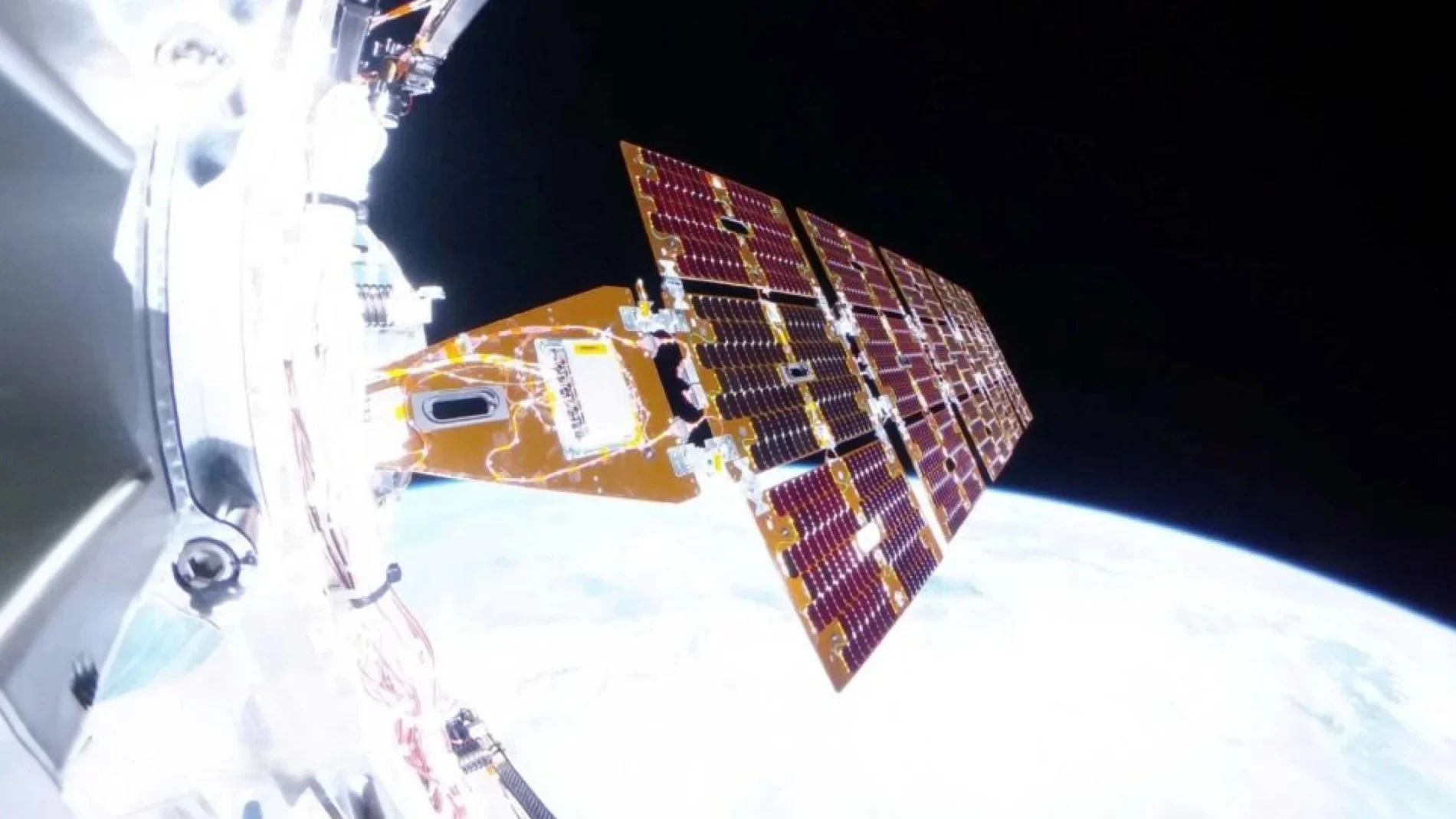
The ship LINK had to carry out an unprecedented operation for the POT when last July 25th it began to spin uncontrollably more than 320 kilometers above the Earth. Its mission is to reach the Swift space observatory, capture it using a robotic system and raise its orbit before it falls to Earth. Now the engineers must first save the vehicle that was to carry out the rescue.
LINK was built and is operated by Katalyst Space Technologiesa company specialized in providing services to satellites in orbit and to which NASA awarded a contract 30 million dollars. This is the first time that the US agency has commissioned a private company to maintain one of its satellites.
The observatory Neil Gehrels Swiftwhat cost 500 million dollarswas released in 2004 to study gamma rays and other phenomena in the universe. The ship is still running, but It lacks a propulsion system capable of raising its orbit. The little atmosphere that still exists at that height generates a small friction that makes it lose altitude little by little. Within a few months it will be too low for LINK to safely complete the maneuver.
The mission was progressing as planned from the launch of LINK on July 3, until the spacecraft began rotating on several axes during a period without communications with the ground. ‘Just before we were in a very stable configuration’he explained to Ars Technica Ghonhee LeeCEO of Katalyst.
The rotation prevented maintaining a stable connection with the control center and made any attempt to regain control of the ship difficult. Two of its three reaction wheels also stopped working. and the engineers detected an additional problem in part of the cold gas thruster system.
The reaction wheels are discs driven by electric motors that allow a ship to be oriented without expelling propellant. When one wheel accelerates or brakes, it transmits a countermovement to the rest of the vehicle. The combination of several wheels allows you to control its orientation on the three axes.
After beginning to spin uncontrollably, the team lost contact with LINK for more than 24 hours. The ship then activated an automatic restart Intended for situations where you spend too much time without receiving instructions. The procedure abruptly cut off the power to the systems and caused a temperature increase in the electronic circuits that control the reaction wheels.
‘It basically shuts down all the systems at once and that has a series of effects on sensitive components like the reaction wheels.’says Lee. The thermal increase ended up leaving two of them unused. The failure of the cold gas thrusters appears to be a separate problem, although Katalyst does not yet have all the data necessary to determine what started the emergency and what damage resulted from it.
Katalyst engineers, in collaboration with NASA control specialists, are developing the system that should stabilize LINK and allow it to continue the mission. The solution goes through reprogram the guidance, navigation and control algorithms to steer the ship using the only operational reaction wheel, the available thrusters and its three xenon-powered electric motors.
These plasma engines were installed to raise orbits, but they can also contribute to stop the turn. Each is mounted on a two-axis gimbal mechanisma joint that allows the engine to be tilted in two directions and direct its thrust without having to first move the entire ship.
‘We have been able to use the thrusters to point in the opposite direction to the rotation speed and thus control the attitude, which has been very effective‘ says Lee. The electrical system generates little thrust and needs time to produce appreciable changes, but it has already allowed reduce rotation speed from about 9 degrees per second to approximately 4 degrees per second.
A slower rotation will facilitate higher capacity communications and allow download detailed information about LINK status. Katalyst will also use two cameras to look for signs of a possible collision with space debrisone of the causes considered for the ship’s malfunction.
The company maintains for now the goal of approaching Swift towards the end of August. ‘There seems to be nothing stopping us reestablish control of the ship in all three axes’says Lee. Although the method will be different from what was initially planned, it is estimated that LINK will be able to get closer to a few dozen meters, inspect the observatory and try to grab it. ‘We believe that capturing Swift, or at least attempting to capture it, remains a very real possibility’.