
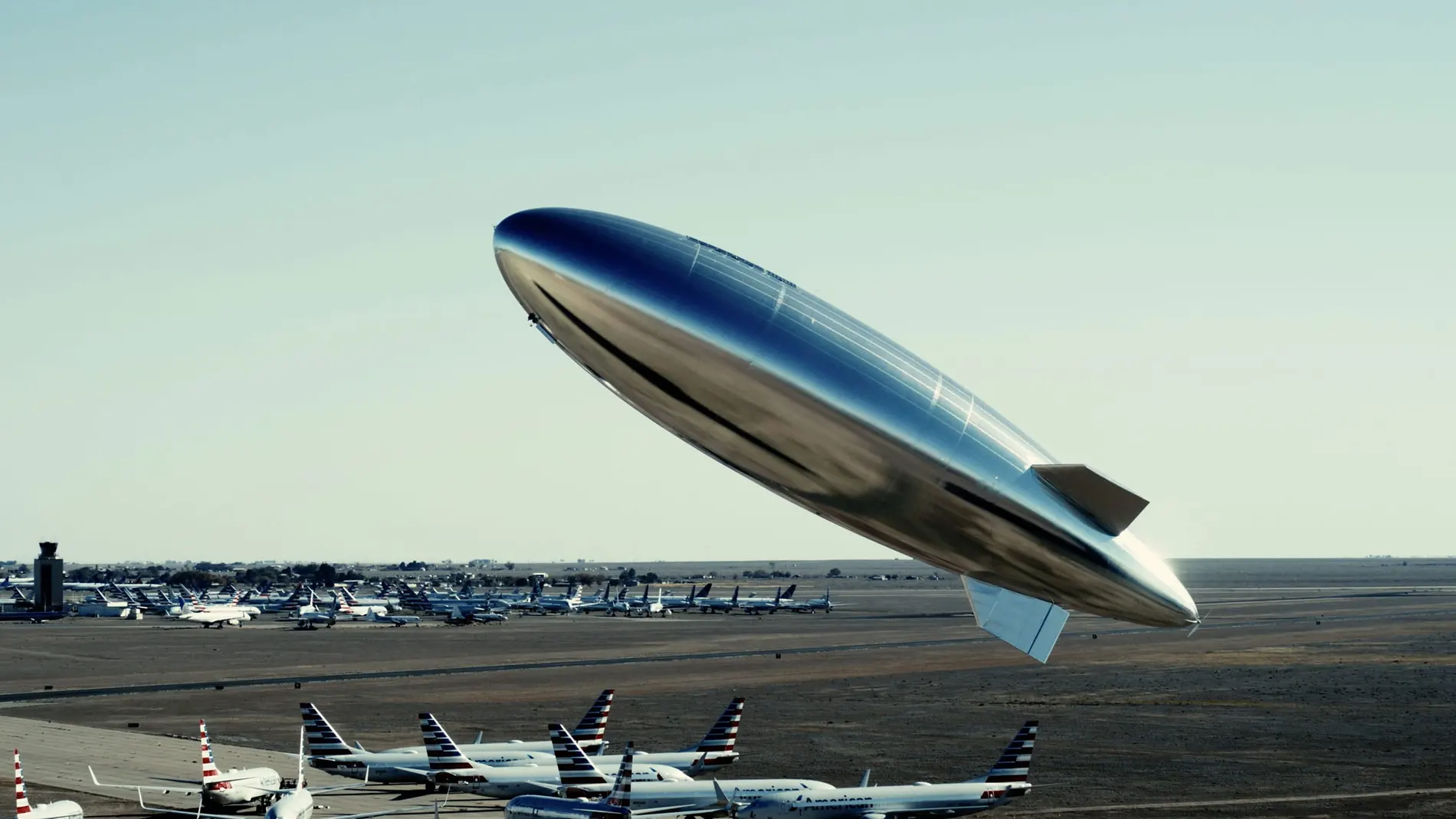
For more than a century, flying has been a matter of transit. The planes take off, cross the sky and land again. It is its nature: everything moves in the sky. But now, a company called Sceye, specialized in high altitude platform systems (HAPS) for telecommunications and real-time environmental monitoring, wants to change that idea with a contradictory proposal: flying without going anywhere.
Their aircraft, a hybrid between a blimp, drone and satellite called SE2, is not designed to travel, but to stay. In a recent test, He managed to stay in the stratosphere for twelve consecutive days, traveling more than 6,400 kilometers at an altitude of about 16 kilometers. That is, above commercial air traffic, but still well below space. And up there, in that forgotten stretch of sky, something interesting happens.
The atmosphere is so thin that there is hardly any turbulence, but there is still enough air to support an aerodynamic structure. And, above all, there is something crucial: almost constant sunlight. No clouds, no full night for long periods, no interference. It is the perfect place for a new type of machine.
The SE2 is solar powered, storing electricity during the day to remain operational at night. But what is truly new is not that it flies with solar energy (we have already seen that in other prototypes), but its ability to stay. It is not designed to cross continents, but to monitor, measure, observe. Like a satellite that, instead of orbiting the Earth, decides to stay floating over a specific point.
This change in focus opens up possibilities that until now were fragmented between different technologies.. Satellites can cover large areas, but with lower resolution and without the ability to react in real time. Drones can be precise, but they have limited autonomy. Airplanes require fuel and constant logistics. The SE2 occupies a middle ground.
“Resilience is what makes it possible – explains Mikkel Vestergaard Frandsen, director of Sceye in a statement -. The ability to remain over an area for prolonged periods allows constant connectivity and real-time monitoring where traditional networks and existing technologies are insufficient. Through stratosphere, we can extend the reach of existing global networks to billions of offline people and provide actionable, real-time information that significantly improves our preparedness and response to wildfires or other natural disasters.”
For example, from that height, you can monitor forest fires, follow the evolution of hurricanes, measure polluting emissions or provide connectivity in remote areas or areas affected by a catastrophe. All of this for days or even weeks, without needing to land.
An additional layer over our heads that didn’t exist until now: neither as high as space, nor as close as air traffic. A new territory, the lower stratosphere, which until recently was only a place of passage and which is now beginning to emerge as a habitable space… at least for machines.
The twelve-day test is not just a technical record. The trip led to SE2 along 6,400 kilometers from New Mexico to Brazil, stopping for up to 88 hours in a row in different areas, motionless. During the day, when the sun gave them energy and at night, when they used the stored energy. They also maintained the pressure standards essential for all onboard devices to function correctly.
Sceye is preparing for its first pre-commercial test flight in Japan, with the objective of providing a connection to the core network of one of the largest banks in Asia and conduct demonstrations of expanded connectivity during emergency and disaster response scenarios.
Logically, as often happens, technology begins to raise questions before it is even consolidated. Who controls that space? How is a network of platforms that are neither airplanes nor satellites regulated? What happens when dozens, or hundreds, of these devices share that strip of sky? Unfortunately, as with most technologies (internet, genetics, nuclear) we will have to wait for conflicts for the questions to be taken seriously.