
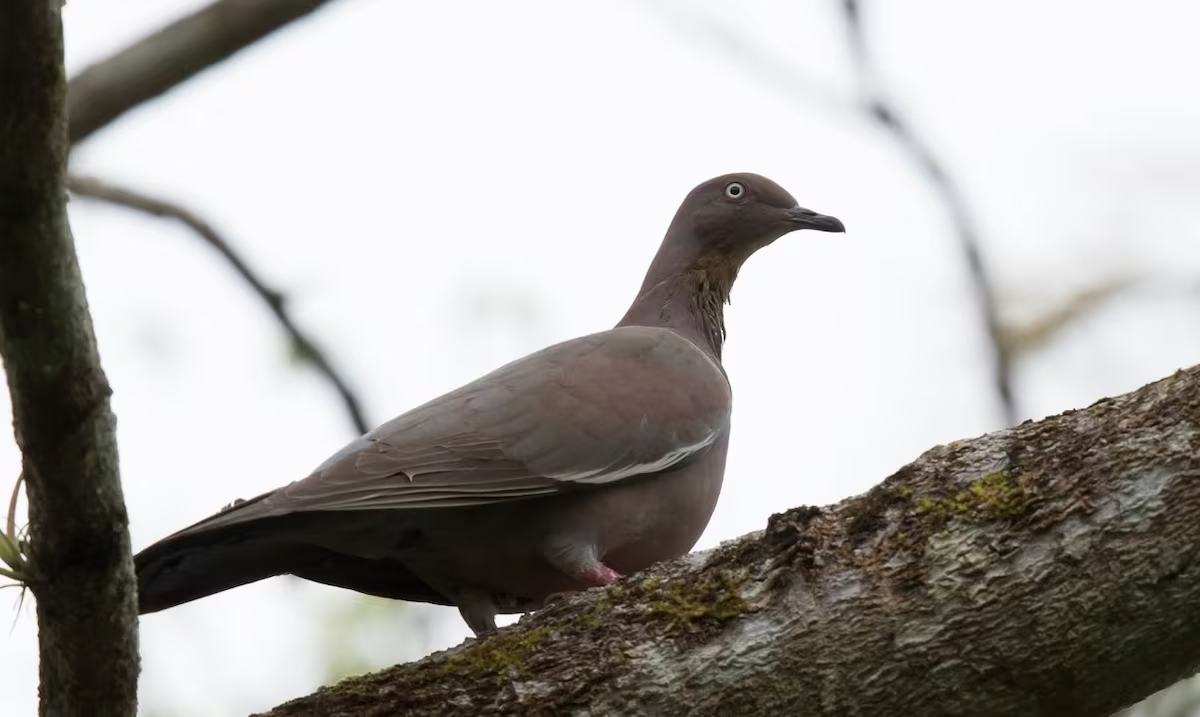
At a time when it is estimated that the population of the savanna pigeon does not exceed 200 birds in the wild, environmental groups and community leaders presented a formal petition to the United States Fish and Wildlife Service (FWS) to claim the designation and protection of a “critical habitat” under the Federal Endangered Species Act.
“The best available scientific data strongly indicates that the designation of critical habitat is prudent for the survival of the Puerto Rican savanna pigeon.. Habitat destruction, modification and fragmentation remain important factors leading to the decline of the species. In addition to being necessary, the small population of the Savannah pigeon and its confined habitat demonstrate that critical habitat is determinable,” states the petition, addressed to the Secretary of the Interior, Doug Burgumvia the FWS.
The petitioners requested that the FWS designate “the broadest possible critical habitat for the savannah dove, consistent with the most important habitat available for the species in the municipalities of Gurabo, Caguas, Cidra, Comercio, San Lorenzo and Cayey”.
In addition, they listed various physical and biological characteristics that are “essential” for the conservation of this bird, such as nesting substrate, adequate food and water sources, and connectivity corridors.
“It is time for the Fish and Wildlife Service to make up for decades of insufficient action by finally providing the vital protections these incredible birds desperately need. Another hurricane could mean the extinction of a species as close as the Savannah pigeon. “The agency must protect the places where these birds live before they disappear forever.”he maintained – in written statements – Ragan Whitlockattorney for the Center for Biological Diversity.
1 / 10 | Sabanera pigeon: symbol of Puerto Rican identity in imminent danger of extinction. The Savannah pigeon is an endemic subspecies, which means that its natural distribution is limited to Puerto Rico. Photography by Amarilys Lebron. – Supplied
The Savannah pigeon (Patagioenas inornata wetmorei) was included on the list of endangered species in 1970. Despite this, Hernaliz Vazquez Torresdirector of Sierra Club Puerto Rico, pointed out that “the federal government has never provided the corresponding protection of critical habitat necessary for its recovery, which has led the population to catastrophic levels.”
This bird has managed to survive threats such as the destruction of its habitat, unregulated hunting and predation by rats and thrushes. The climate crisis has added a challenge: the onslaught of increasingly intense hurricanes.
Vázquez Torres recalled that the savanna pigeon was on the verge of disappearing in the 1930s due to deforestation and hunting. In 2017, after the hurricanes Irma and Mariathe population plummeted from 11,984 individuals to only 287 in 2024. According to experts, at present, there are only between 55 and 200 birds left in the wild..
“Decades of habitat loss, compounded by increasingly severe climate-induced hurricanes, have brought this species to a critical point. Climate-induced hurricanes have devastated this species, and without critical habitat, another major storm could mean its extinction. Protecting critical habitat is not optional, it is essential. Sierra Club Puerto Rico joins its conservation partners to demand immediate federal measures to prevent the permanent loss of this endemic species,” said the environmental activist.
For its part, Eliezer Colonpresident of the Despertar Cidreño Committee, highlighted that the designation of critical habitat is the only way to give this pigeon “a real opportunity to recover.”
The group shared that an agreement was recently reached to reestablish an aviary at the Humacao Campus of the University of Puerto Rico which closed in 2003, when estimates indicated that its wild population exceeded 11,000. Additionally, a private donor committed to finance, design, build and manage a second aviary, in Golden. However, Savannah pigeon advocates stated that these efforts “will only be successful if the FWS ensures the protection of suitable critical habitat for the species, both now and in the future.”