
We think we see the world as it is. But our eyes are actually extraordinarily selective. Imagine that the electromagnetic spectrum is an immense library. Everything our eyes are capable of reading only occupies a narrow shelf. Beyond begins a gigantic library, a space up to 2,500 times larger, of books written in languages that evolution never taught us to understand. That sector is the infrared and until now it was a section prohibited for humans.
That ability has belonged only to science fiction: Superman distinguished forms of light invisible to any human being, just like the Silver Surfer, since both saw the infrared part of the electromagnetic spectrum. Now an international team of researchers has taken a small step towards that idea.
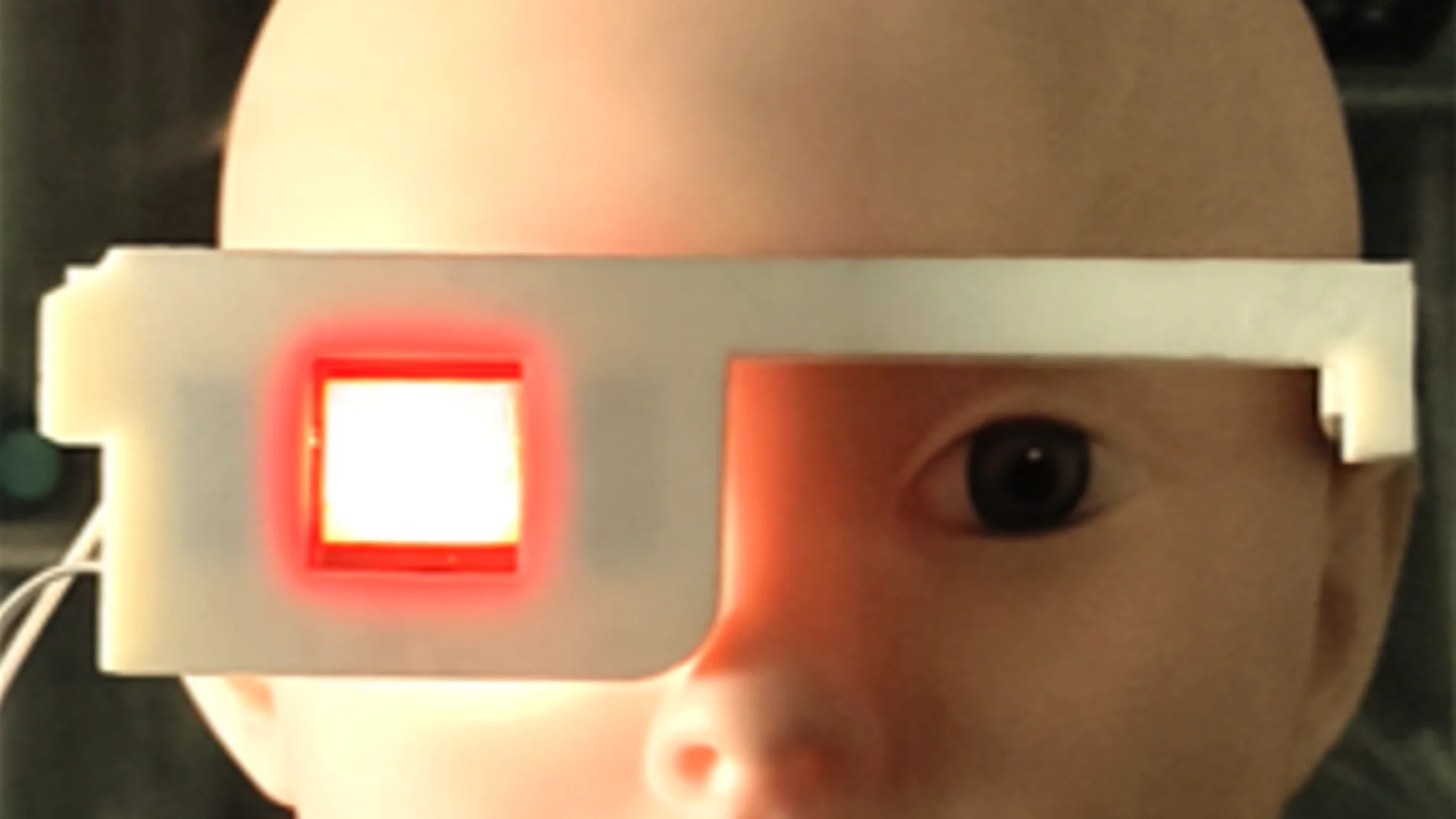
In a study published in Naturea team of scientists, led by Chengchang Fu, has developed an ultrathin device based on quantum dots capable of transforming infrared light into visible images. Integrated into some experimental glasses, allows us to observe part of the infrared using only our own eyes. And the trick is much more elegant than it seems. But let’s start from the beginning.
Why are we unable to see infrared? The answer lies in the energy of light. Each color is made up of tiny packets of energy called photons. Infrared photons carry less energy than those of visible light and do not have sufficient intensity to activate the photosensitive pigments in our retina. It’s like trying to ring a house bell by hitting it with a feather. There is contact, but not the force necessary to activate the mechanism.
For hundreds of millions of years, evolution accepted this limitation because our eyes adapted precisely to the small region of the spectrum where the Sun emits most intensely and where the Earth’s atmosphere is most transparent. The rest of the spectrum was always there, it simply remained written in a language our senses could not read.
The device developed by Fu’s team does not modify the human eye, but instead builds a translator. When an infrared photon hits the glasses, a layer of quantum dots absorbs it and converts it into an electrical signal. That signal immediately activates a tiny organic light-emitting diode (OLED), which generates a new photon, this time within the visible range.
The entire chain barely lasts a fraction of a second and the eye never detects the infrared. What you receive is an instant translation that you interpret exactly the same as any other image. We have not changed our eyes, rather the language in which the light speaks with them. Although it may seem like it, these glasses do not work like the thermal cameras used by firefighters or rescue teams. They detect near infrared and shortwave infrared, a region of the spectrum located just after visible light and rich in information reflected by objects.
Furthermore, there is another fundamental difference. Traditional cameras capture the image with a sensor and then display it on a screen. There is no screen here: visible light passes through the lenses while the device simultaneously adds information from infrared. We do not observe a digital representation of the environment. We are still looking at the real world, only enriched with an additional layer of information.
Another of the most surprising achievements of the study is that the system does not convert all infrared radiation into a single color. Each wavelength generates a different visible color. It may seem like a minor detail, but it represents a huge technological leap. It is the difference between translating all the world’s languages using a single word or preserving the nuances of each of them.
The potential applications are enormous: navigation in low visibility conditions, rescue operations, augmented reality or helping people with certain visual disabilities. However, perhaps the greatest contribution of the work is something else. For centuries we have built instruments capable of observing what our eyes could not see: telescopes, microscopes, radio telescopes or thermal cameras. This study proposes a paradigm shift: it is no longer about making machines that see for us, but rather about expanding our own senses.