
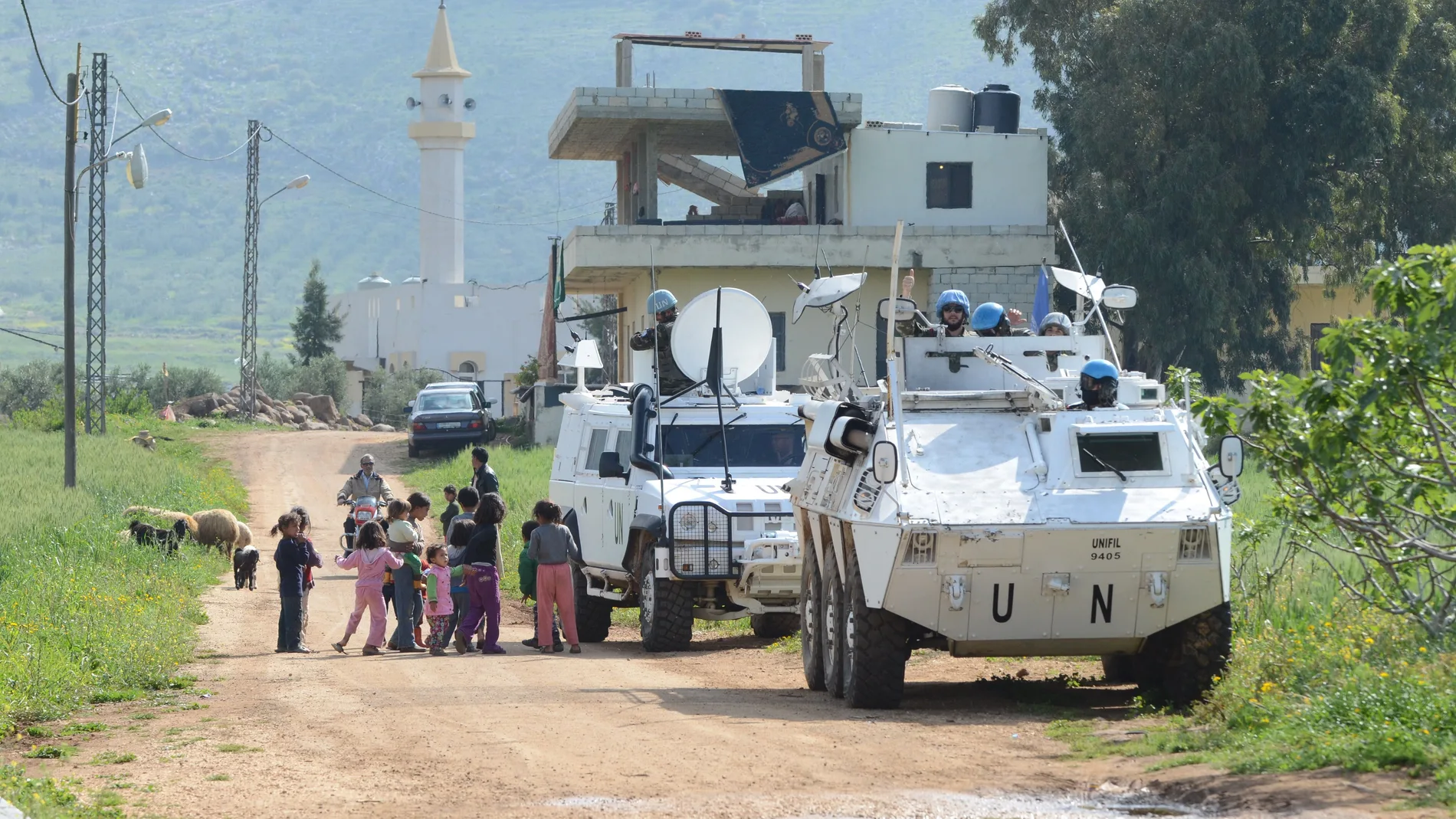
The nearly 670 Spanish soldiers deployed in southern Lebanon as blue helmets of the UNIFIL mission face days marked by alarms, races to the bunkers and an uncertainty that is renewed every morning. This is explained by Marco Antonio Gómez Martín, president of the Spanish Troop and Marine Association (ATME), who receives direct testimonies from the contingent and their families.
Routine, if it can be called that, has ceased to exist. “There is no day to day,” summarizes Gómez Martín. «The alarms ring and you grab whatever you have in your hand. “They spend practically all day with a vest, helmet and rifle on them, and they have to run to the bunker area.” Gómez describes a reality in which soldiers They cannot maintain meal, rest or work schedules. Whoever is having breakfast leaves it and runs. He who sleeps, gets up and runs. Everything revolves around what may happen in the following minutes.
The stress is total and without an end date. “Any normal person, you keep them under constant stress for 30 days a month, and you can imagine how the body ends up,” he says, although he immediately qualifies: “It doesn’t mean that are not prepared, they are true professionals, but also people.
Absolute helplessness
At the same time, it is a question of absolute helplessness. The contingent is on a UN mission, its job is to help those living in southern Lebanon, either with humanitarian aid or patrol work that maintains security. Now that the conflict has broken out, The soldiers are tied up, they can’t do anything but stare at the barbarism. what happens around you. In addition to the fact that not everyone runs to the bunker when the alarms go off.
It is often overlooked that security posts cannot be left unattended. “If you put everyone in the bunker and leave all the sentry posts unattended, anyone can get in.”
Soldiers who are in sentry boxes, in vehicles or in surveillance positions have protection, but are exposed in a way that those who take refuge underground are not. They risk everything to maintain security.
Spain knows well the price of that exhibition. On January 28, 2015, Corporal Francisco Javier Soria Toledo, 36 years old, a native of Malaga and assigned to the Córdoba 10 Mechanized Infantry Regiment, died at United Nations position 4-28, in the Ghajar area, next to the Blue Line that separates Lebanon from Israel. A 155-millimeter Israeli artillery shell hit their observation position. Israel acknowledged that the death was due to “several errors” by its forces and agreed to compensate his widow and daughter.
Posthumous decoration
The UN described the event as the most serious incident since the signing of Resolution 1701 in 2006. Soria Toledo was posthumously awarded the Cross of Military Merit with a red badge. Eleven years later, the situation has not only not been deactivated, but has worsened.
The risk of a direct attack exists. Gómez Martín does not hide it: “Whoever says no is deceived.” Now that Israel has announced ground incursions on Lebanese soil, the Spanish contingent finds itself at the epicenter of tension between the Israeli defense forces and Hezbollah. Since the beginning of the mission in 2006, 15 Spanish soldiers have lost their lives in Lebanon.
The contingent, which numbered 1,100 troops at its peak, Since 2012, it has maintained between 600 and 700 soldiers, with the Miguel de Cervantes basenear Marjayún, as the operations center of UNIFIL’s Eastern Sector. This base, about 100 kilometers from Beirut, is a small autonomous city in the middle of southern Lebanon.
It is three kilometers in diameter and is divided into a living area and a work area. It has two gyms, a dining room, a laundry, a field hospital that coordinates diagnoses with the Gómez Ulla Hospital in Madrid, an armored workshop where Vamtac vehicles are maintained and a store that sells the basics: toothpaste, gel, shampoo. There is a soccer field, paddle tennis and basketball courts.
In calm times, the day started with breakfast at seven in the morning. Each soldier was assigned his role: the cavalry units went out on patrol at random times to avoid ambushes, the EOD (explosive disposal) teams tracked down dropped munitions, the sappers maintained infrastructure, the veterinary lieutenant inspected the food that arrived from all over the world through UNIFIL, and the medics covered emergencies. The pace of work was dizzying, and its mission was to improve security and living conditions in the region.
That monotony was suddenly broken. Patrols outside the base have been reduced to a minimum. UNIFIL protection levels, ranging from 1 (permanent vest and helmet) to 3 (all personnel in bunker), They activate with a frequency that commanders have not seen since 2006.
The Eastern Multinational Brigade led by Spain, made up of 3,500 troops of nine nationalities, now operates with movement restrictions that limit the ability to monitor the Blue Line, precisely the reason for the entire mission.
The other side of the coin is in Spain. ATME has been receiving messages from fathers and mothers of soldiers deployed in Lebanon for weeks.
The president of the association says it bluntly: “They send me messages telling me that their son is there and that they haven’t heard anything for a week or ten days.” They do not demand operational information, they are aware that it falls within the security of the mission, but rather a basic confirmation: that their children are fine.
Gómez Martín understands that revealing movement dates or logistical details would put the contingent at risk. Airspace is frequently closed by rocket launches and a plane with 150 soldiers on board would be a target with incalculable consequences.
The complaint is that Defense has not found a formula that reassures families without compromising the operation. “That they are not finding out because a video appears or because I don’t know what appears on social networks”he asks. ATME tries to fill this gap by transmitting what their colleagues in the field send them by phone, photos or videos, but recognizes that their means are limited.
post-traumatic stress
What worries the association the most is the day after. Post-traumatic stress. Gómez Martín insists that returning soldiers will need psychological care and monitoring, and that the Ministry must prepare in advance, not improvise. «We are not a number. “We are also people,” he repeats. And it is a maxim that is impossible to forget. Spending weeks under fire, without rest, without being able to act, psychologically undermines any person, regardless of their advanced training. They are very prepared, ready for anything and they risk their lives for their country. That is why it is necessary to monitor them when they return to the warmth of their homes and can recover normality after weeks of sustained bombings, lack of sleep, rest and with stress levels through the roof.
Presumably patrols outside the base have been drastically reduced and the life of the contingent It takes place for the most part within the perimeter of the barracks, between the bunker and the guard posts. However, it is essential to remember that the help that the Armed Forces are providing to the inhabitants of the region has always been very notable. In 2017, Lebanese troops waved the Spanish flag after their victories against the self-proclaimed Islamic State in solidarity against the jihadist fight.
Meanwhile, in Spain, the next relay is on tenterhooks. They do not know if they will go, if the rotation will be suspended or if the nature of the mission will change from one day to the next. UNIFIL’s mandate was extended by the Security Council until August 2025, but on the ground everything seems provisional.