
As happens in almost all works that have a teenage protagonist, a novel like “The Adventures of Tom Sawyer” has suffered from the “juvenile” label. Despite its author’s explicit wish, in the preface to the first edition of the book, in 1876, that “adult men and women should not despise it, for part of my plan has been to try to pleasantly remind them of who they once were.” Be that as it may, with Samuel Laughorne Clemens, or, rather, with Mark Twain, a pseudonym taken from the expression “two fathoms!”, which served to indicate to ships that the river they were navigating was deep enough, the modern American novel was born, as Hemingway said. And it does so with the adventures of a series of children who, bordering the Mississippi River, ignore the rules of the adults to live adventures of all kinds: innocent and risky, fun and dramatic and, according to Twain’s own confession, true, since his memories would be the basis for writing the work. His fascination with the river – the true protagonist of his literature, the immobile and at the same time changing witness of city and peasant life – with its elegant boats, Tom, the son of the drunk of the town of Hannibal where Twain lived as a child, the observation of the misery and fear of the blacks…
Reading Twain is getting wet in that river in the center of the United States that flows south through ten states, until it empties into the Gulf of Mexico, as the reader appreciated, for example, when Reino de Cordelia published “Life on the Mississippi” in 2021. That river had witnessed the civil war between the North and the South and was the best testimony of an extreme racism whose effect, as the translator and editor’s prologue said, “had turned the state of Mississippi into the fifth richest in the country, a white wealth, that of cotton, forged with the sweat and blood of slaves.” After that, it became what it still is: the North American state with the worst per capita income, as Twain already envisioned.
From humor to disappointment
In this sense, it was very interesting how the narrator, with his journalistic and traveling training, became a chronicler of the reality of the local people, as when he spoke of how “until now the problem has been – and I quote the comments of the plantation owners and the crew of the steamers – that the planters, although they own the land, do not have cash and are forced to mortgage both the land and the harvest in order to continue.” “Life on the Mississippi” is from 1883, a year before “Huckleberry Finn”, a period in which his sense of humor was already turning into sarcasm as the United States, with its idealized democratic ideology, and due to the expansion of its territory as an expansionist empire and its love of weapons, aboriginal genocide and slavery, became an inhospitable and disappointing place for him.
Under this biographical prism it is possible to delve into “The United States of Lynching”, about which its translator and editor, Javier Fernández Rubio, reports that it was written in 1901 but that it was hidden for years for fear of reprisals against his family. And its background is what the Mississippi River saw pass in front of it for decades and decades: a whole series of extremely dark episodes in American history: the period dominated by the segregation laws known as Jim Crow, in force from the end of the 19th century until well into the 20th century, which institutionalized racial separation under the deceptive principle of “separate but equal”, along with the expansion of racial terrorism.
The text was published in 1923 in the posthumous compilation of late writings “The United States of Lyncherdom, Europe and Elsewhere”, when Twain had already been dead for almost three decades. At one point in the following decade, in 1937, Abel Meeropol would write the poem “Strange Fruit”, which Billie Holiday made immortal as a song with an image full of shadow: he did not talk about flowering trees, but about something that hung, that is, the bodies of black men hanging from trees in the southern United States, victims of lynchings. Imagine what it would be like to enter the Café Society club in New York and hear from the American singer, who also suffered racism from childhood until the end of her career, a verse like “Black bodies swinging in the Southern breeze”, in which the soft landscape becomes a silent accomplice of horror.
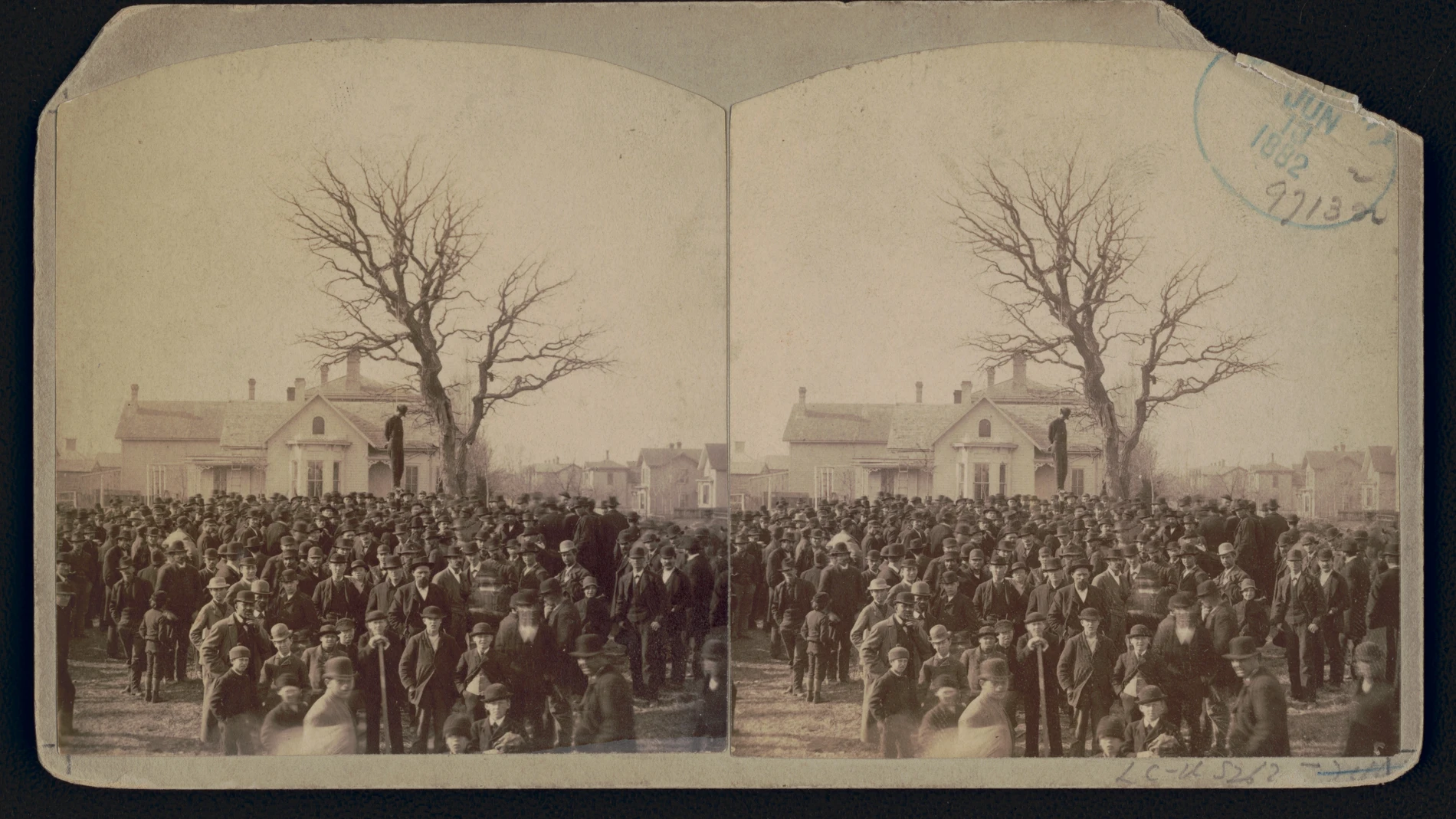
Holiday was born in 1915 in a deeply segregated United States and worked in clubs where, even as the star, he could not enter through the front door or mix with the white public, or had to stay in different hotels occupied by his fellow white musicians. The black individual is annoying and what proceeds, protected by the law, is to murder them, in connivance or silence with white society. It is exactly this climate that Twain denounced in his text, which is accompanied by extraordinarily harsh photos. Such is the horror of seeing these African-American fruits hanged, sometimes surrounded by a crowd of macabre and morbid witnesses, including children.
a stain
«And thus has Missouri, that great State, fallen! Some of their children have joined the lynchers and the stain spreads to the rest of us. That handful of children has given us a reputation and labeled us with a name: for the inhabitants of the four corners of the earth we are “lynchers”, now and forever,” says Twain. It tells of a tragedy that occurred near Pierce City, when a young white woman returning alone from church was found murdered; As a result, people lynched three blacks (“two of them very old”), burned five black homes, and drove thirty black families into the woods. This leads the author to reflect on the reason for taking justice into his own hands and why lynching, along with other barbaric actions, became a common crime in southern society.
For Twain, lynching was a disease that spread through: Colorado, California, Indiana… In provincial and sometimes remote places, but the writer knew well that the fatal attack on the black could occur anywhere, even in the capital of the world, in ways that the rest of the 20th and 21st centuries have developed to purge those fruits: “I may live to see a black man burned in Union Square, New York, with fifty thousand people present and not a single sheriff in sight, not a governor, not a agent, nor a colonel, nor a clergyman, nor any representative of the legal order of any kind.