
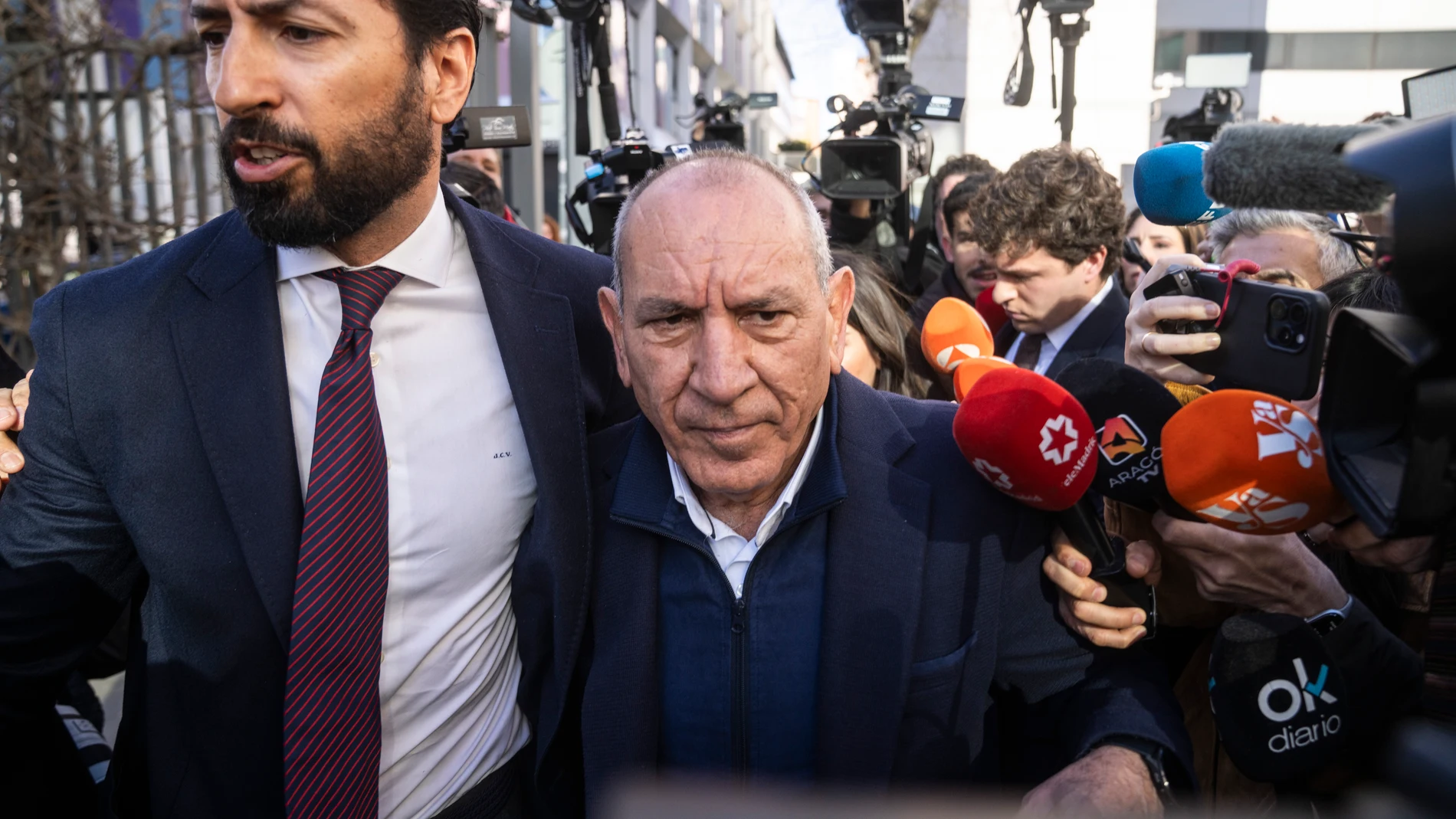
Just a few hours before today the complainant of the former Deputy Director of Operations (DAO) of the National Police finally testifies in court about the alleged sexual assault that she attributes to the police command on April 23 and the judge instructing the procedure hears her own José Ángel Gonzálezsources close to the former “number two” of the Police assure that he is “calm” and eager to be able to “give his version” in court. He will do so a month after his resignation from office after being summoned to testify as being investigated following the complaint filed by the inspector, who accuses him of a violation that the defense of the former police chief denies.
The woman will have to ratify her complaint in the Court of Violence against Women number 8 in Madrid. And according to sources close to the agent She attends this key appointment “distraught like any victim of such a serious crime of sexual assault, and at the hunt that is on her person.”. According to those same sources, the police “are completely encapsulated with the police escort to avoid pressure of any kind.”
The appearance of the former Police Chief opens the door for the accusations – the Prosecutor’s Office or the private accusation carried out by the complainant’s lawyer, the lawyer Jorge Piedrafita – to be able to request the adoption of precautionary measures against González. Once a possible request for provisional detention has been ruled out, it does seem feasible for the alleged victim’s lawyer to propose to the investigator the possibility of adopting less burdensome measures, such as a restraining order or the prohibition of communication by any means, directly or indirectly, between the former DAO and the complainant.
Police measures to protect your identity
In any case, first we will have to listen to the statement of both before the judge and, above all, gauge what position the Public Ministry adopts in this regard. However, it will be the instructor who must make a decision in this regard if these requests finally occur. The statements of the former operational chief of the National Police and the inspector who attributes a sexual assault to him have generated great media expectation. Hence, this morning a large media presence is expected around the acts of violence against women on Madrid’s Albarracín street. According to legal sources, the former DAO will access the judicial headquarters on foot through the main entrance.
In the case of the complainant, the protection protocol for victims of gender violence will be activated, so a police device will be put in place to protect her privacy by the escort assigned by the Ministry of the Interior –the decision was made by the then interim DAO Gemma Barroso–. Hence, the agent is expected to access the judicial premises through a safe place that prevents her public exposure. Both are summoned at half past ten in the morning at the courthouse.
Just yesterday it emerged that the alleged victim wants the magistrate investigating the facts to open a separate piece to investigate a possible crime of revealing secrets for what he considers a “violation of the summary secrecy” due to the dissemination on the 3rd of the defense brief of the former deputy operational director in which the victim was identified and several texts of the recording provided to the court were reproduced to try to prove the reported violation.
“Risk situation”
The lawyer for the private prosecution refers in the document sent to the Court of Violence against Women that on March 3, on behalf of LA RAZÓN and “El Español”, the document requesting evidence from the defense of González, alias “Jota”, “in which the complete affiliation with name and surname of the complainant was outlined in the request for the mechanics of the request for her choice of destination.” Piedrafita wants the instructor to summon the three journalists who signed both reports, including the person writing this chronicle, to testify as witnesses, within the framework of that separate piece whose opening he intends to open. Furthermore, it emphasizes that the information included fragments of the audios provided – regarding which the lawyer unsuccessfully asked the judge for special protection to avoid leaks.
As highlighted by the private accusation, “in an unlawful and unacceptable manner, third parties unrelated to the procedure have been made aware of a document of the investigation that is under secrecy and by extension the full name and surname of my client as the complaining victim, implying a serious interference in his privacy, security and integrity as a victim of the reported crimes.”
And remember that given the “risk situation” in which the alleged victim finds himself, the Ministry of the Interior proceeded to “implement a police escort 24 hours a day” to thus preserve “his safety and integrity.” Something that, as he explains, “with this leak he puts himself in clear and objective danger, both for himself and for the police officers guarding him.”
The lawyer invokes Supreme Court jurisprudence to defend that the investigation “is necessary when there are indications of disclosure and damage, even if the source of the leak is still unknown.” The opposite, he warns, “would generate a space of impunity precisely in cases where authorship is hidden by the mode of commission.”
Two opposing versions
In the background of this initiative is the instructor’s refusal to shield access to the 40-minute audio provided to the court by the alleged victim. The private prosecution tried to get the judge to restrict access to those recordings – which it considers decisive to prove the alleged sexual assault, although the former DAO’s lawyer “does not support the story of the complaint, quite the opposite” – but obtained a rejection in response. The judge argued that the transfer of this documentation was carried out to the parties “through a secure channel that guarantees confidentiality.” A “safe” channel that now questions the complainant’s lawyer regarding what he considers leaks in the procedure that put her safety at risk.
In the complaint that gave rise to the procedure, the police lawyer states that he was the victim of a sexual assault at the official residence of the then DAO. “Despite the complainant’s unequivocal, clear and persistent refusals” to have sexual relations – it states – the police command “displayed aggressive conduct of a sexual nature characterized by physical violence and environmental intimidation, taking advantage of the situation of isolation, physical superiority and institutional authority that it held over the victim.”
However, in the letter sent to the judge, González’s lawyer, José Carlos Velasco, denies this sexual assault and frames what happened in a scene “marked by jealousy.” “Complicity, intimate treatment and mutual verbal interaction are appreciated” in an “environment of trust” that he considers “incompatible” with the police story, which insists that his attitude evidenced a “outright, express and continued refusal at all times” to comply with their wishes.