
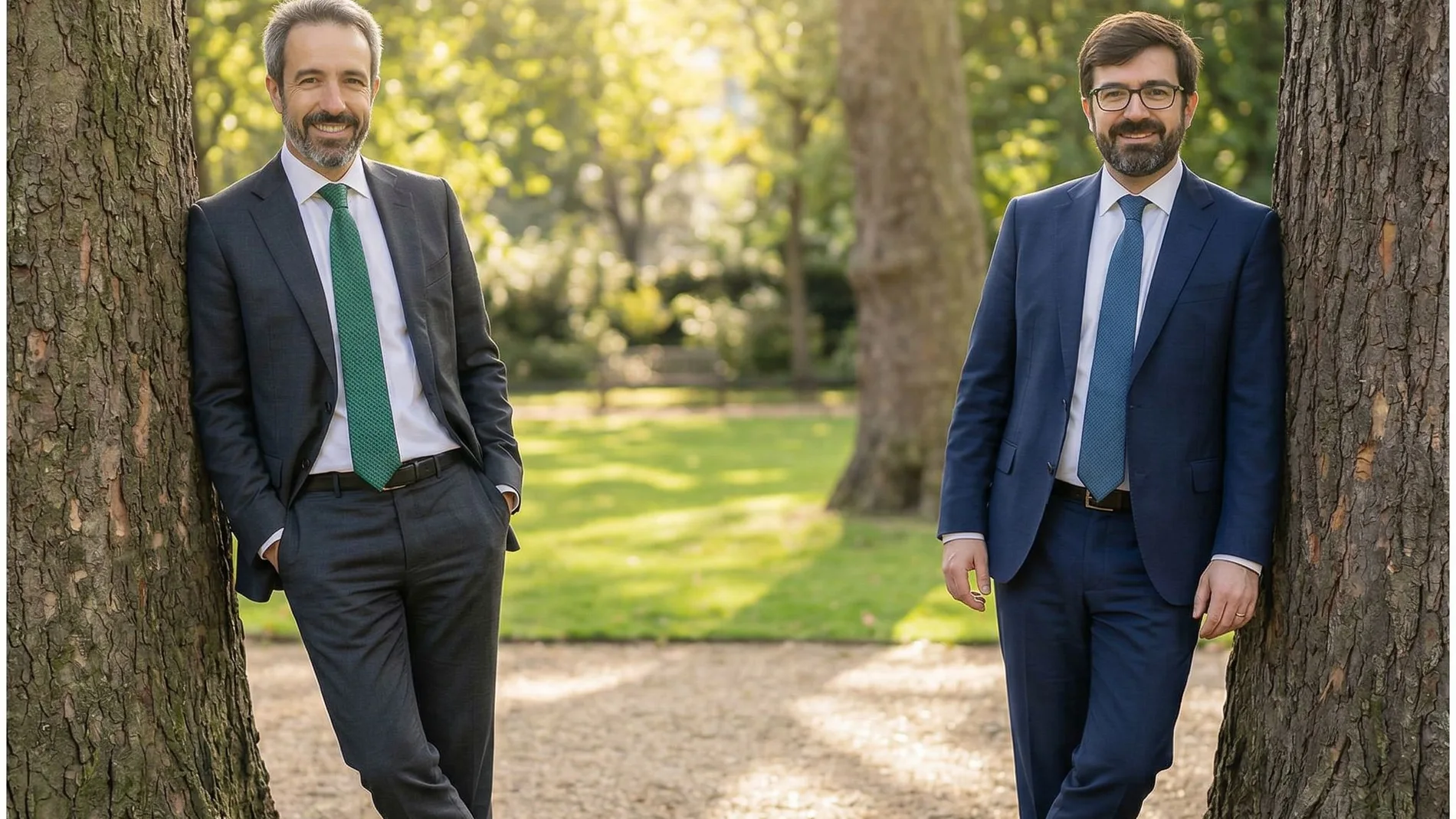
Luis Quiroga and Toni Timoner, two financial specialists based in London, detected an anomaly in the Spanish environmental debate based on their own experience. At environmental events they were questioned for not being leftist; In center-right circles, it was surprising that the financial sector defended the green cause. The situation led them to found the Oikos think tank in 2022. And now they collect their theses in The right-wing ecologist (Deusto), prefaced by former president José María Aznar, where they claim the role of capitalism and maintain that the right can—and must—save the planet.
They maintain that in Spain the problem is not so much denialism as the identification of environmentalism with a single ideology. To what extent has this conditioned the climate debate?
LQ: Denialism exists and we must fight it, but in Spain the underlying problem has been: converting the climate into an ideological credential. As soon as a cause is identified with a single bloc, it stops being a country policy and becomes a cultural battle. Half of society stops discussing specific policies and begins to react against the messenger. And that’s how you don’t mobilize the majority: you agitate the convinced and expel the rest.
TT: Our approach is very simple: less moral superiority and more solutions that people can touch on their bills, their jobs and their energy security. It’s not that the left shouldn’t talk about climate; It is that it cannot claim to have the exclusive.
It was a PP Government that promoted key structures in the nineties, from the ministry to Kyoto. Why didn’t the right consolidate that leadership?
TT: The right did an important part of the institutional work, but neglected the narrative work. He signed the commitments, made foundational decisions and left a key public architecture. He built the administrative cathedral, but left the pulpit free. He did not turn all of this into a recognizable narrative for his voters or into a coherent moral and political vision. He made environmental policy, but he did not write an environmental story
LQ:. And, meanwhile, the left did understand earlier that the climate could become a great cultural framework. He occupied that symbolic void and presented green as if it were his heritage, when it was not. There was the error: the right appeared in the management, but too often it did not appear in the battle of the story.
In a polarized international context, you defend an alternative path. How is it articulated?
TT: Exactly. The mistake of the European right would be to believe that the only alternative is to copy extractive and quarrelsome Trumpism. And the symmetrical error would be to think that the only way to take the climate seriously is to assume the ideological package of the left. We defend the realistic path: decarbonize because it is economically and strategically convenient, not because virtue must be exhibited. We are not organizing a moral pilgrimage; We are advocating making serious industrial policy.
LQ: Neither energy Trumpism nor a copy of the good-natured and urban environmentalism of the left. In Europe, and especially in Spain, the sensible agenda involves three priorities: cheaper energy, less dependence on gas and a transition that strengthens the industry instead of penalizing it.
If you had the capacity to govern, what would you do so that the transition does not harm the middle classes?
LQ: We would start by really making electricity cheaper. We would clean up the bill of taxes and charges that do not respond to the real cost – such as generation – and we would improve the efficiency of the system: more storage to integrate renewables, prolong the life of nuclear power already amortized and expand demand to better distribute fixed costs. The key is for electricity to win the price battle against gas. If you continue penalizing it, you block electrification. If you correct that signal, you lower the bill and make the transition in industry, buildings and transportation viable. It stops being a speech and becomes economic logic.
TT: In addition, we would use carbon revenues to alleviate costs for households and businesses. A transition that impoverishes the middle classes will be neither stable nor lasting. Aid should be directed where it has the greatest impact. The transition has to start with the bill and end with the climate, not the other way around.
They claim that capitalism has contributed to reducing emissions. How do they support that idea in the face of their role as a driver of consumption?
LQ: It is provocative only if it is presented in a caricature. Capitalism has generated prosperity and obviously also environmental damage, of course. Although worse were the ecological disasters of the dehumanized industrialization of the Soviet Union or even China. In a market economy, the reduction in cost of solar panels, batteries, efficient lighting or many clean technologies has not come from a moral assembly or a five-year plan, but from investment, competition, industrial learning and the capacity for innovation. Thanks to that, today we can produce and consume more with fewer emissions than before. It is not that the market is morally pure; but well channeled, it is the most powerful mechanism we have to mobilize capital and talent at the scale that decarbonization demands.
Why are they so critical of degrowth?
LQ: Because it is an indefensible proposal: socially regressive, politically unviable and ethically very dubious. You cannot ask the European middle classes to accept permanent austerity as a new civic virtue, nor tell the so-called global South that development is suspended because rich countries have discovered supposed ecological limits. Many times, those who defend it are not fully aware of what it would imply for employment, well-being, consumption and social cohesion, unless one implicitly proposes returning to a pre-industrial standard of living. Climate change should not be, in essence, a moral referendum against prosperity. The historical task is not to decrease, but to decarbonize growth.
With the climate urgency on the table, to what extent is it realistic to trust technological innovation as the axis of the solution?
LQ: The risky thing would be to bet against her. Innovation is not the excuse for not acting; It is the only way to act. There is no serious path to deep decarbonization that does not involve massively deploying technologies that we already have and improving others that are not yet fully mature. Many of the decisive tools no longer belong to the realm of futurism: renewables, electric vehicles, heat pumps, energy efficiency or part of industrial electrification are already here. With what we have today, we can decarbonize a very substantial part of our economies, around two thirds. Innovation is especially necessary for the remaining third, where technological challenges remain greatest. In this it is important to be sober: technology is not a miracle, but it is the decisive lever.
They defend prioritizing incentives over prohibitions. Are there areas where direct restrictions are inevitable?
TT: I’m not a regulatory anarchist. Of course, there are areas where regulations or limits may be justified, especially when there is immediate and clear damage to health or when there are mature alternatives. But in climate policy the ban should be the exception, not the operating system. Before banning, there has to be a reasonable, affordable and truly deployable alternative. The sequence matters a lot: banning before there are viable substitutes does not speed up the transition, but rather discredits it. Democracies digest standards, price signals, realistic calendars and well-sequenced incentives much better than abrupt vetoes on housing, mobility or consumption. As soon as you turn the transition into a succession of prohibitions with no alternative, you stop gaining support and start manufacturing rejection.
Can a poorly designed transition generate new dependencies for Europe?
TT: Poorly designed, any transition can create new fragilities: replacing Russian fossil dependence with dependence on imported Chinese silicon. That’s not a transition, it’s changing landlords. Well designed, the transition strengthens European energy and industrial security, because Europe’s great historical vulnerability has not been the sun and the wind, but rather the dependence on imported hydrocarbons. Now, this requires stopping thinking simplistically: we need robust networks, storage, interconnections, voltage control, demand management and a dispassionate debate about the role of existing nuclear as the system matures. Security is not the argument against the transition; It is one of the best arguments for doing it with technical rigor.
When they founded OIKOS they spoke of a certain discomfort on both sides of the ideological spectrum. Four years later, has that climate changed or does that barrier still exist?
TT: Yes, something has changed, and that is already important. In 2022, for many, we were a platypus: working in finance and taking the environmental cause seriously sounded like an oxymoron. It generated grimaces among supposedly serious journalists and intellectuals. Today there is a broader conversation, there is more openness and more people willing to think about the climate out of intergenerational responsibility and natural patriotism. I wouldn’t say that the anomaly has disappeared, but I would say that we have stopped talking from the open. Our aspiration now is not to be an interesting oddity, but to contribute to making all of this stop being strange for everyone.
LQ: Today there are more people in the center and the right who no longer feel forced to choose between prosperity and ecology. And there are also more people outside that space who are beginning to understand that without social legitimacy there is no lasting transition. In general, greater pragmatism is perceived: this is no longer just about “saving the planet”, but also about energy security and industrial opportunity. But let’s not fool ourselves: tribal inertia is still there. That is precisely why this book arrives on time, because it tries to open a space of normality in a debate that for too long has functioned as an ideological customs house.