
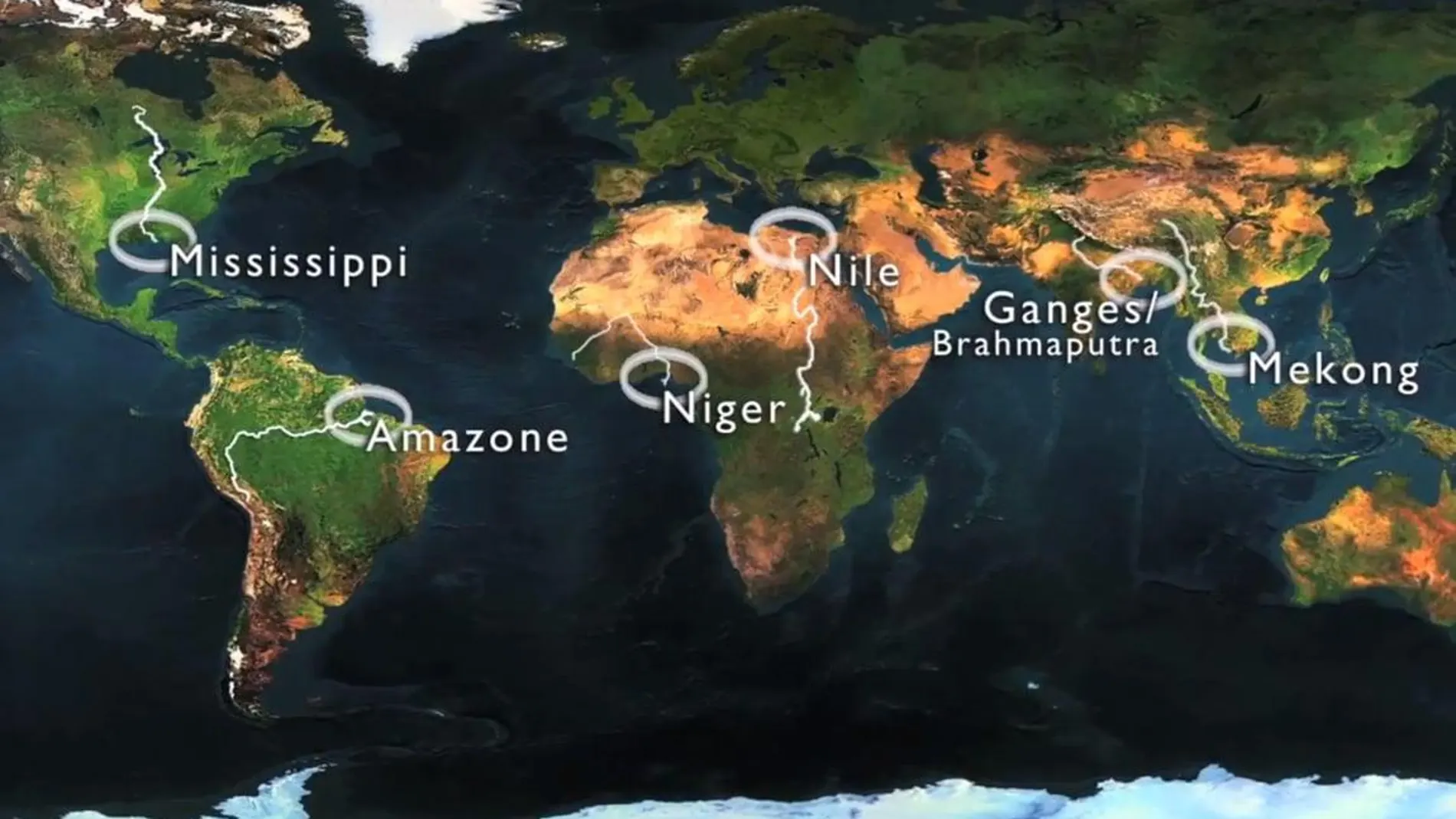
The deltas of the planet’s large rivers are sinking faster than sea levels are rising, which could affect hundreds of millions of people in those regions.
The lack of sediment due to retention in the channels of dams, the extraction of groundwater and natural resources such as oil and gas, together with the expansion of large cities built on these lands, are causing these places, inhabited by millions of people, to face the risk of disappearing.
These are some of the conclusions reached by a recent study published by the journal Nature, which warns about the rapid sinking of the world’s main river deltas, a phenomenon that exceeds the rate of rise in sea level and threatens hundreds of millions of inhabitants of these regions.
The study, which performs a comprehensive analysis of elevation loss in 40 river deltas across five continents, was supervised by Virginia Tech geoscientists Manoochehr Shirzaei and Susanna Werth and led by Leonard Ohenhen, associate professor at the University of California, Irvine.
Aided by the use of advanced satellite radar technology, researchers have identified three factors that contribute to this loss of river deltas, such as excessive extraction of groundwater, decreased sediment supply and urban growth, although the greater or lesser weight of one or the other varies depending on the region of the planet.
“In many places, groundwater extraction, sediment shortages and rapid urbanization are causing land to sink much faster than previously recognized,” says Ohenhen.
The deltas in the worst situation
The study’s findings show that in almost all river deltas examined, at least a portion is sinking at a rate greater than sea level rise. The team, led by Ohenhen, discovered that in 18 of the 40 deltas studied, subsidence already exceeds local sea level rise, increasing the risk of flooding for more than 236 million people.
The deltas experiencing the most worrying rates of elevation loss are the Mekong, Nile, Chao Phraya, Ganges-Brahmaputra, Mississippi and Yellow river systems, where land subsidence is at twice the global rate of sea level rise.
Some regions are sinking at a rate more than double the current global rate of sea level rise. «Our results show that subsidence is not a problem of the distant future; “It is happening now, at scales that exceed climate-driven sea level rise in many deltas,” says Shirzaei, co-author and director of the Earth Observation and Innovation Laboratory at Virginia Tech.
Relevance of the study
River deltas support dense human populations, important economic centers and vital ecosystems around the world. Sea level rise and land subsidence threaten the sustainability of these valuable landscapes with relative sea level rise and the associated dangers of flooding, land loss and salinization.
The findings and results of the study evidence the need for specific interventions that address subsidence as an immediate and localized problem, in parallel with broader efforts to mitigate and adapt to global sea level rise resulting from climate change.
The study concludes that solutions are within reach, since the responsible processes are directly linked to human decisions. For Werth, co-director of groundwater analysis. “When groundwater is over-extracted or sediments do not reach the coast, the Earth’s surface sinks and these processes are directly related to human decisions, which means that the solutions are also within our control.”