
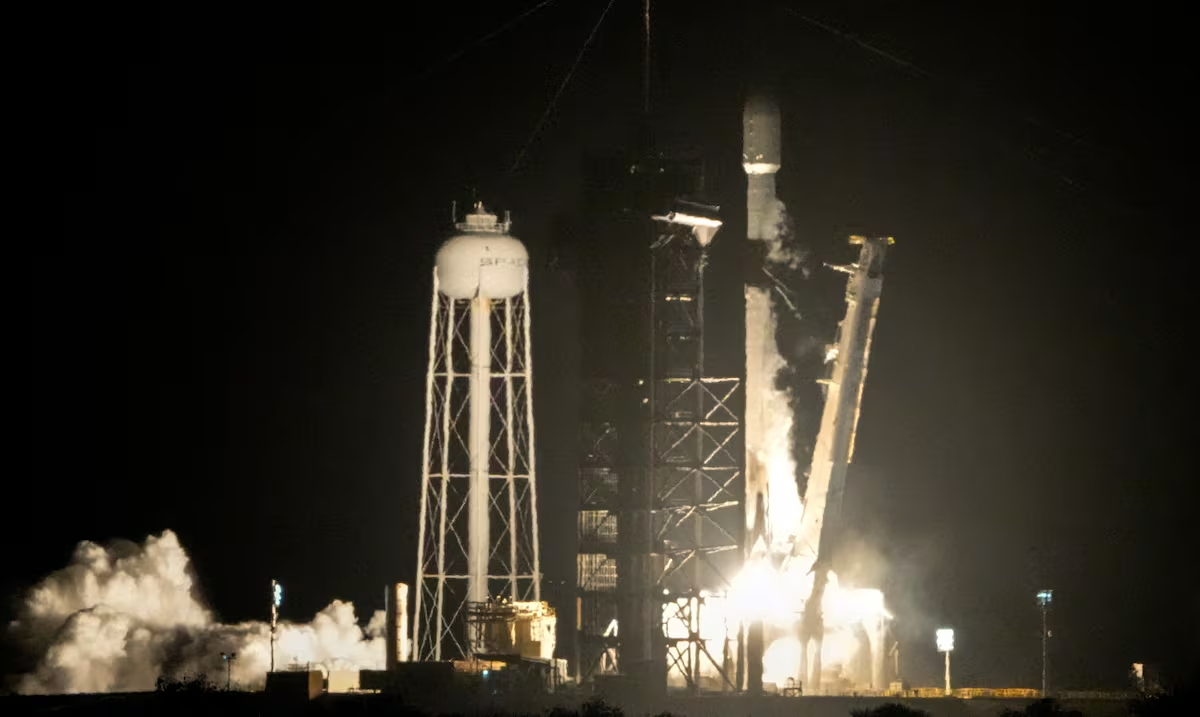
The upper stage of a SpaceX Falcon 9 rocket crashed this Wednesday into the Moon after spending more than a year and a half adrift in space. As reported by the BBC, the impact occurred at around 7:35 am (UK time), when the object was traveling at about 5,400 miles per hour.
The fragment corresponds to the part of the rocket that does not return to Earth after launch and is similar in size to a five-story building. Its trajectory ended up being defined by the combined effect of gravity and solar radiation, after the launch, in January 2025, of two lunar landing modules developed by companies from USA and Japan.
Although the POT assured that the crash did not represent any danger to the Earth, scientists and astronomy fans were eagerly awaiting the possibility of observing the impact site to study the dust and debris expelled by the collision. Some specialists also warned that the episode once again highlights the problem of increasing space debris.
Before the collision, space object tracking specialist Bill Gray had estimated that the impact would occur near Einstein Crater, on the illuminated western edge of the Moon. He also calculated that The object would reach the surface at about 5,400 miles per hour, a speed equivalent to about seven times the speed of sound.
Falcon 9 launches from pad 40 in Florida pic.twitter.com/kmjCBMVd9Z
— SpaceX (@SpaceX) August 5, 2026
Gray also argued that the growing number of objects abandoned in space represents an increasing challenge.
“Everything up there is getting too full,” he said before the impact, referring to the accumulation of remains from space missions.
Second known case
If the result of the crash is fully confirmed, it would be the second known case of a decommissioned rocket accidentally hitting the Moon. In 2022, a segment of a Chinese rocket opened a pair of craters on the far side of the natural satellite.
On this occasion, the collision occurred on the visible side of the Moon, a circumstance that offers better observation opportunities. Specialists estimated that the impact would release energy equivalent to three tons of TNT, although the initial flash would probably be too faint to distinguish from Earth.
Instead, scientists were confident that the material ejected by the explosion could rise several kilometers above the lunar surface and remain visible for several minutes to telescopes.
“Gravity on the Moon is low and there is no wind to disperse the dust,” explained Benjamin Fernando, from the Los Alamos National Laboratory.
1/6 | Impressive fireball: this was the explosion of the Blue Origin rocket. A Blue Origin rocket exploded during a test at the launch pad on Thursday night. – The Associated Press
Fernando also pointed out that the study of the crash will allow us to better understand the risk that this type of impact represents for future manned missions.
“Part of the reason we are interested in this event is to determine the extent to which debris impacts pose a risk to future astronauts,” he said.
The researcher calculated that the impact would leave a crater about 89 feet diameter and 16 feet deeptoo small to be distinguished from Earth. However, NASA’s Lunar Reconnaissance Orbiter and the South Korean Danuri orbiter planned to obtain images of the site before and after the crash to analyze its consequences.
The abandoned Falcon 9 stage had launched two private lunar landing modules into orbit on January 15, 2025.
One of them, Firefly Aerospace’s Blue Ghost, became the first private spacecraft to complete a completely successful moon landing. The other, belonging to the Japanese company ispace, ended up crashing on the lunar surface.
The United States and China are competing to take astronauts to the Moon again, while private companies such as SpaceX and Blue Origin seek to participate in the next missions of the Artemis program.
In this context, retired astrophysicist Jonathan McDowell warned that this type of impact “will not represent a problem” for now, but maintained that, when there are permanent bases on the Moon, it will be necessary to stop abandoning rocket stages in chaotic orbits like this one.