

United Kingdom will have an invisible shield of swarms of Submarine drones that will patrol their waters in search of threats such as Russian submarines. The German defense technology company Helsing has announced the AI platform Lura and submarine drones SG-1 Fathom that will use it and with which the British Royal Navy will have, according to The Times.
The LURA, trained with more than 5 decades of acoustic intelligence of the British Navy
The SG-1 Fathom were initially developed by Blue Ocean for environmental monitoring and whale monitoring, but have been adapted by Helsing For military uses through system integration Lura. This solution based on AI He has trained with more than 5 decades of acoustic intelligence collected by the British Navy to detect, classify and automatically inform about acoustic firms of enemy ships, including submarines.
According to Helsing, Lura has unprecedented sensitivity and precision and can detect acoustic signatures up to 10 times quieter than with other AI models. Also differentiate between specific vessels from the same class and a speed up to 40 times faster than human operatorshe states in a statement.
With LURA, a human operator can monitor hundreds of planners and receive precise intelligence to 10 percent of the cost of man -man -manubmarine patrols.
‘Lura detects that our armed can deter. We must take advantage of new technologies to follow the rhythm of Threats against our critical infrastructure, our national waters and our way of life. The deployment of AI at the edge of underwater constellations will illuminate the oceans and will dissuade our adversariesfor a strong Europe, ‘said Dr. Gundbert Scherfco -founder and executive co -director of Helsing.
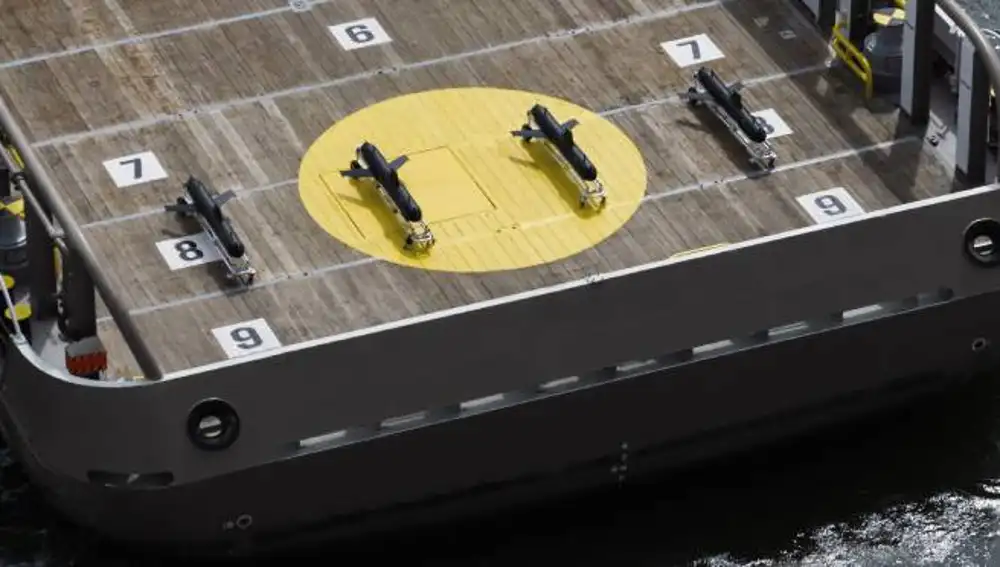
SG-1 Fathom, as a constellation of submarine satellites
The SG-1 fathom are Autonomous vehicles without propeller capable of navigating in silence Under the sea at speeds of 1 to 2 knots (Between 2 and almost 4 km/h) By periods of up to 3 months. Each SG-1 fathom has a length of 195 centimetersdiameter of 28 cmweighs 60 kilograms and is designed for deployments that do not attract attention and long -term missions.
These drones, also called OLDERoperate as an autonomous and ultra -silent submarine network and carry a payload focused on Intelligence, surveillance and recognition (ISR).
They are equipped with acoustic sensors and underwater communication capabilities that allow A passive listening in real time. Once a threat is detected, drones emerge to the surface to transmit alerts via Satcomthus facilitating geolocation and coordination in swarm. They work as a constellation of underwater satellites continuously watchingwhich significantly reduces the detection time and improves maritime situational consciousness. Thus, the British Navy may expand its coverage of maritime areas and release manned resources for other operations.

The SG-1 program began after the award of A British Royal Navy contract to Helsing to explore the use of AI in acoustic detection. With hundreds of these economic and scalable planners planned for their deployment, this approach Transites from traditional sound platforms to a disjection model distributed and data -based.
The value of contracts with Helsing and Blue Ocean is unknown, but the ongoing operational evidence and collaboration with the British Ministry of Defense point To a future full integration into the Naval Defense Network.
Lura and SG-1 fathom can be deployed rapidly, as a service hired or operated by armed themselvesin any area of strategic importance, from the North and Baltic Sea to the Oceans of the Atlantic and the Indo-Pacific, says the company.