
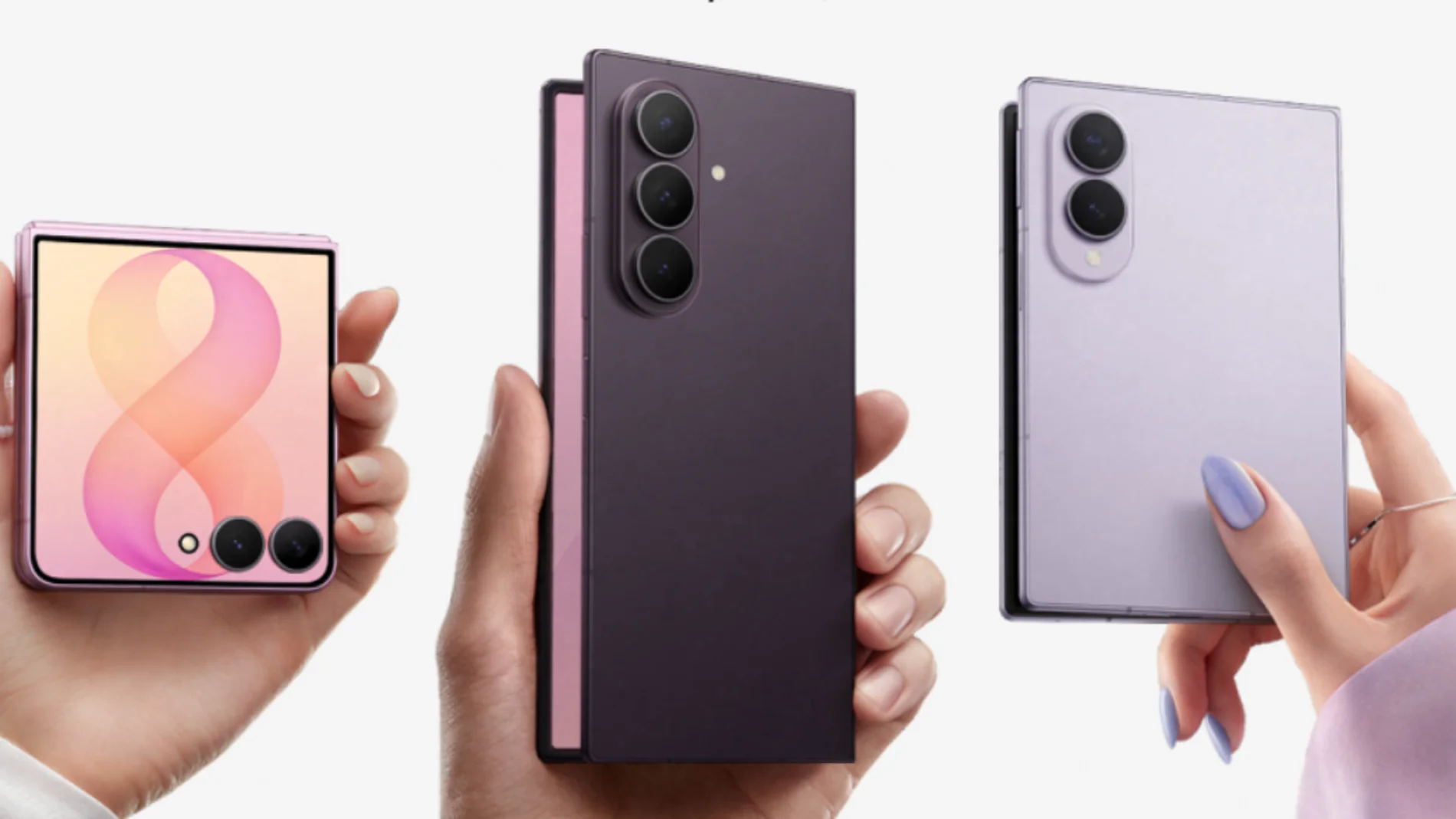
For almost twenty years, the evolution of the mobile phone has followed a surprisingly linear path: more power, more memory. Cameras with higher resolution. Faster processors. Increasingly sophisticated artificial intelligence. But in reality, they were all still the same object: a glass rectangle. That is why the presentation of the new Galaxy Z Fold8 Ultra, Galaxy Z Fold8 and Galaxy Z Flip8 deserves a different reading than that linked to its specifications and materials. Samsung hasn’t just shown three new phones. It has presented a vision of the future of personal computing: devices capable of physically changing to adapt to what we are doing. And that change can be much more important than any improvement in the processor or camera.
For decades we have used different devices for each task. The telephone was used to call. The camera took photographs. The MP3 player carried the music. The computer was used to work. The smartphone brought together all these functions in a single device. The foldables are now trying to take the next step: that this single device also changes physically depending on what we need to do. As if the same podcast headphones could also be used for sports, to stay connected with the environment without stopping listening or to completely isolate ourselves on a plane.
With its latest foldables, Samsung pursues a similar adaptation: a device capable of changing shape as our day changes. When the Galaxy Fold remains closed it is a conventional phone. When opened it transforms into a small tablet. If it is also connected to a monitor through Samsung DeX, it works like a desktop computer: it stops being a rigid tool and becomes a dynamic object.
The curious thing is that the true innovation of foldables is not where we usually look: not on the screen, not even on the hinge. It is in the enormous amount of scientific disciplines that have had to converge to make opening a phone a completely natural gesture. Behind each opening are years of research in materials science, mechanical engineering, optics, electronics and software development.
Making a folding mobile phone means solving problems that just a decade ago seemed incompatible. One of them is to manufacture a screen capable of bending hundreds of thousands of times without breaking. To solve it, Samsung years ago developed Ultra Thin Glass, an extremely thin sheet of glass (a few tens of microns) reinforced by different polymer layers.. The result is a material that retains the feel of glass, but withstands repeated bending for years.
If the screen represents the visible challenge, the hinge is probably the device’s biggest engineering feat. It is not simply about joining two halves. It must distribute stresses, keep the screen perfectly aligned, prevent dust from entering, close without leaving gaps and withstand hundreds of thousands of opening cycles. In many ways, it is more like the mechanism of a high-precision watch than that of a mobile phone. And the less we think about it while using the device, the greater its success will be.
But perhaps Samsung’s greatest merit is not the hardware, but the software. Getting the operating system to instantly understand that the device has just been resized is a completely different challenge. Apps should be rearranged automatically, windows should adapt seamlessly, multitasking should be redistributed, and yet all content should continue exactly where it was a second before you opened the phone. Something that happens in a fraction of a second. It is one of those innovations that almost never appear in technical sheets because, when they work well, they simply go unnoticed. And Samsung has spent almost seven generations perfecting precisely that behavior.
The arrival of Galaxy AI has further reinforced that philosophy. The new functions based on artificial intelligence are no longer just about answering questions, they edit photos, rewrite documents, translate conversations in real time, summarize meetings and work simultaneously with several open applications. A foldable phone offers a larger screen, with the new generation of Flip and Fold, Samsung seeks an environment where artificial intelligence can display several tools at the same time without forcing the user to constantly change applications.
The Galaxy Z Fold8 Ultra and Fold8 refine the concept of the phone-tablet through a thinner and lighter design, improvements in endurance, new photography capabilities, greater integration with Galaxy AI and the use of Qualcomm’s most advanced processors. The Flip8, for its part, continues to perfect the idea of the compact mobile phone that displays a large-format screen when the user needs it, while expanding the possibilities of its external screen to interact with artificial intelligence, notifications and numerous applications without having to open the device.
All this accompanied by One UI 9.0, designed specifically to take advantage of new AI features and different screen formats. More than an isolated revolution, Samsung seems to be betting on a coherent evolution of a concept that it has been perfecting since 2019.
Maybe in ten years we will stop talking about folding phones, in the same way that today no one talks about phones with touch screens. And this will have been the first step, as if we could have a headset that adapts its shape as we go out for a run and we care that they do not fall, that they are resistant to rain and that they are light, but if we ride the subway, they become a precise cover for our ears to isolate us from outside noise. That is the step that Samsung has taken with its new foldables. It’s not about folding a screen, rather it’s about starting to ask the phone to adapt to us. Samsung faces the false idea that Technology can only advance in a straight line by resorting to evolution: adapting has always been more important than continuing to advance.