
For centuries, the brain was a black box. We could observe which areas seemed related to movement, memory or emotions, but there was a question that was much more difficult to answer: what happens if we specifically activate the neurons in that area? Knowing that a brain region was related to a function did not mean proving that those cells were responsible for it. It was necessary to know and understand “the switch” that allows neurons to be turned on and off with precision.
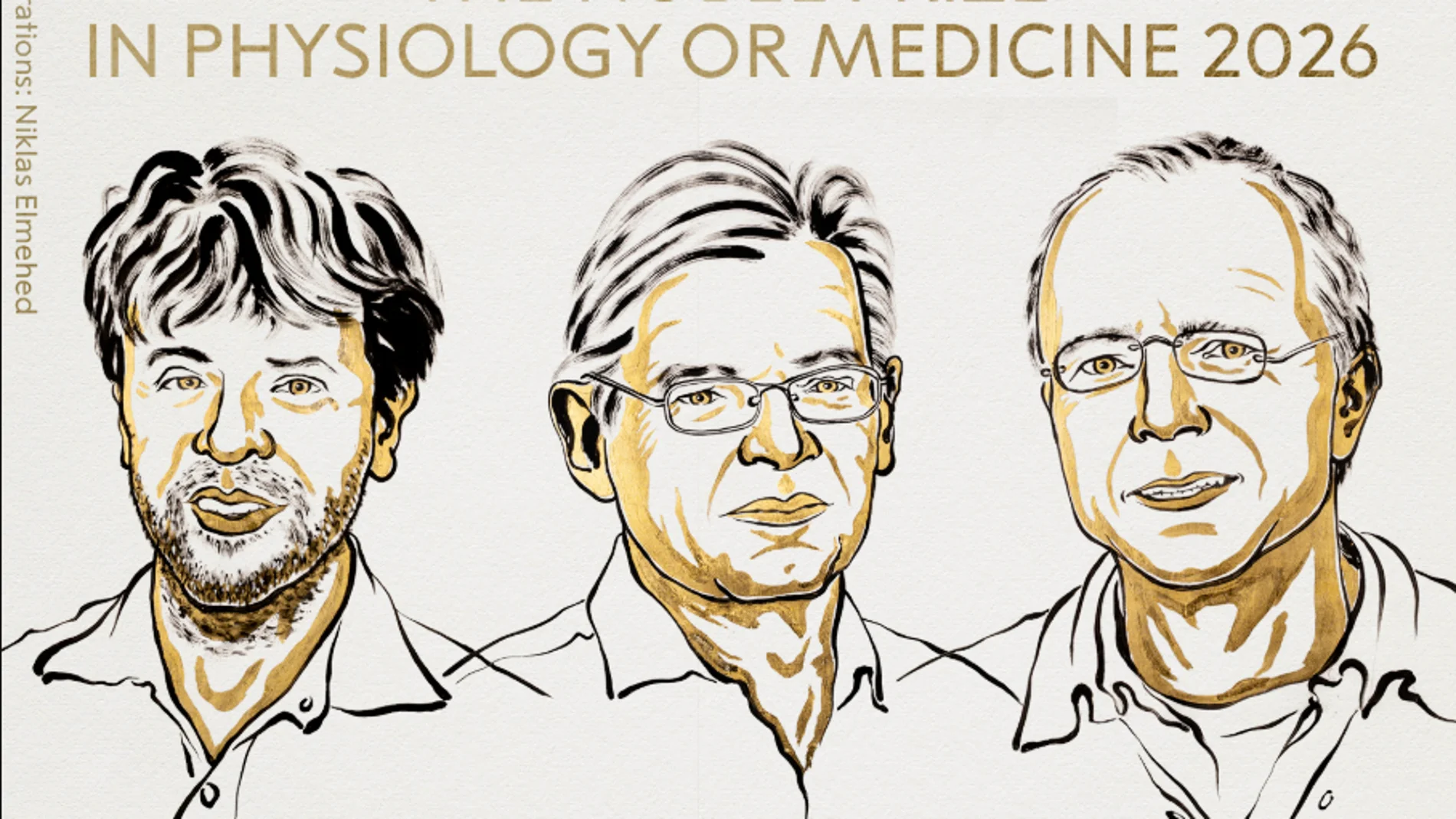
And that switch came from an unexpected place: a single-celled algae. The 2026 Nobel Prize in Physiology or Medicine has recognized the American Karl Deisseroth and the Germans Peter Hegemann and Georg Nagel “for his discoveries relating to light-activated ion channels and optogenetics.” The technique allows controlling the activity of nerve cells using light and studying, in a living brain, how neuronal circuits participate in memories, emotions and behaviors.
The story begins with a seemingly simple question. Hegemann wanted to understand how a small green algae, Chlamydomonas reinhardtiicould detect light and move toward it. In the early 2000s, together with Georg Nagel, identified an extraordinary protein in the membrane of these cells: channelrhodopsin. When it receives blue light, the protein opens a channel that allows ions to pass through and generates an electrical signal. The extraordinary thing was that this protein could make practically any cell it was introduced into sensitive to light.
And then came the decisive question: If a protein from an algae can convert light into an electrical signal, could it be used to do the same for a neuron? Karl Deisseroth and his team introduced the channelrhodopsin gene into rat nerve cells. By shining blue light on them, the neurons could activate. The results were published in 2005. Two years later, Deisseroth managed to use this light switch in the brains of living mice. The light had literally entered the neural circuit.
The key wasn’t simply getting a neuron to respond to light. It was precision. The techniques available until then could stimulate relatively large groups of cells, but optogenetics made it possible to select specific populations and control them in milliseconds, a time scale comparable to that of neuronal communication itself. Thanks to this, scientists could begin to respond to one of THE questions of neuroscience: what happens when a certain circuit is activated and observe what changes in the living being.
That change made optogenetics one of the fundamental tools of modern neuroscience. It has allowed us to study circuits related to movement, fear, memory, addictions or different neurological and psychiatric disorders. In animal models, it has even been possible to manipulate memories through the selective activation of certain circuits. The question is no longer just “what part of the brain is related to this?” to become a much more powerful one: “what happens if I turn on exactly these neurons?”. We go from analyzing the forest to understanding the seed.
There is, furthermore, an irony that is more sentimental than cerebral in the history of this award. One of the most sophisticated technologies for studying the human brain was born from studying how a plant cell perceives light. Deisseroth himself has highlighted that The deepest roots of optogenetics are in botany.
Unsurprisingly, the technique has also left the laboratory. One of its most promising applications is the restoration of vision in people with certain retinal diseases. The idea is to introduce light-sensitive proteins into cells that have lost their normal ability to respond to light and then use light stimuli to recover part of the visual signal. These studies are still in the realm of clinical research, but they show how far a tool originally conceived to ask basic questions about the brain can go.
The Nobel thus recognizes something more than a technique, rather it rewards a new way of experimenting with the most complex organ in the body: selecting a population of neurons, illuminating it and observing what happens. Light, which for millions of years allowed a tiny algae to find its way in water, has now become a way to explore the paths of our own minds. And perhaps that is the best paradox of this award: To begin to understand the brain, scientists had to first learn to listen to light.