
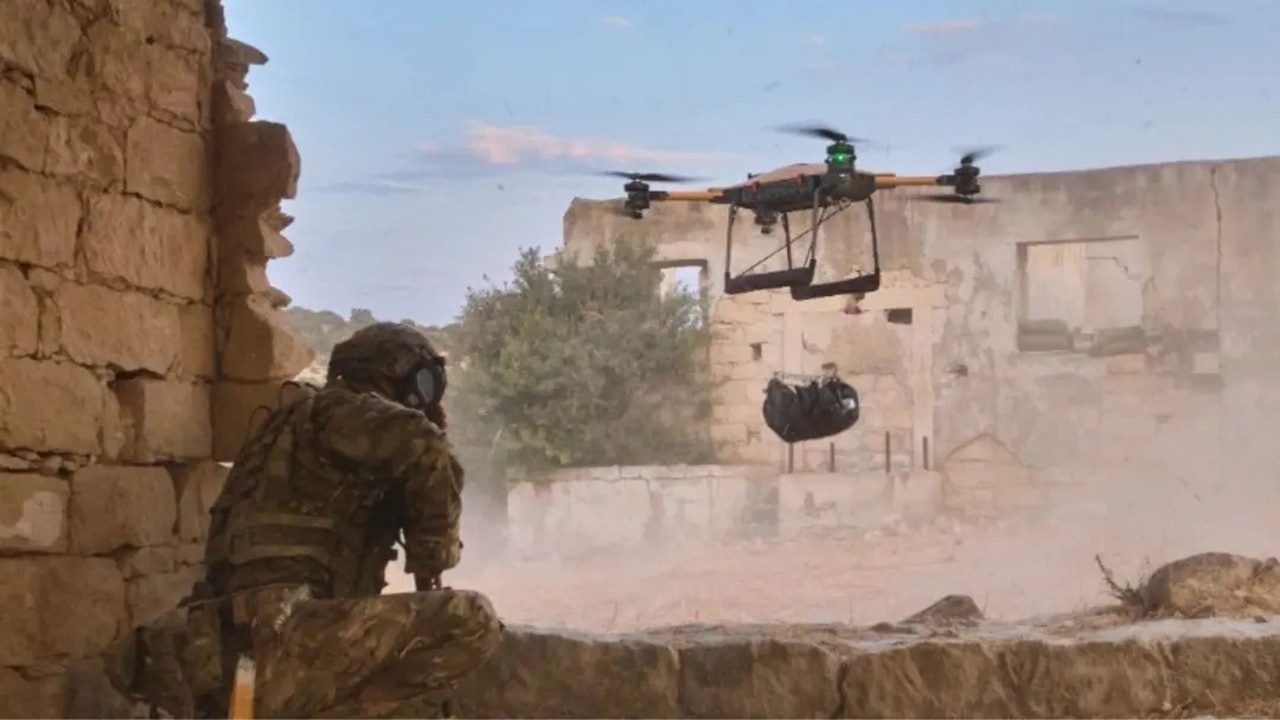
He United States Army has a plan to extend autonomous resupply to units deployed on the front line and, as part of it, has been testing a new high-capacity cargo drone on February 12 at Fort Stewart (Georgia), according to Defense Blog.
The exercise has served as a formal evaluation of the TRV-150a logistics unmanned aerial vehicle that is already in service in the Marine Corps. During the maneuvers, the aircraft was operated by members of the Multipurpose Company of the 6th Squadron of the 8th Cavalry Regiment, integrated into the 2nd Armored Brigade Combat Team of the 3rd Infantry Division.
The commanders took advantage of the event to evaluate both the performance of the drone and the degree of readiness of the troops assigned to fly and manage it. He Tactical Resupply Vehicle (‘Tactical Resupply Vehicle’) 150 It was developed by the British Malloy Aeronautics and, in addition to the Marine Corps, it has already entered operational service with the Royal Navy, which designates it as T-150. Now, the Army wants to determine how the system fits into its own brigade-level operations.
The TRV-150 is an electric aircraft vertical takeoff and landing (eVTOL) designed for cargo transportation missions. It can take up to 68 kilograms of supplies and cover approximately 69 kilometers per flight. Reaches speeds close to 108km/h. Each mission can last up to 36 minutesdepending on the load and conditions.
Soldiers can program routes using navigation by waypoints. The drone then flies autonomously to its destination. It can land at a specified point or drop the payload from the air.
Units can charge it with ammunition, rations, first aid kits or any other critical equipment. The platform can also be used to extract material of exposed areas.
The Army sees cargo drones as a way to reduce dependence on traditional resupply convoys. Ground convoys remain vulnerable to surveillance, long-range fire and loitering munitions. Autonomous aircraft can move smaller loads more discreetly and reduce the number of soldiers exposed during transport missions.
At Fort Stewart, troops deployed the drone in a simulated operational environment. There they practiced procedures launch, route planning and recovery operations. Testers monitored how quickly crews integrated the system into existing workflows, planned missions, coordinated logistics, and trained operators.
The Army seeks to understand if systems like the TRV-150 can maintain operational units deployed in a dispersed manner. Modern U.S. doctrine emphasizes mobility and rapid maneuver. Units often operate over larger areas than in previous conflicts and cargo drones could help maintain operational tempo without overextending supply lines.
If adopted more widely, smaller-scale aerial refueling missions could complement larger transportation efforts, both by air and by land. In any case, the Army’s evaluation of the TRV-150 indicates a growing interest in move more logistics tasks to autonomous systems. Whether or not the platform becomes standard equipment will depend on its performance in subsequent tests and its integration into operational deployment.