
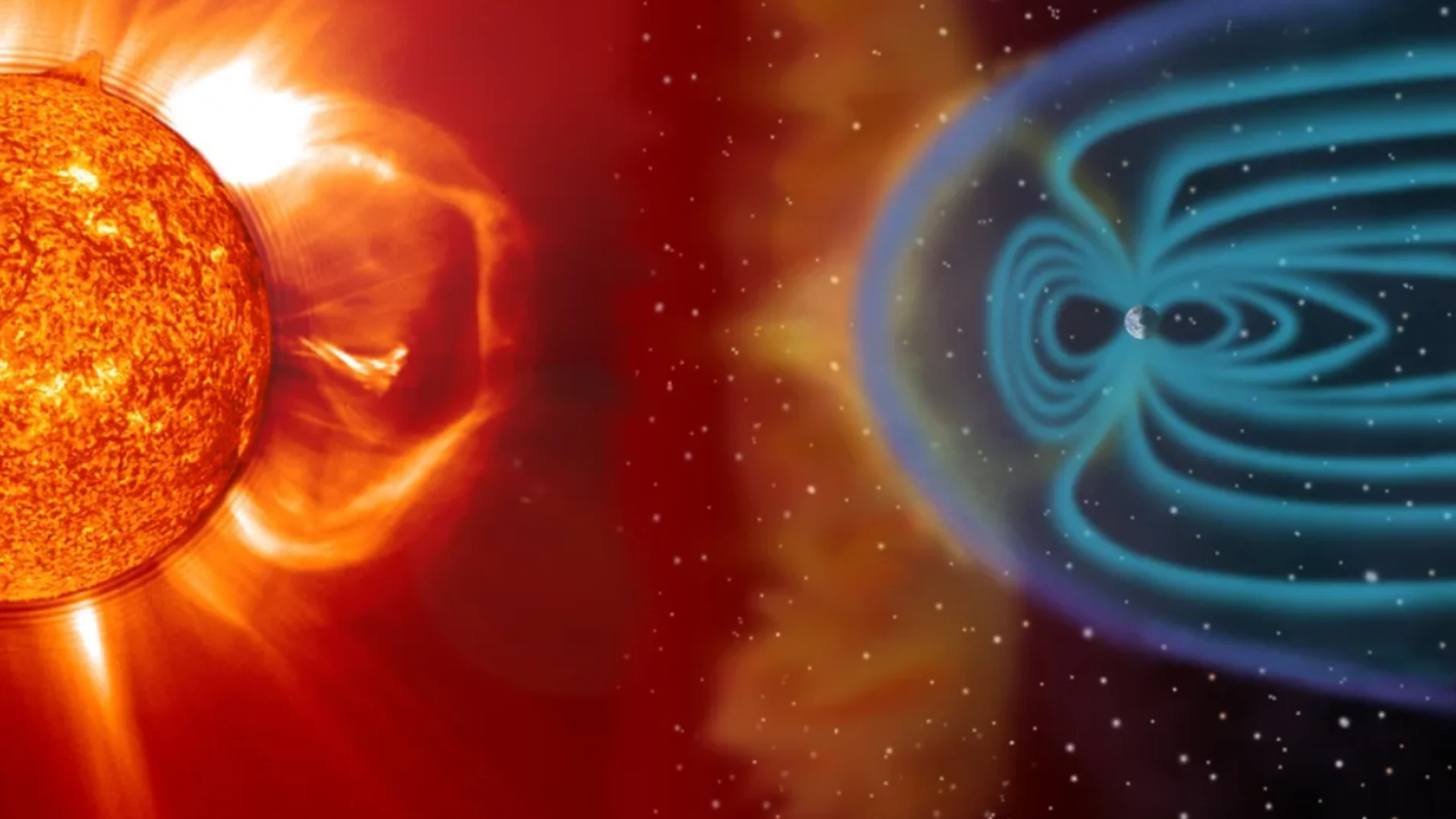
There are storms that we do not see coming from the horizon, but from the Sun. In the coming days, as the Artemis II mission prepares to take off, NASA looks in a direction less intuitive than the launch pad: the space around the Earth. Because there, invisible to us, A very different type of meteorology is developing, capable of putting astronauts at risk. It’s called space weather.
Unlike weather, space weather does not depend on clouds or storms, but on the activity of the Sun. Our star is not a calm sphere: it is a dynamic engine that periodically releases enormous amounts of energy and matter into space. Solar flares, coronal mass ejections and bursts of charged particles are part of this repertoire.
When these phenomena are directed towards Earth or, in this case, towards a ship like Orion, they become solar storms. In essence, they are waves of energetic particles traveling at high speed through the solar system. And the problem is not just his speed, but his energy. They are capable of passing through materials, altering electronic systems and, in the case of humans, damaging living tissues.
On Earth we are relatively protected. Our planet is surrounded by a magnetic bubble (the magnetosphere) that deflects much of that radiation. But Outside of that protection, in the so-called deep space, the situation changes completely. And that’s where Artemis II comes in.
The mission will take four astronauts to orbit the Moon for about ten days. It may seem like a short trip, but it involves something that hasn’t happened since the 1970s: abandoning the Earth’s natural protection. In that environment, an intense solar storm can become a real risk.
If a solar particle event occurs, one of the most energetic forms of space weather, radiation levels inside the spacecraft can increase significantly. This is not a theoretical question. Radiation can affect both the short term (cell damage, alterations in the nervous system) and the long term, increasing the risk of cancer or cognitive impairment.
In the worst case, a sufficiently powerful storm could cause acute radiation symptoms. It is not the most likely scenario, but it is not ruled out either. And that’s why it worries. Furthermore, the timing is not coincidental. The Sun is currently going through a period of maximum activity within its approximately 11-year cycle. This is what is known as “solar maximum”, a phase in which sunspots, flares and coronal mass ejections increase.
In fact, the National Oceanic Administration (NOAA) notes that “the 4405 region (of our star) produced a solar flare of magnitude X1.5 that peaked at 03:19 UTC on March 30.” For a mission that ventures into deep space, this context adds an extra layer of uncertainty. NASA has been developing monitoring systems for years together with organizations such as the aforementioned NOAA. Specialized equipment constantly analyzes solar activity and can issue alerts in real time.
If detects a storm on its way, the crew can take action: from reconfiguring the ship to sheltering in more protected areas, specifically designed to reduce radiation exposure.
It is, in a way, a new form of meteorology applied to space. It is not about avoiding the storm, because you cannot, but about anticipating it. And that is what NASA is doing by analyzing all possible options.