
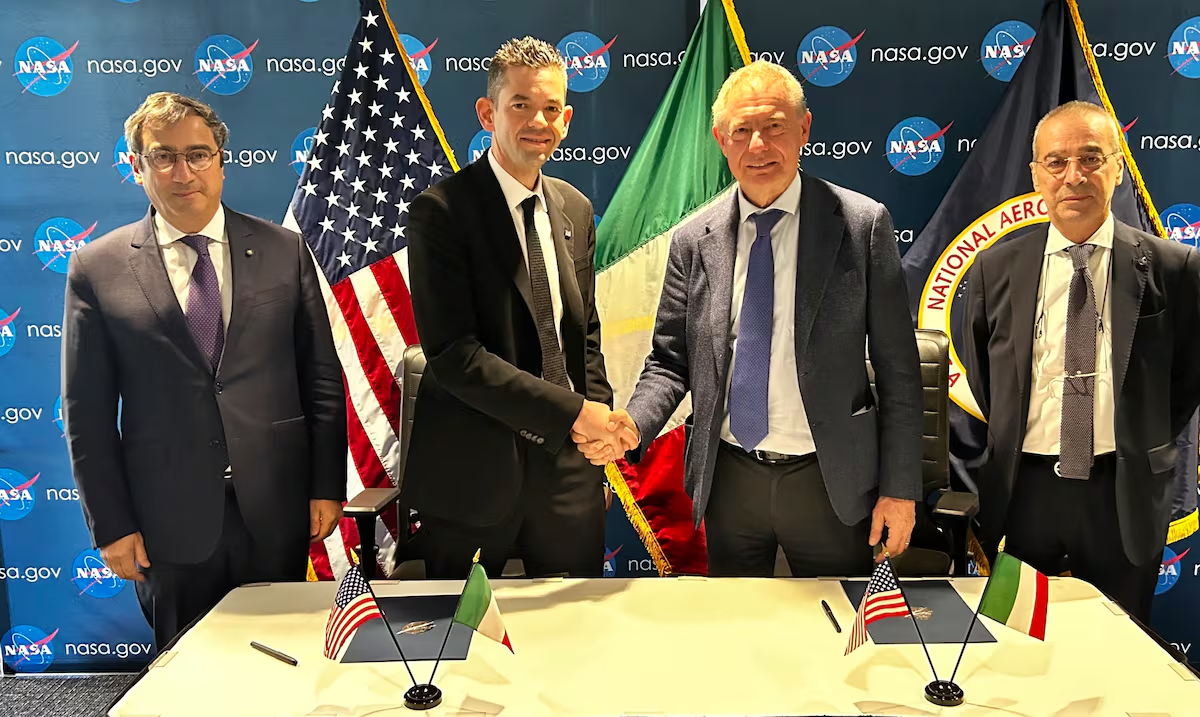
Rome – The living modules that will allow astronauts to live in the moon on a stable future base will be built by Italian companies, confirmed this Tuesday the Minister of Companies, Adolfo Ursoafter signing a strategic agreement with the NASA in Washington.
Urso, delegate of the Italian Government for space policies, signed a declaration of intent with the US space agency to strengthen cooperation on the lunar surface within the Artemis program.
“It is an important recognition for Italy and for our companies, which will be in charge of building the modules designed so that astronauts can remain safely and for long periods on the Moon”Urso said in a statement.
And he added: “The astronauts’ ‘house’ will be ‘made in Italy’, made with Italian technologies and by Italian companies.”
The president of the Italian Space Agency (ASI), Teodoro Valente, also participated in the event.
The Artemis program is a NASA initiative, with international cooperation and support from private companies, whose purpose is to establish a sustainable human presence on the Moon as a preliminary step for future manned missions to Mars.
Following the success of the 2022 unmanned mission, the program faces this week the launch of Artemis II, a mission that will mark the return of a crew to lunar orbit for the first time in more than half a century.
Minister Urso highlighted that with this agreement Italy assumes a “leading role” in this new phase of exploration, maintaining a historical tradition of space cooperation with the United States that dates back to the figure of Rocco Petrone, director of the Apollo program and a key player in the arrival of man to the Moon in 1969.
The declaration of intent establishes close collaboration in three areas: habitation modules, communication systems and scientific activities on the lunar surface.
“We will return to the Moon to stay. We will do it thanks to Italian technology and with the participation of at least one astronaut from our country in the next Artemis missions,” explained the head of the Company.
This agreement, the note states, reinforces bilateral cooperation that began with the “San Marco” program, a milestone that made Italy the third nation in the world to access space with its own launch vehicle.