
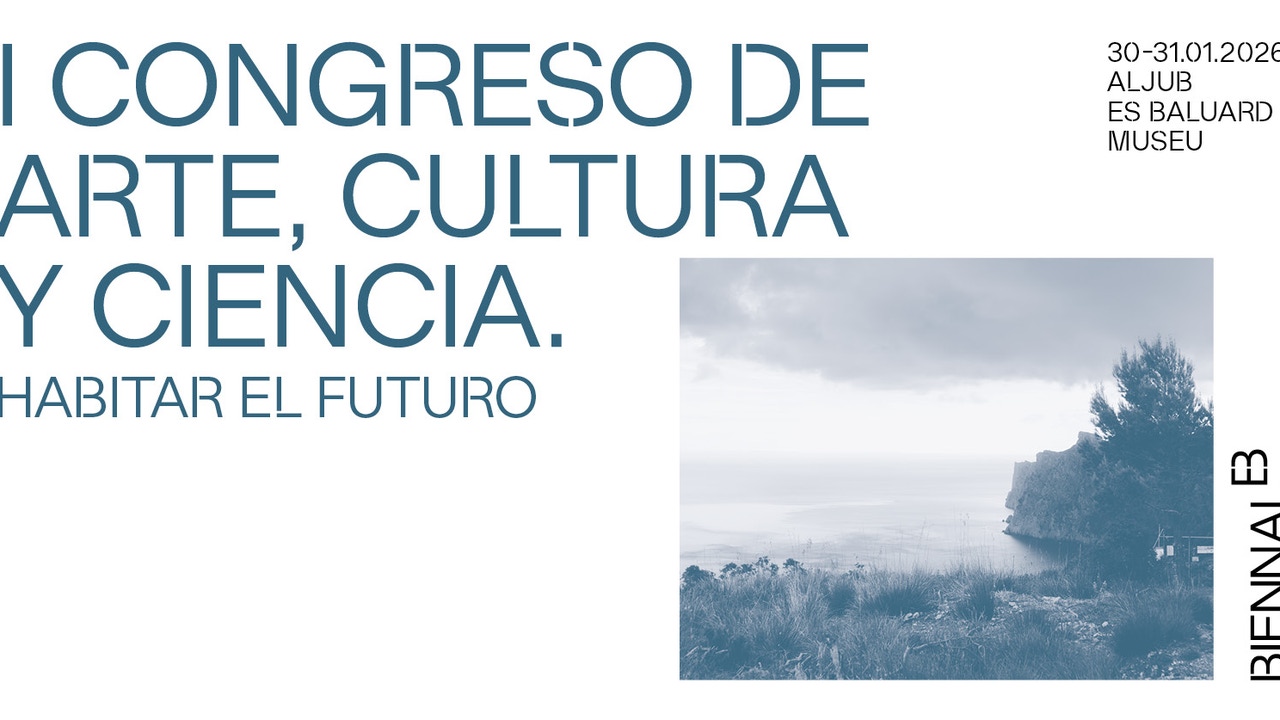
Es Baluard Museu d’Art Contemporani de Palma is the headquarters of the I Congress of Art, Culture and Science – Biennial B that is held between today and Saturday the 30th and 31st in the Aljub of the museum with the title “Inhabiting the future”. This congress is part of the framework of Biennal B, an initiative promoted by Es Baluard Museu and the Consell de Mallorca that promotes contemporary creation as a tool for thought and transformation.
This meeting will bring together artists and professionals from science, design, anthropology, urban ecology or human rights to propose models of responsible transformation.
The meteorologist and scientific communicator specialized in climate change and sustainability, Mercedes Martín – co-director with David Barro of Biennal B, will present the event, as well as the strategic lines of this initiative that seeks to generate spaces of convergence between the humanities and sciences, recognizing the need to reconcile knowledge to face the challenges of the future.
A day of thought, art and action
With intercultural dialogue as its purpose, Biennial B wants to be a transformative initiative and, to this end, it wants to attract key figures from different disciplines, from the humanities to the sciences, incorporating experts with a multidisciplinary approach to create an enriching dialogue on the challenges we have when it comes to “inhabiting the future.”
The congress began with an opening conference given by Alastair Fuad-Luke, facilitator, consultant, educator, writer and international activist who is a pioneer in the field of sustainable design. Next, several professionals from the creative field, such as the Portuguese artist Fernanda Fragateiro, will introduce their way of understanding art with references to art theory, the history of architecture, feminist discourse and political revisionism. There will also be references to the relationship between art, culture and nature, by the Panamanian facilitator Ela Spalding, and to primary architectural forms and vernacular architectures close to the imaginal and feminine by the Catalan artist residing in New York, Ester Partegàs.
The director of Es Baluard Museu and co-director of Biennal B, David Barro, will be the moderator of the debate on landscape and city based on the interventions of the Cuban artist Carlos Garaicoa and the anthropologist and philosopher Santiago Beruete, author of numerous essays on the philosophical dimension of the garden and the territory.
The Friday afternoon block will open with the screening of the documentary Changing everything without changing anything, by urban ecologist Salvador Rueda, a piece that introduces the main challenges of change in contemporary urban environments. Next, Rueda – founder of ecosystemic urbanism and creator of the superblock model – will present a practical case focused on ecosystemic urbanism as a tool for transformation.
The Catalan curator Carolina Grau will introduce the good practices proposed by the Gallery Climate Coalition, an international network of artistic organizations committed to environmental sustainability, and the Egyptian artist Ghada Amer will explain her pioneering work when it comes to talking about gender issues, racial oppression of women, sex and cultural identity. Finally, Friday’s day will close with a conversation featuring Musimbi Kanyoro, one of the most influential figures in global leadership in human rights and gender justice. Former president and executive director of the Global Fund for Women, Kanyoro will reflect with Mercedes Martín on the power, responsibility and ethical weight of decision-making in times of crisis and uncertainty.
The diversity of perspectives expands on Saturday with the guided tour of the exhibition “Jannis Kounellis. Labyrinth without walls” by its curator and director of Es Baluard Museu, David Barro, and the screening of the animated film Black Butterflies, winner of the Goya award for best animated film, prior to the discussion with its director, also a film producer, David Baute. The film, which deals with the impacts of the climate crisis and migration, and is inspired by real women and proposes a journey from Africa, the Caribbean and Asia towards an uncertain future for humanity, is the perfect prelude for the biologist and scientific communicator Odile Rodríguez de la Fuente to close the Congress by talking about her experience about the climate emergency and its effects on people.
David Barro, director of Es Baluard Museu and co-director of Biennal B, emphasizes that “Biennial B is conceived as an ecosystem in constant movement, a space where art dialogues with other forms of knowledge to collectively think about the present. This first Congress is an opportunity to share processes, experiences and perspectives from the most diverse areas, reaffirming the role of art as a catalyst for reflection, innovation and social action.”
For her part, Mercedes Martín, meteorologist and scientific communicator and co-director of Biennal B, adds that “Biennal B arises from the need to think about the great contemporary challenges from a complexity perspective. In the face of crises that are not only environmental, but also social and cultural, this Congress proposes a space where art, science and critical thinking intersect to question how we live, how we decide and how we want to inhabit the future.”