
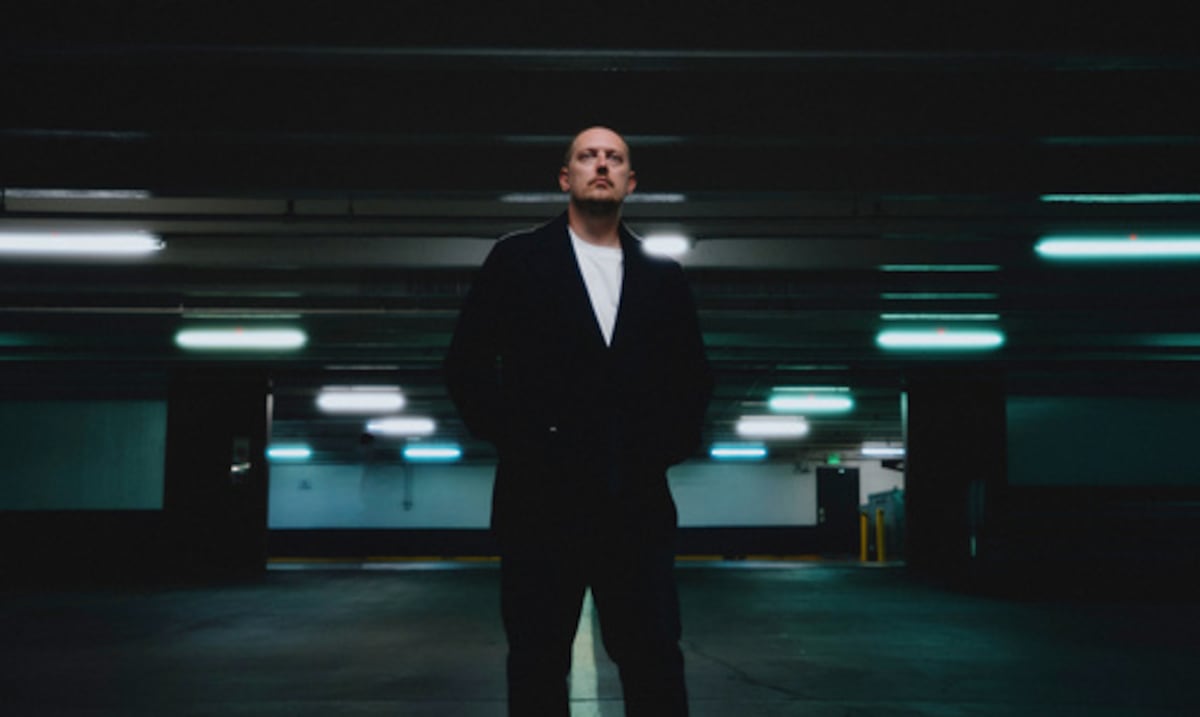
When the groups of Pop and the bands of rock They practice or act, trust their guitars, keyboards and drumsticks to make music. Oliver McCanna music creator with British (artificial intensity) who uses the artistic name imoliver, lights his chatbot.
McCann’s songs cover a variety of genres, from indie-pop to electro-soul and country-rap. There is only a crucial difference between McCann and traditional musicians.
“I have no musical talent,” he said. “I don’t know how to sing, I don’t know how to play instruments and I don’t have any musical training.”
McCann, 37, who has experience as a visual designer, began experimenting with AI to see if he could boost his creativity and “give life to some of my lyrics.” Last month, he signed with the independent record label Hallwood Media after one of his clues accumulated 3 million views, in what is considered the first time that a record label signs a contract with a music creator with AI.
McCann is an example of how Chatgpt -style song tools, such as Suno and Udio, have generated a synthetic music wave. An outstanding movement especially for a fictional group, Velvet Sundownwhich went viral despite the fact that all his songs, lyrics and album covers were created by AI.
This fed the debate on the role of AI in music, while generating fears about the ‘garbage of AI’: content produced in low quality generated automatically. He also shed light on the generators of songs that are democratizing musical creation, but threaten to disturb the music industry.
Experts say that generative AI is destined to transform the world of music. However, so far there are few details about how the world market for engraved music of $ 29.6 billion is impacting, which includes around $ 20,000 million of the transmission.
The most reliable figures come from the Deezer Music Transmission Service, which estimates that 18% of the songs uploaded to their platform are generated purely by AI, although they only represent a small amount of total transmissions, which suggests that few people really listen to them. Other larger transmission platforms such as Spotify have not published any figure about music with AI.
Udio declined to comment on how many users he has and how many songs he has generated. Suno did not respond to a request for comments. Both have free basic levels, as well as PRO and Premium levels that come with access to more advanced models.
“It is a total boom. It is a Tsunami,” said Josh Antonuccio, director of the School of Arts and Media Studies at Ohio University. The amount of music generated by the “will only increase exponentially” as young people grow up with AI and feel more comfortable with it, he said.
However, the generative AI, with its ability to generate apparently unique content, has divided the world of music, and musicians and industry groups complain that recorded works are being exploited to train AI models that drive song generation tools.
The record stamps are trying to defend against the threat represented by the new music companies with AI for their sources of income, even while they hope to take advantage of it to obtain new profits, while record artists fear that they devalue their creativity.
Three big record companies, Sony Music Entertainment, Universal Music Group and Warner Records, filed demands last year against Suno and Udio for the violation of copyright. In June, according to reports, the two parties also established negotiations that could go beyond the resolution of the demands and establish rules on how artists are paid when AI is used to remind their songs.
Gema, a German copyright collection society, has sued Suno, accusing her of generating music similar to songs like ‘Mambo no. 5 ‘by Lou Bega and’ Forever Young ‘by Alphaville.
More than 1,000 musicians, including Kate Bush, Annie Lennox and Damon Albarn, launched a silent album to protest the changes proposed to the laws of the United Kingdom on AI that fear that they erosion their creative control. Meanwhile, other artists, such as Will.i.am, Timbaland and Imogen Heap, have adopted technology.
Some users say that the debate is only a repetition of old arguments about technology that was once new and that eventually became generalized, autotune, rhythms and synthesizer boxes.
People complain “that you are using a computer to do all the work for you. I don’t see it that way. I see it like any other tool we have,” said Scott Smith, whose AI band, Press Empire, was inspired by British groups of the 1980s driven by synthesizers such as New Order and Depeche Mode.
Smith, 56 years old and ex-official of Public Affairs of the United States semi-stirred in Portland, Oregon, said that “musical producers have many tools in their arsenal” to improve the recordings of which listeners are not aware.
Like McCann, Smith never dominated a musical instrument. Both say they spend a lot of time and effort to elaborate their music.
Once Smith is inspired, he takes only 10 minutes to write the lyrics. But then it will spend up to eight or nine hours generating different versions until the song “coincides with my vision.”
McCann said that he will often create up to 100 different versions of a song requesting and re -requesting the AI system before being satisfied.
Song generators can generate lyrics and music, but many experienced users prefer to write their own words.
“The lyrics of AI tend to be quite cliché and quite boring,” McCann said.
Lukas Rams, a resident of the Philadelphia area that makes songs for his band of Sleeping With Wolves, said that the lyrics of AI tend to be “extra cheesis” and not as creative as a human, but they can help start the writing process.
“He will make very basic rhyme schemes and will continue to repeat the same structure,” said Rams, who writes his own words, sometimes while he lies his children and waits for them to sleep. “And then you will get words there that are very revealing letters generated by AI, such as ‘neon’, anything with ‘shadows’.”
Rams used to play the battery in high school bands and collaborated with his brother in his own songs, but work and family life began to occupy more of his time.
Then he discovered the AI, which he used to create three albums for Sleeping With Wolves. He has taken it seriously, making a CD box with album covers. Plan to publish their songs, which combine Metalcore and EDM, more widely online.
“I want to start uploading this to YouTube or social networks or distribution or whatever, just to have it out there,” said Rams. “I could well do it, otherwise, I am literally the only person who listens to these things.”
Experts say that AI’s potential to allow anyone to create a successful song is about to shake the production process of the music industry.
“Just think about what it used to make a success or do something that breaks,” said Antonuccio. “And that continues to decrease from an important study to a laptop to a bedroom. And now it’s like a text message: several text messages.”
But he added that music with AI is still in a phase of “Wild West” due to the lack of legal clarity on copyright. He compared it to the legal battles of more than two decades ago on file exchange sites such as Napster, which announced the transition from CDs to digital media and finally raided the way for current music transmission services.
Creators expect AI to eventually become part of the world of conventional music.
“I think we are entering a world where anyone, anywhere, could create the next great success,” said McCann. “As IA becomes more widely accepted among people as a form of musical art, I think it opens the possibility that music with ia appears on lists.”