
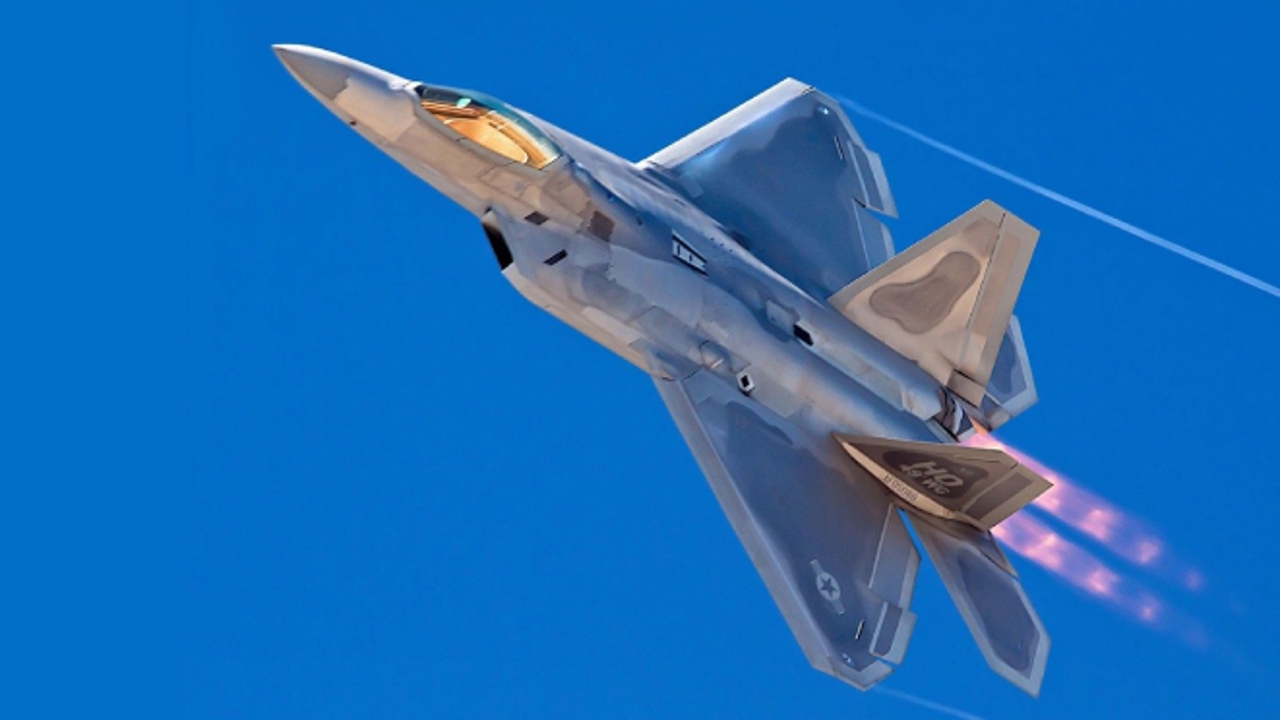
The Air Force of USA and three major defense contractors have completed a new flight test that brings collaboration between manned and unmanned aircraft closer to actual deployment. In the exercise, a F-22 Raptor managed to link with a drone GA-ASI MQ-20 Avenger through a new generation communications architecture. The Air Force had already tested similar concepts with fourth-generation fighters F-15 and F-16 and the drone XQ-58A Valkyrieother UCAV (Unmanned Combat Aerial Vehicle) type ‘loyal escort’, but this is the first time that idea has been brought to a fifth-generation fighter like the F-22.
General Atomics Aeronautical Systems, Lockheed Martin and L3Harris Technologies explained this Tuesday that the demonstration, carried out on October 21 at the Nevada Test and Training Range, validated secure government-owned data links that allowed the F-22 pilot to command and control the MQ-20 in mid-flight at more than 15,000 meters altitude.
The companies classify the result as a significant advance towards autonomous systems of open architecture and towards future combat concepts that foresee manned fighters operating alongside autonomous aircraft.
Demo used advanced tactical data links BANSHEE from L3Harris, operated through their software programmable radios Pantherinstalled on both the F-22 and the MQ-20. The entire system was built on Lockheed Martin’s open radio architecture.
The engineers installed a Pantera radio on each aircraft to create a bidirectional link. With a tablet-type control interface and mission module GRACE of the F-22, the pilot maintained full communications with the dronesending orders and receiving information in real time.
GRACE, a fast way to adopt experimental capabilities for the CCA program
GRACE, acronym for Government Reference Architecture Compute Environment, is an open architecture computing module that allows the F-22 to load and run new software without modifying its critical systems. In this test, this environment served to integrate the interface that connects the pilot with the MQ-20, demonstrating that the fighter can adopt experimental capabilities much more quickly than usual and without redesigning its avionics. By functioning as an independent space within the aircraft itself, it avoids long certification processes and turns the F-22 into an operational test bed.
For the Air Force, GRACE fits directly with concept development CCA (Collaborative Combat Aircraft), a military program that began to take shape in the early 2000s and seeks to manned fighters team up with future autonomous combat drones.
The objective is that the F-22 is the first platform capable of controlling these systems in real missions and that, later, this capacity will be extended to other models. The integration with the MQ-20 shows how GRACE allows us to accelerate this transition towards the definitive CCAs

However, there are doubts about using a tablet to control drones from a single-seat fighter. According to the defense media The War Zone, a General Atomics executive admits that he flew with a tablet in the cabin and that It was ‘really difficult’ to fly the plane, operate the weapons system and monitor one drone at a timewhile since Skunk WorksLokheed Martin’s advanced projects division, recognize that the tablet is useful for experimenting quickly, but it will hardly be the final solution.
Those responsible for the program emphasize that the test demonstrates the possibility of reuse hardware between platforms without intellectual property limitations, a pillar of the approach Open Mission Systems of the Pentagon to accelerate avionics improvements with different suppliers.
MQ-20, the companion drone controlled by the F-22 pilot

The MQ-20, formerly known as the Predator C Avenger, is a high speed jet stealth drone that General Atomics has been developing for more than a decade to operate in highly contested airspace.
Flew for the first time in 2009. The current production version has a wingspan of 23 meters and more fuel capacity, allowing you to overcome the 20 hours of autonomy. The variant Avengers Extended Range increases that reach even further.
With a turbofan engine Pratt & Whitney of more than 2,300 kilos of thrustthe Avenger reaches up to 740km/h speed and can operate above 15,000 meters.
The drone needs less than 1,500 meters runway for takeoff or landing and can carry a combination of internal and external loads, including up to 1,360 kilos of precision weapons in its internal warehouse. In addition, it can mount multiple intelligence, surveillance and reconnaissance sensors on the supports located under the wings.
General Atomics presents the MQ-20 as a new generation remotely piloted platform, designed for broad-spectrum surveillance missions, high-priority strikes, maritime target designation, and long-range electronic intelligence acquisition. Its speed and autonomous functions allow it to be quickly repositioned, improving its survivability in or near enemy air defense networks.
The aircraft uses the same ground control stations as the family’s drones predatorwhich allows operators to change platforms with virtually no retraining. The test is part of a series of self-funded demonstrations with which the industry seeks to explore how far cooperation between manned fighters and unmanned systems can go.
By validating the new communications links between the MQ-20 and the F-22, the companies maintain that The test promotes the autonomy ecosystem that will allow connecting multiple types of aircraft in combat and confirms the interest in quickly integrating unmanned platforms capable of entering high-risk airspace without putting the pilot at risk.