
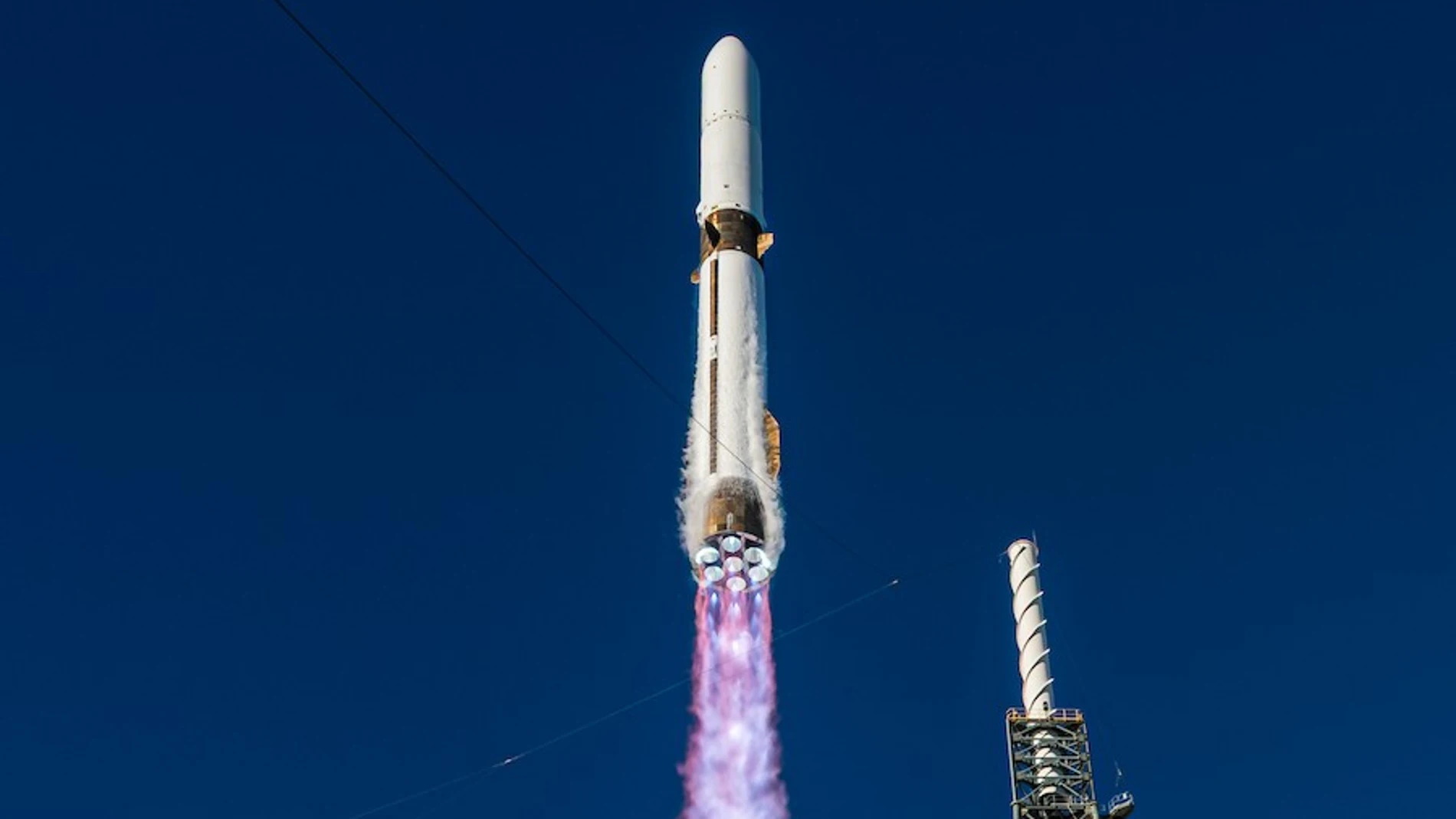
This weekend two technology magnates are playing. On the one hand, we have Jeff Bezos and his aerospace company Blue Origin and, on the other, to Elon Musk with SpaceX. On Sunday, Blue Origin will launch its New Glenn orbital rocket again and, for the first time, will reuse a first stage. If everything goes well, SpaceX’s monopoly will be over on reusable orbital launch vehicles and, furthermore, the competitors of starlinkamong whom is also Bezos with Amazon Leothey will have a much easier time putting their satellites into space.
The launch window of the enormous New Glenn rocket, 98 meters highwill take place between 12:45 and 14:45Spanish peninsular time, on Sunday, April 19. It will take off powered by the same first stage that was launched and landed on the program’s second mission last November.
At the moment when the propeller 57 meters high of New Glenn lands again, SpaceX, which has been reusing rockets for 2017will no longer be the only company in the world with that capacity. Blue Origin already has the New Shepardcompletely reusable, for years, but this It is a suborbital and non-orbital rocket, like the Falcon 9 and the New Glenn. Additionally, that program is currently on hiatus. Blue Origin said in January that I would not fly for at least two years.
Amazon desperately needs a reusable rocket of its own to accelerate launches of its Leo broadband satellite network. Without one, it has only been able to launch into orbit in one year 241 Leo satelliteswhich leaves it far behind the planned schedule. In that same 12-month period, SpaceX’s Falcon 9 managed to deploy more than 1,500 satellites for its Starlink constellation. With New Glenn, Blue Origin can carry more than 45 tons of payload to low orbit on each flight.
However, the New Glenn’s load this time will not be Leo satellites, but rather a single satellite BlueBird 7 of AST SpaceMobile which will be deployed in low Earth orbit. AST SpaceMobile, instead of covering the region with thousands of small satellites, as Amazon and SpaceX do, wants to deploy fewer satellites, but much more powerful.
BlueBird 7 incorporates a huge phased array antenna of about 223 square metersmaking it the largest commercial communications antenna deployed in low Earth orbit. It is basically a cell phone tower in space and it will be the second of the new generation satellites Block 2 of the company to be launched.
Unlike the better known Starlink, BlueBird 7 is designed to offer broadband on the phones that we already have, at speeds greater than 120 Mbps, through 4G and 5G networks. AST plans to have between 45 and 60 satellites launched before the end of 2026. When AST activates its service sometime this year, it will compete directly with the service Direct to Celldirect connectivity to Starlink satellite mobile, which already operates with T-Mobile in the United States, and with globalstarthe satellite network acquired by Amazon that keeps the iPhone and the Apple Watch in areas without coverage.