
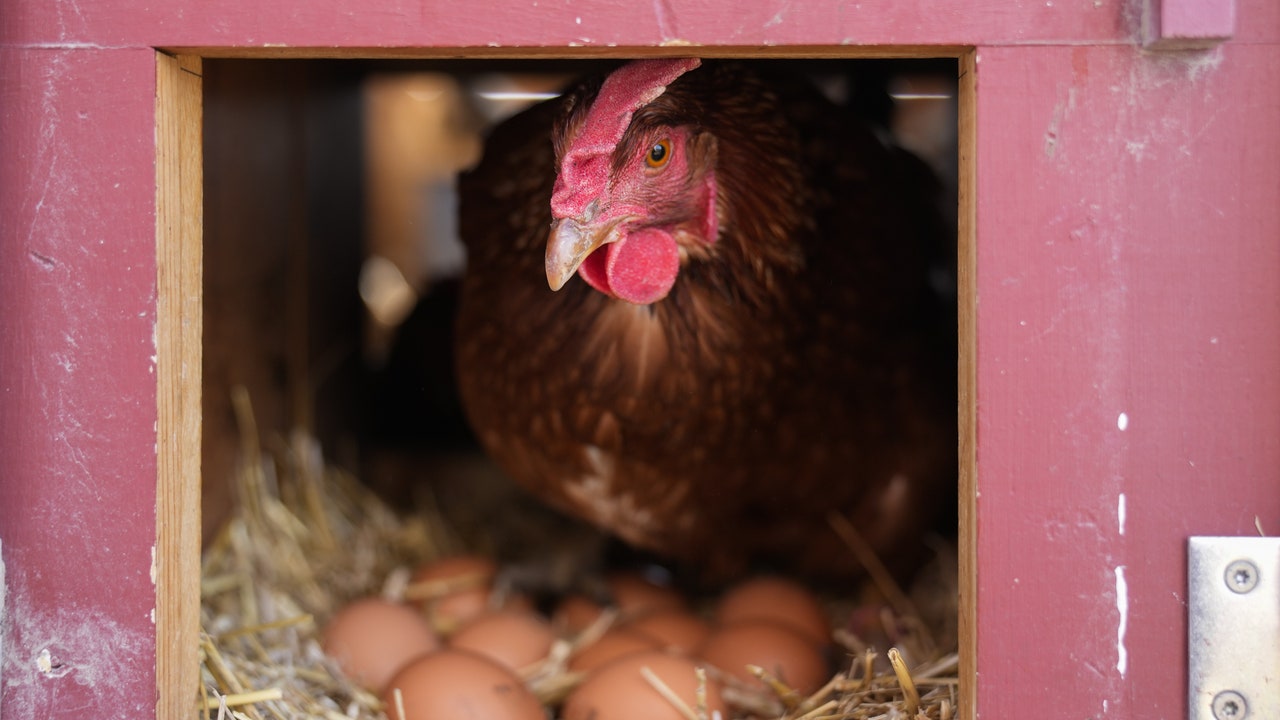
The Pontevedra newspaper informs that this month the sale of chickens is on the rise. Although Corral’s birds now cost 5% more than a few months ago, sales are recovering after a 2024 marked by a constant decrease. According to the newspaper, the reason why many families did not dare to buy was “the fear of registering the chickens. Many people were fearful of what could happen. Races such as Sussex have been sold again to about nine euros per pitch for weeks, even before the increase in the price of eggs.
The increase in eggs, up to 25% in the last month According to the Organization of Consumers and Users (OCU), it has revived concern about the obligation to register chickens for self -consumption. Not doing so carries fines that range between 600 and 3,000 euros. However, the regulations are not new. This is Royal Decree 637/2021, of July 27, and stipulates that all people who owe chickens must register them, even if they have them for self -consumption. The mandatory registration entered into force in January 2024 for existing farms and it is each CC AA that must apply the regulations and develop formulas so that citizens can register their chickens, up to 30 for self -consumption, as livestock exploitation.
When the mandatory in Galicia began a true “chicken coop war”, as some media called it. The Xunta, headed by the Minister of Rural Affairs, José González, complained that the only thing that the norm does is take the desire to the people of having self -consumption chickens and accused the government “of promoting a meaningless record.” A year later, 138,898 poultry farms have already been registered For self -consumption, although the Xunta continues to regret “not having been heard during the development of the RD. This regulation is another example of legislation designed and implemented with its back to the territory, without taking into account its peculiarities. The Xunta presented about 40 allegations and always insisted that self -consumption farms should be outside the scope. This position was motivated to relieve the administrative burden of citizens, in addition to repeatedly warning the central government that, in Galicia, attending to the important volume of self -consumption and its volatility, this registration work would be huge and not very effective ».
In Spain, it is estimated that the population of corral birds in exploitation is around 300 million animals, according to data from the Integral Animal Traceability System of the Ministry of Agriculture, Fisheries and Food (Map). But how many chickens, turkeys or poultry outside the commercial network are there? Is it important to know the data? And register each bird? Although the rules for commercial and self -consumption farms are different, since 2024 It forces the person who have up to 30 laying chickens or 50 chickens for fattening to register them and have a reference veterinarian for any health problem. The expansion of the aviar flu is concerned. «I understand that the measure seeks to have more information about the population that could, at a given time, to sustain the circulation of the virus. Having better data on the distribution of domestic birds could be related to the distribution of wild birds or with risk areas. There is very good information about commercial farms, but there is no, which is logical, about the so -called backyard chickens. I think that chickens should not be supervised, but with information you can do management, ”says Ursula Höfle, veterinarian of the Institute for Research in Hunting Resources-CSIC and responsible for the area of infectious diseases of wild birds.
The H5N1 virus has been circulating since the 90s but in recent years its expansion between wild and domestic birds and between mammals increasingly close to the human population. The virus is behind the rise in the price of eggs in the US (a dozen has cost more than 10 dollars), and also that new control measures appear on farms. «We attend a world epizootia (the animal equivalent to an epidemic), in which infections are seen in new species such as marine or terrestrial mammals, in addition to birds. This flu has lost seasonality and sprouts are already verified throughout the year and has geographically jumped through all the points of the globe, except by Oceania. At biodiversity level, it is a catastrophe. We still don’t know the impact it will have. But for example we know that 10% of the population has disappeared with a scripted pelican World Cup, ”says Höfle.
It is calculated that More than 500,000 wild birds have died from this virus and that the number of sacrificed farm animals is incalculable throughout the world. In Europe in the last year and according to data from the European Center for Disease Prevention and Control between December 7, 2024 and March 7, 2025, 743 virus detections have been recorded (239 in domestic birds and 504 in wild). In Spain until January 15, infections had been verified in Burgos, Barcelona, A Coruña or Pontevedra. On January 20, specific mitigation measures were taken in areas of special risk and surveillance such as avoiding contact with wild birds.
In Europe it is a year not too bad, “the biosafety measures adopted in recent years and vaccination campaigns such as the French are noticed,” says Höfle. However, in the last week the first infections have been confirmed in domestic and wild carnivores cats since the spring of 2024.
If you look at the US, it can only be said that the situation is worrying. If a year ago a case of avian flu was confirmed on a cattle farm, now already There are a thousand cows farms with contagios in 17 states. There have been 68 cases detected in humans one of them fatal and more than 21 million chickens have been sacrificed, according to the United States disease control and prevention Center. In addition, at the end of 2024 a different virus strain was detected in a farm of oregon pigs from the one that affects beef, which is seen as a risk due to the possibility that pigs are infected with different types of viruses that can adapt and mutate creating different strains with the capacity to spread to other species.
The good news is that today there is no transmission evidence between humans. «The more transmissions, the more possibilities a mutation arises that allows the virus to be transmitted from human to human. This virus, of course, has been very successful; It has managed to distribute worldwide infecting a lot of different species. You may have lost the pathogenic effect, that is, it is not so lethal, but trusting that is a lottery. We must not overestimate the risk because although it is true that with all the possibilities and infections that it has caused so far it has not caused a transmissible strain among humans, all that can change overnight because it is a virus; One of the most monitored for their possibility of causing a pandemic. In that group is the influenza, although surprises such as Coronavirus also appear in places where wild, domestic animals and people are more and more together, ”concludes the veterinarian.
Bird density
These days, the Greenpeace organziation requested special measures such as the reduction of animal density in commercial farms. They have done so taking advantage of the public consultation period of specific protection measures against avian flu in Spain that ends this March 26. The veterinarian Ursula Höfle also recalls that “we are removing natural ecosystems, which modifies the behavior of wild birds, forces them to approach domestic animals. In addition, we are creating new ecosystems such as farms, in which there are a large number of birds together and where an ideal breeding ground is created, but also landfills or water treatment plants, which provide food to wild birds that have lost their habitats, creating dense populations of wild birds that were previously distributed. It is true that the human has always modified the habitat, but now it is much more massive.