
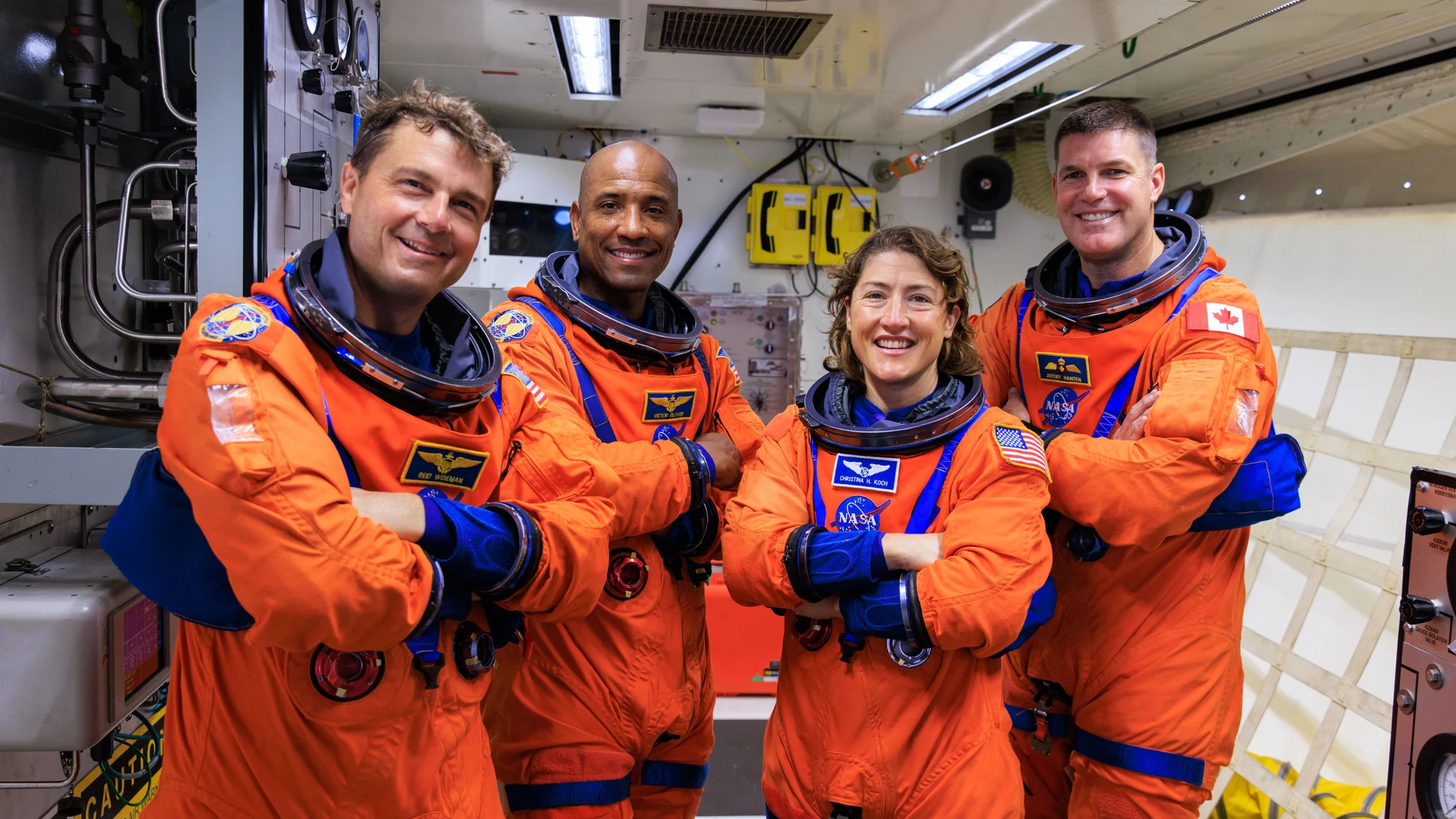
In a few minutes, The Artemis II crew will answer questions from the press from a location that rarely appears in official images, but which is as important as the rocket itself: the quarantine zone.
Before traveling to the Moon, astronauts must go through a period of strict isolation. It is not a symbolic question, but a medical one. In a closed environment like the Orion capsule, hundreds of thousands of kilometers from Earth, a mild infection can become a serious problem. Therefore, during the days before launch, the crew limits contact with the outside world as much as possible. They only interact with a very small group of people, all subject to constant health controls. It is a bubble within another bubble: the silent prelude to one of the most ambitious missions of recent decades. From there the four protagonists of this trip will speak.
In command will be Reid Wiseman, NASA veteran and former naval pilot. He has already experienced microgravity on the International Space Station, where he spent more than five months in orbit. His colleagues describe him as a calm leader, one of those who make decisions without raising his voice. In a mission where every second counts, that kind of character is as important as any system on board.
At your side, as a pilot, will be Victor Glover, also with experience on the space station and with a career that mixes engineering, aviation and a remarkable ability to communicate what is happening beyond Earth. He was the first African-American astronaut to participate in a long-duration mission on the ISS, and is often noted for his ability to translate the complex into something close, almost everyday.
The mission will also have Christina Koch, mission specialist and one of the most experienced astronauts on the crew. Her name is linked to a record: the longest space flight by a woman, with 328 consecutive days in orbit. Accustomed to long-duration missions, her role will be key in systems management and the execution of operations during the flight.
Complete the team Jeremy Hansen, astronaut of the Canadian Space Agency. He will be the first Canadian to travel to the Moon, a milestone that underscores the international nature of the Artemis program. An engineer, pilot and with solid experience in operations, Hansen also brings something less visible but fundamental: the ability to coordinate in complex environments where every decision is shared.
Four different profiles, the same mission: travel around the Moon and return. Without a moon landing, but with a clear objective: test all the systems that, in future missions, will take humans back to the lunar surface.From that quarantine room, far from the noise of the launch and the spotlights, one of the last conversations before takeoff will begin today. The next time they talk, it will probably be with Earth receding through the hatch.
The first to speak was Reid Wiseman, who confessed the nerves inherent to the imminent mission and that they are seated just a few meters from the suits they will use on the mission.
For your part Victor Glover confirmed that one of the main missions of this maiden voyage, so to speak, is the evaluation of the manual controls of the Orion ship. This will allow feedback to be sent to Earth on how the ship responds and what things would need to be adjusted.
One of the most interesting questions was how they see the Moon, taking into account that they are one of the few humans who have it as a destination, while the rest of us humans observe it from a distance. For Christina Koch, the answer was very clear: we want the day to come when all humans can see the Moon as a possible destination.
One of the most interesting answers was the one given by Wiseman when he was asked about preparation for the unexpected: possible problems, crises… “We are clear that we trust the team, each other. And “We also know that our response to these types of events will be slow, thoughtful and, therefore, safe.”
The mission has many “firsts”: the first African American on a mission to the Moon, the first woman… The first time returning after 50 years.
For Victor Glover The objective is to create a positive impact and for boys and girls to see that it is possible and that inspires them to follow a career linked to science. For Koch, in a 180º turn, Its goal is not to inspire women, girls or certain cultures, its goal is so that we can all feel part of that mission.
What is the point of no return, if a problem is discovered, when will it be time? For Christina Koch, there is a technical answer: our suits. As long as we can return in 6 days, which gives us the survival of our suits, we will have time.
What happens minutes before starting the trip? For Glover, the seconds before beginning the protocol are spent sending messages to his family.
“As much as we have the entire mission prepared in our heads – says Wiseman -, We know that unexpected events can occur. And we are prepared for them.”
“Which We don’t have an emotion simulator. – adds Koch -. “We don’t know how we are going to react to the sight of the Moon so close, to be so far from the Earth… We prepare ourselves physically and technically, but emotionally, the unexpected is going to be challenging.”
The question that many people ask has arrivedhos: Why return to the Moon? For Christina Koch the answer is clear. “It’s not just about the scientific, economic, future and present benefits. It is a way of answering humanity’s most pressing question: are we alone? That’s the reason we’re going.”
For Wiseman, the key is that “We humans seek to share and be able to transmit this knowledge, this experience, to others, it is almost like carrying all of humanity.”
Jeremy Hansen He explained that one of the most interesting moments will be be able to observe a solar eclipse from the Moon, something that Buzz Aldrin and Jim Lovell could see from space in 1966 on the Gemini 12 mission. Another milestone will be seeing, with your own eyes, the far side of the Moon, something that had not been seen directly to date.
“This mission is very important to us – Hansen explained -. It is a foundational mission, like the Mercury, Gemini or Apollo programs were. We are going to inspire a new generation, new generations. And that has incalculable value.”
Finally, for Christina Kochexperience this moment, prior to takeoffmade her remember when she visited the area when she was ten years old and now she is riding this train, when before she only saw it from the station. They also clarified that since yesterday, they can only see their families through glass due to their stay in the quarantine zone. That makes it, at the same time very distant, but enormously real.