
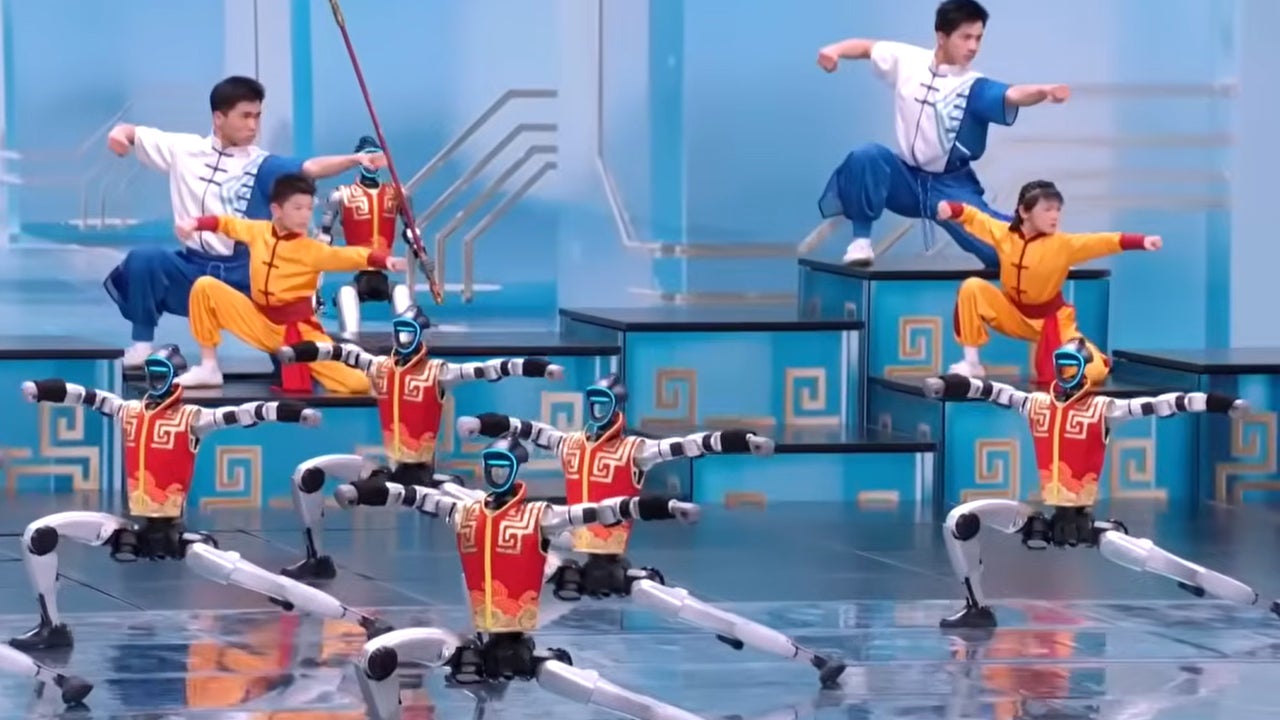
China has turned its humanoid robots into the stars of one of the most watched television shows of the year, surprising the world with performances that combine dance, martial arts and acrobatics. During the 2026 Spring Festival Gala, dozens of robots from companies such as Unitree Robotics, Galbot, Noetix and MagicLab They appeared on stage performing synchronized choreography, kung-fu routines and even dance steps. before nearly a billion viewers, if we count streaming services and TV transmission.
This type of exhibition is not a simple fair trick or mere entertainment: it represents the rapid evolution of humanoid robotics in China, a sector that in recent years has gone from showing simple gestures to complex movements with remarkable precision. The CEO of Unitree Robotics himself, Wang Xingxing, stressed in an interview that maneuvers like that “require an extremely high level of balance control, dynamic response and landing stability”, and that the essence of these actions is precisely to make robots more stable and capable, not only for show, but for real applications.
The presence of these robots at a cultural event of enormous relevance such as the Lunar New Year Gala (the equivalent of the Super Bowl in terms of local importance) seeks to send a message to the domestic public and the international community about the country’s technological leadership, especially in artificial intelligence and advanced manufacturing. At a time when robotics is at the center of Chinese industrial strategy, The media visibility of these actions coincides with a political and economic push to position the country as a global benchmark in “AI + Robotics.”
At first glance, seeing dancing robots may seem anecdotal or even curious, but behind each step there is much more than entertainment: to begin with, 41 independent motors that control movements.
In reality, teaching a robot to perform complex movements such as dancing, acrobatics or martial arts requires solving some of the most difficult problems in modern robotics: multi-axis balance, real-time stability prediction and coordination of dozens of joints.
The interesting thing is that the choreography is just a “set” to take us to see robots move in real environments, adapt to irregular surfaces or interact with objects and people. Every time a robot adjusts its center of gravity to execute a turn or accelerates a leg to complete a jumpis training and refining movement algorithms that can be reapplied in tasks as varied as logistics, manufacturing, home care, or robot-assisted surgery.
To this we must add a social component: these Public performances accelerate social acceptance of humanoid robotics. Seeing machines moving in a seemingly natural way on the screen familiarizes the public with devices that, in the near future, could become co-workers or household assistants.
Thus, the exhibition of robots at these types of events becomes an indication of what could come. As Control systems, environmental perception sensors and neural networks that learn human movements continue to maturewe will see increasingly capable and versatile humanoids.
But it’s not all good news, there are challenges too. The rapid deployment of advanced robots raises questions about employment, ethics, safety and regulation, particularly when is combined with artificial intelligence capable of making complex decisions in real time. As these systems become more present in everyday life, we will have to debate not only what these machines can do, but also what we want them to do and under what rules they should operate.
In short, although dancing may seem frivolous, it is precisely in that mixture of mechanical precision, synchrony and adaptability where the keys to a future in which robots and humans lie They could share not only the stage, but also tasks, spaces and daily challenges.