
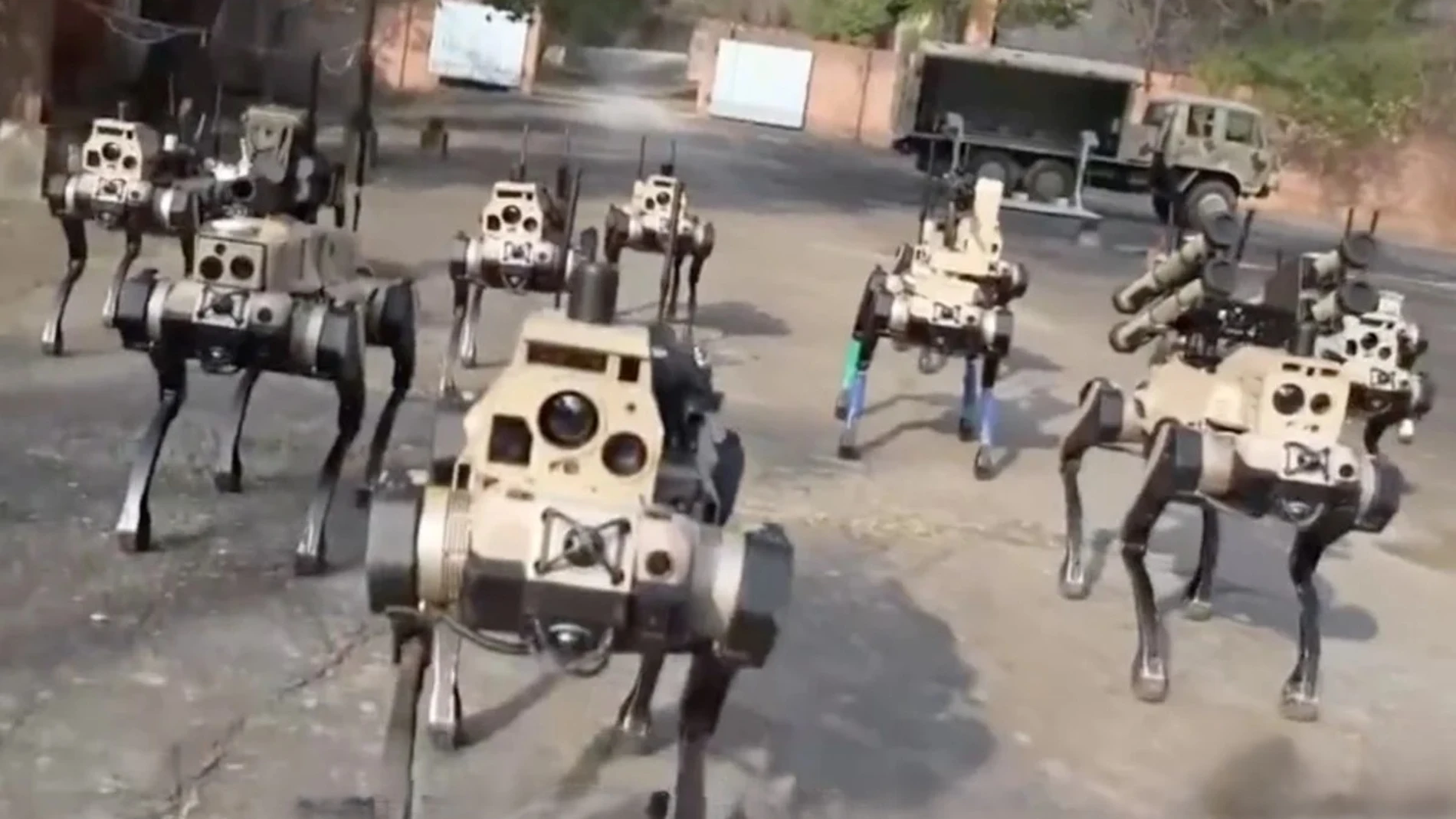
China has taken the approach from aerial drone swarms to canine robots. A group of robot dogs has recently operated as a coordinated ‘wolf pack’, with specialized roles and a shared ‘brain’, in an urban warfare simulationaccording to South China Morning Post. These ‘robot wolves’ represent a generational leap from a ‘single soldier support system’ to a ‘coordinated swarm combat platform’according to an episode of the documentary series Unmanned Competition, broadcast last week on Chinese state television, CCTV, which shows the latest advances in China’s unmanned weapons systems.
Designed with enhanced physical and operational capabilities
These robotic units stand out for physical and operational capabilities superior to previous generations of this type of robots. They move quickly, can carry more equipment, and maintain performance in difficult terrain and adverse conditions, expanding their usefulness in different combat scenarios.
Thanks to a shared sensory network, These robot dogs can operate in a coordinated manner, exchange information and make decisions within the group without depending on external orders. The system can also combine with drones to execute joint operations on the ground and in the air.
They also admit various control methodsso that operators can monitor or direct the mission with more flexibility. Command can be exercised from consoles, through voice commands or with a tactical glove or a control lever attached to the rifle. Compared to previous models, they incorporate more flexible joints, reach up to 15km/hsupport a payload of 25 kilos and improve both resistance in extreme environments and adaptation to diverse terrain, according to SCMP.
A pack with specialized roles for each unit
These new robotic systems are built to operate as a network. Each unit is connected to a shared digital infrastructure which allows you to exchange information with others instantly. By sharing data and responding collectively, they can adapt more effectively to rapidly changing situationsespecially in complex environments such as cities.
The strength of this ‘wolf pack’ model lies in the specialization. Each robot is assigned a specific function, ensuring that the group operates efficiently as a whole. Some units focus on gather intelligence and monitor the environmentwhile others are equipped for direct intervention. Additional robots provide logistical or operational support.
The ‘wolf packs’ that China is testing are a new example of the extent to which automation and robotics are gaining weight in the military field. This jump, however, raises several questions. The more decision-making margin is delegated to these machines, the more diffuse human responsibility becomes when an action in combat occurs.
There is also concern about its impact on the escalation of conflicts. Automated systems can react at a speed much faster than human speed, reducing the margin of control and increasing the risk of responses that are difficult to contain. In any case, Although these robot dogs can identify and acquire targets autonomously, they still require confirmation from a human operator before attacking..