
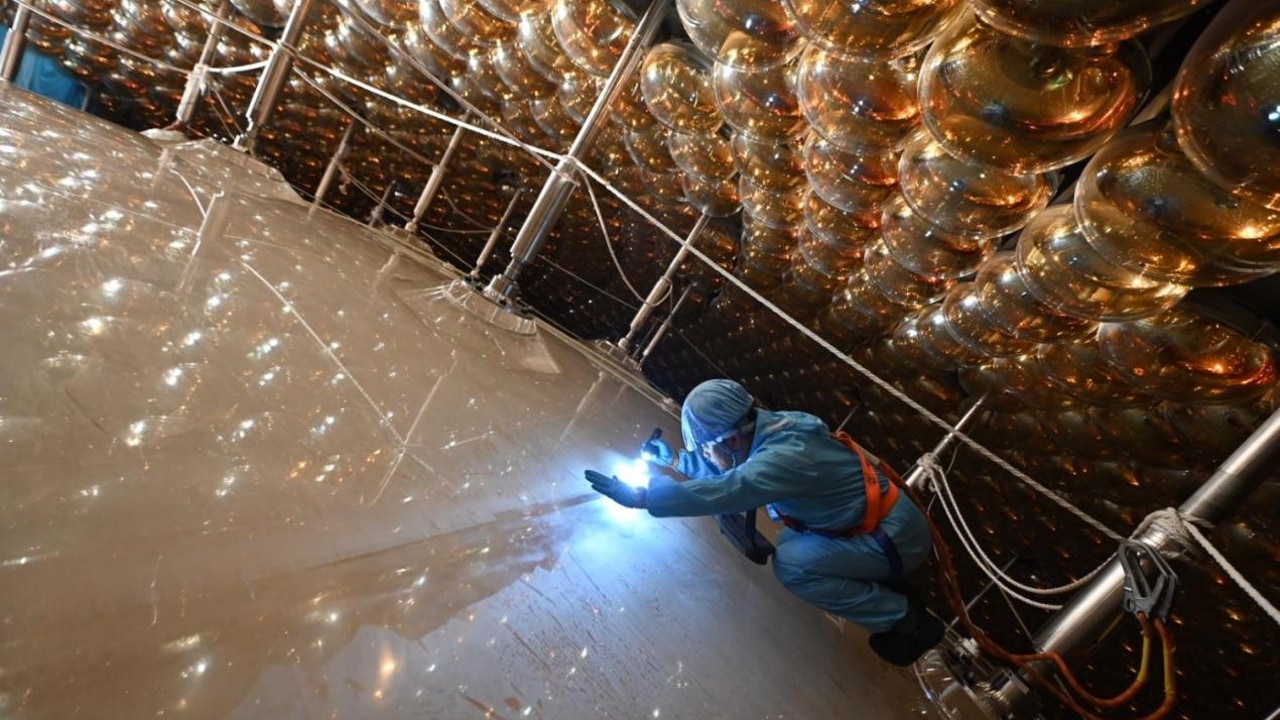
“Complete the filling of the Juno detector and initiate the data making a historical milestone -explains Yifang Wang, a scientist at the Institute of High Energy Physics (IHEP) of the Chinese Academy of Sciences and spokesperson for Juno, in a statement -. For the first time, we have a detector of this scale and precision dedicated to neutrinos. Juno will allow us to answer fundamental questions about the nature of matter and the universe. ”
Lying 700 meters under the ground near the city of Jiangmen, in the province of GuangdongJuno detects antineutrinos produced 53 kilometers away by the nuclear power plants of Taishan and Yangjiang and measures their energy spectrum with record precision.
Unlike other methods, the determination of mass ordering through Juno is independent of the effects of matter on Earth and practically free of parameter degenerations. Juno too It will provide improvements of order of magnitude in the accuracy of several neutrin oscillation parameters and allow avant -garde studies on neutrinos from the Sun, Supernovas, the atmosphere and the earth. In addition, it will open new opportunities to explore unknown physics, including the search for sterile neutrinos and the disintegration of protons.
Proposed in 2008 and approved by the Chinese Academy of Sciences and the province of Guangdong in 2013, Juno began its underground construction in 2015. The detector installation began in December 2021 and was completed in December 2024, followed by a phase filling campaign. In 45 days, the team filled 60,000 tons of Ultrapura (an extremely high quality liquid, with a neutral, transparent, colorless, tasteless and toilet pH used in industries such as electronics, pharmaceutical or biotechnological), maintaining the difference in fluid level between internal and external acrylic spheres with centimeters precision and uncertainty of the flow of less than 0.5%, thus safeguarding structural integrity.
During the next six months, 20,000 tons of liquid spintinger were introduced in the acrylic sphere of 35.4 meters in diameter, displacing the water. Throughout the process, the statement points out, the strict requirements of ultraralta purity, optical transparency and extremely low radioactivity were met. At the same time, the collaboration carried out the purification, commissioning and optimization of the detector, which allowed a fluid transition to the complete operation once the filling was completed.
The study of neutrinos is important because It allows us to understand the sun and other star processes, explore physics beyond the standard model, observe extreme cosmic events, and understand the formation of structures in the universe. In addition, neutrinos can be a tool to study dark matter.
In Juno’s heart is a central scintillater detector (a material that lights up When a radioation is going through iteithern ionizing) fluid with an unprecedented effective mass of 20,000 tons, located in the center of a 44 -meter depth water pool. To that adds a stainless steel structure of 41.1 meters in diameter supports the acrylic sphere of 35.4 meters, The spintinger, 20,000 photomultiplier tubes (PMT) of 20 inches, 25,600 pmt of 3 inches, frontal electronics, wiring, antimagnetic compensation coils and optical panels. All PMT operate simultaneously to capture the sparkle light of neutrinos interactions and turn it into electrical signals.
“The construction of Juno has been a process of extraordinary challenges -adds Ma Xiaoyan, Juno chief engineer -demanded not only new ideas and technologies, but also years of careful planning, evidence and perseverance. Complying with the strict requirements of purity, stability and security required the dedication of hundreds of engineers and technicians. Teamwork and integrity transformed a bold design into a functional detector, ready to open a new window to the world of neutrinos. ”
Juno is organized by the IHEP and has The participation of more than 700 scientists from 74 institutions in 17 countries.
“The historical achievement that we announce today is also the result of the fruitful international cooperation of numerous research groups outside China, which contribute to Juno the experience acquired in previous configurations of liquid spintings. The international community of liquid spint -up He has taken the technology to its maximum limit, racing the way to the ambitious physical objectives of the experiment”, Concludes Professor Gioacchino Ranucci, deputy spokesman for Juno and professor at the University of Milan.
Juno is designed to A scientific useful life of up to 30 years, with a reliable update process that will lead him to a world leading search for double beta disintegration without neutrinos. This update would investigate the absolute mass scale of the neutrinos and check if they are particles of Majorana, addressing fundamental issues that cover particle physics, astrophysics and cosmology, and deeply transforming our understanding of the universe.