
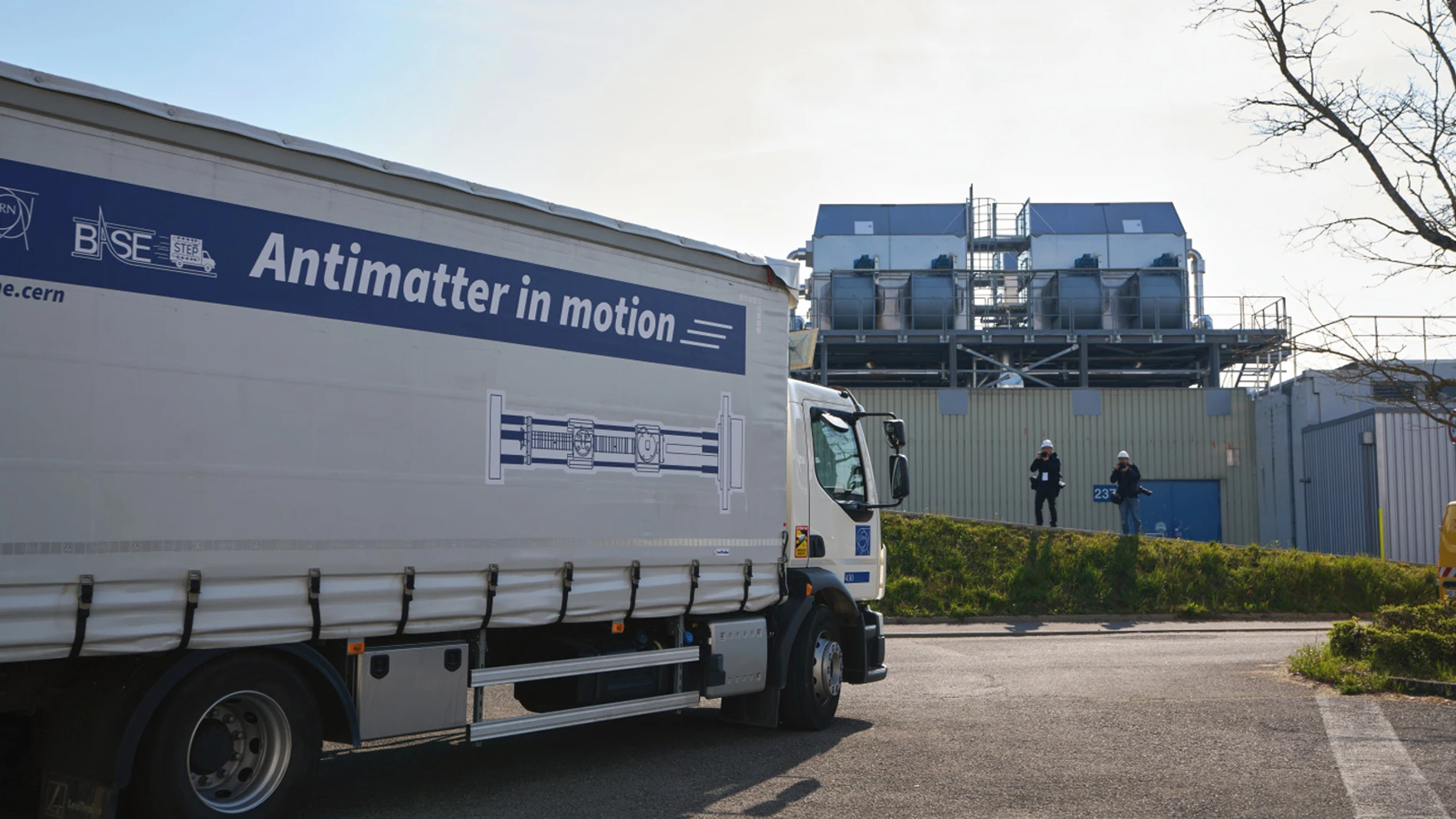
This week, CERN has achieved something unprecedented. It has transported 92 antimatter antiprotons by truck during a half-hour journey. According to the Associated Press, the operation forced the antimatter to be stored in a 1,000 kilo cryogenic unit. The test demonstrates that, in the future, these antiprotons could be sent to other research facilities.
When it comes into contact with matter, it releases that energy immediately and violently.. And since everything around us is made of matter, safely isolating it is especially complex. Therefore, transporting it is a major technical challenge, since the containment system must not only work, but must also be able to move.
In this test, CERN used a 1,000 kilo container based on supercooled magnets. It is not exactly a handy device, but it is robust enough to allow the transport of antiprotons by road.
‘Transporting antimatter is a pioneering and ambitious project. We are at the beginning of an exciting scientific journey that will allow us further deepen our understanding of antimatter’has pointed out Gautier Hamel de Monchenaultdirector of research and computing at CERN.
During the 30-minute drive across the CERN campus in Geneva, the researchers demonstrated that antimatter could be transported safely, no leaks or explosive damage. They did admit, however, that the amount of antimatter was so small that, even if it had come into contact with matter, the resulting energy release would have been almost imperceptibledespite its potential on a larger scale.
To understand the proportion, you would need about 6 × 10²³ antiprotons to gather just one gram of antimatter. It is a huge figure, equivalent to a 6 followed by 23 zeros. In this experiment, CERN transported only 92. The difference is so enormous that it helps to understand the extent to which we are talking about almost insignificant quantities. CERN can produce more than 400 million antiprotons per hour, but even maintaining that rate it would take billions of years to reach a single gram.
Although this does not mean that we will see antimatter rocket engines or functional power plants in the near future, being able to successfully transport it opens the door for many more scientists and researchers to work with antimatter and explore what you can learn from it. Since it is probably the rarest material in the universe, at least as far as we know, Accessing antimatter is difficult. Limiting it to a single location made it even more complicated.
The containment truck will also have to improve. Researchers believe it could keep antiprotons for about four hoursbut trips to relatively nearby research facilities, such as the Heinrich Heine University from Dusseldorf, last eight hours.
In the future, however, antimatter could reach all types of facilitiesas long as they have the necessary containment systems to house it once it reaches its destination.