
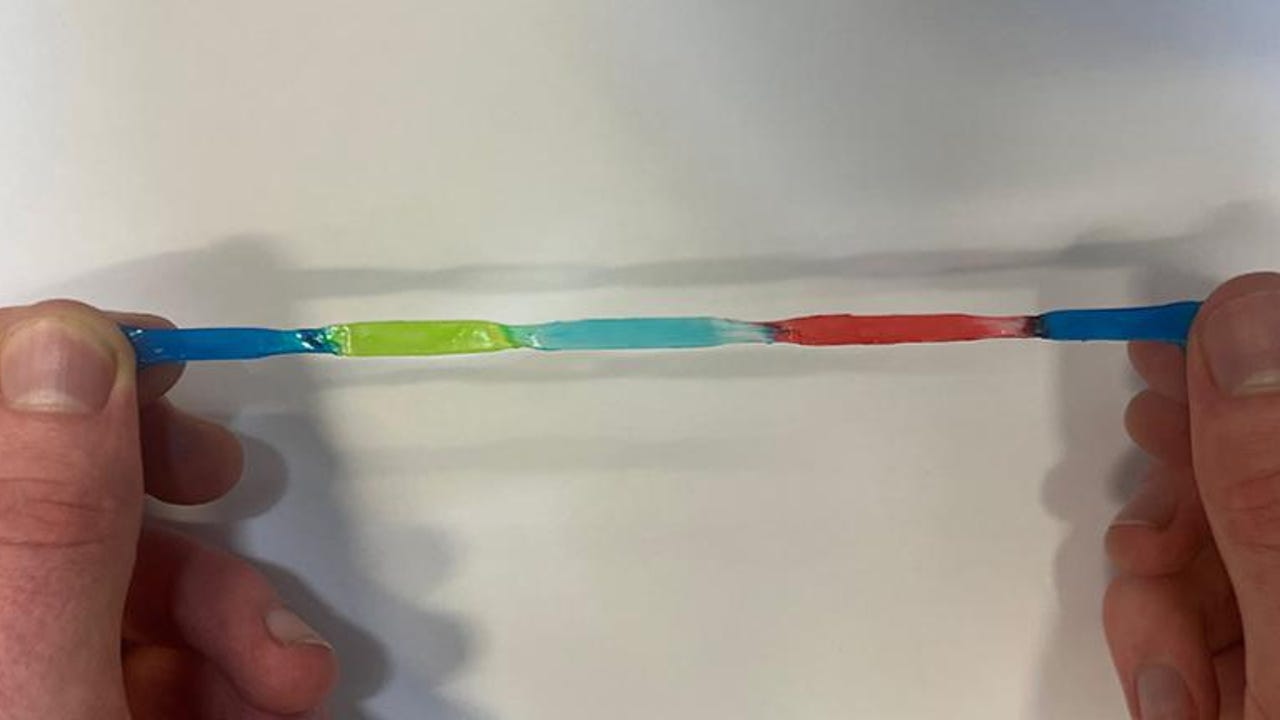
Microchips, pacemakers, biological “switches”… There are more and more devices that can and are implanted in the human body. But all of them need a reliable and compatible power source. With this in mind, a team of scientists from the University of Cambridge has developed a soft and elastic “gelatin” battery that could be used in wearable devices or soft roboticsor even implanted in the brain to administer drugs or treat diseases such as epilepsy.
Those responsible, led by Stephen O’Neill, were inspired by electric eels, which stun their prey with modified muscle cells called electrocytes. Conventional electronics use rigid metallic materials with electrons as charge carriers, while gelatin batteries use ions to carry charge, like electric eels.
Like electrocytes, the gelatinous materials developed by O’Neill’s team have a layered structure, like that of sticky Lego, which allows them to supply an electric current.
These self-healing gelatin batteries can stretch to more than ten times their original length without affecting their conductivity: It is the first time that such stretchability and conductivity have been combined in a single material.. The results have been published in Science Advances.
Gelatin batteries are made of hydrogels: three-dimensional networks of polymers containing more than 60% water. The polymers are held together by reversible on-off interactions that control the mechanical properties of the gelatin.
The ability to precisely control mechanical properties and mimic the characteristics of human tissue makes hydrogels ideal candidates for soft robotics and bioelectronics; however, they must be conductive and elastic for such applications.
“It is difficult to design a material that is both very elastic and very conductive, since those two properties are usually at odds with each other – explains O’Neill -. In general, conductivity decreases when a material is stretched. Typically, hydrogels are made of polymers that have a neutral charge, but if we charge them, they can become conductive. And by changing the salt component of each gel, we can make them sticky and crush them into multiple layers, so that we can develop higher energy potential”.
In this way, hydrogels adhere strongly to each other due to the reversible bonds that can form between the different layers, using barrel-shaped molecules called cucurbiturils that are like molecular links. The strong adhesion between layers provided by these cucurbiturils allows gelatin batteries to stretch, without the layers separating and, fundamentally, without any loss of conductivity.
The properties of gelatin batteries make them promising for its future use in biomedical implantssince they are soft and mold to human tissue.
“We can customize the mechanical properties of the hydrogels to match human tissue,” adds co-author Oren Scherman. Since they do not contain rigid components such as metal, a hydrogel implant would be much less likely to be rejected by the body or cause the buildup of scar tissue.”
In addition to their softness, hydrogels also They are surprisingly resistant. They can withstand being crushed without permanently losing their original shape and can self-heal when damaged.
O’Neill’s team is planning future experiments to test hydrogels on living organisms and evaluate its suitability for a variety of medical applications.