
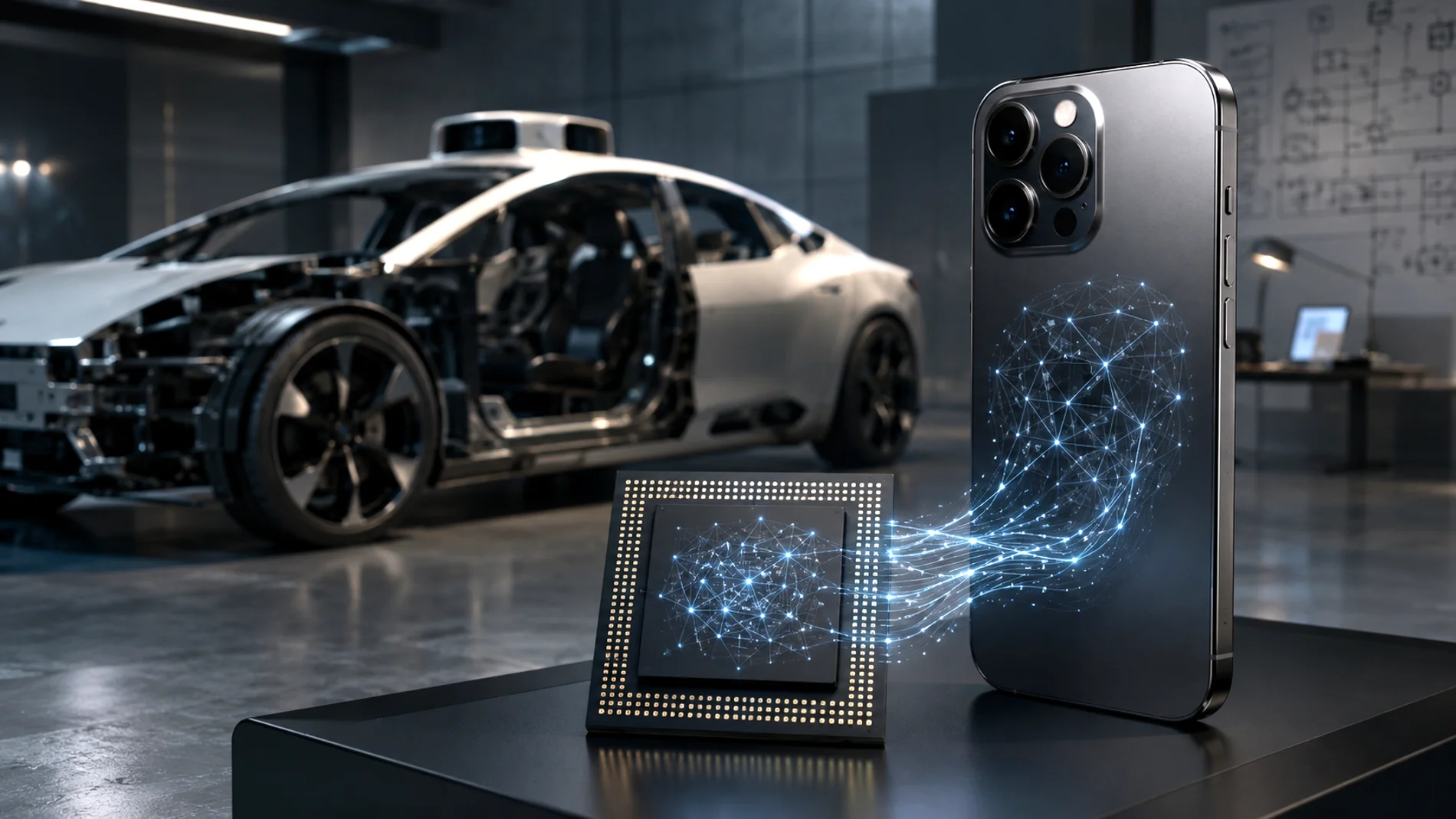
Apple spent nearly a decade and a few 10 billion dollars to develop an electric and autonomous car that never reached the roads, but that would ultimately have a decisive impact on the creation of its own chips for iPhone, Mac and iPadas revealed by Mark Gurman in Bloomberg. The project of Apple Car started around 2014 under the internal name ‘Project Titan’ and it was canceled in February 2024, after numerous changes in direction, delays and replacements among those responsible.
During those years, the company went from initially considering an electric vehicle to a completely autonomous one, no steering wheel or pedalsand finally reworking the original concept. The last proposal contemplated advanced driving assistance systems, a price close to $100,000 and a possible launch in 2028. That was far from the objective of revolutionizing the automobile industry in the same way that the iPhone had transformed mobile telephony.
The managers too They doubted that the car could reach Apple’s usual profit margins. Added to the cost of manufacturing a vehicle were the complexity of supply chains, the difficulties in finding an industrial partner and a technical problem that the entire sector remains unresolved, achieve reliable autonomous driving in any circumstance. The board of directors ended questioning whether it made sense to continue spending hundreds of millions of dollars on a product without a clear release date.
The closure of Project Titan does not mean, however, that all that work ended up in the trash. Mark Gurman has explained in his newsletter ‘Power On’ that the program left a decisive inheritance for current Apple processors. During the early phases of the project, its engineers understood that a self-driving car would need to analyze cameras, sensors and the environment in real time using artificial intelligence.
This processing had to be carried out inside the vehicle itself. Relying on a connection to external servers would have introduced delays and availability risks incompatible with decisions that must be made in fractions of a second. Although the car-specific processor never became a product, The work done to solve that problem led, according to Gurman, to the development of the Neural Enginethe artificial intelligence accelerator integrated into Apple processors.
Neural Engine
The Neural Engine debuted in 2017 with the chip A11 Bionic of the iPhone X. Its first version had two cores and could perform up to 600,000 million operations per second. Apple initially used it for computer vision and machine learning tasks, including Face IDthe Animoji and augmented reality applications.
Apple later incorporated it into the following generations of A processors for the iPhone and iPad. Technology made the leap to computers in 2020 with the M1the first M series processor for Mac, which integrated a Neural Engine of 16 cores. Since then it has also been part of the MPro, Max and Ultra used in the company’s most powerful equipment.
This architecture has left Apple better positioned in hardware for artificial intelligence than in softwarewhere it has advanced more slowly than some of its competitors. Their devices have been prepared for years to run image recognition, photo processing, transcription and AI models without sending all the information to external servers.
Local processing also underpins much of Apple’s privacy strategy. The more calculations that can be performed inside the iPhone, iPad, or Mac, the less personal data needs to leave the device. More complex operations can be moved to the cloud, but an increasing part of the work can be solved directly by the Neural Engine.
M6 and M7
Apple now aims to accelerate that advantage. Gurman assures that the company will launch the M6 basic at the end of 2026, but will not develop M6 Pro, Max or Ultra versions. Apple has prepared major neural processing improvements for the family M7 and considers them sufficiently relevant as to advance that generation instead of completing the entire M6 range.
The basic M7 would arrive during the first half of 2027, while the M7 Pro and M7Max they would appear later that same year. He M7 Ultra It is planned for 2028 and would considerably increase performance in artificial intelligence. According to Gurman, it could approach specialized accelerators such as Nvidia Blackwelladmit up to 1.5 TB of unified memory and serve from 2029 as a base for new servers Apple Intelligence. For now, none of these plans have been officially confirmed by Apple.