
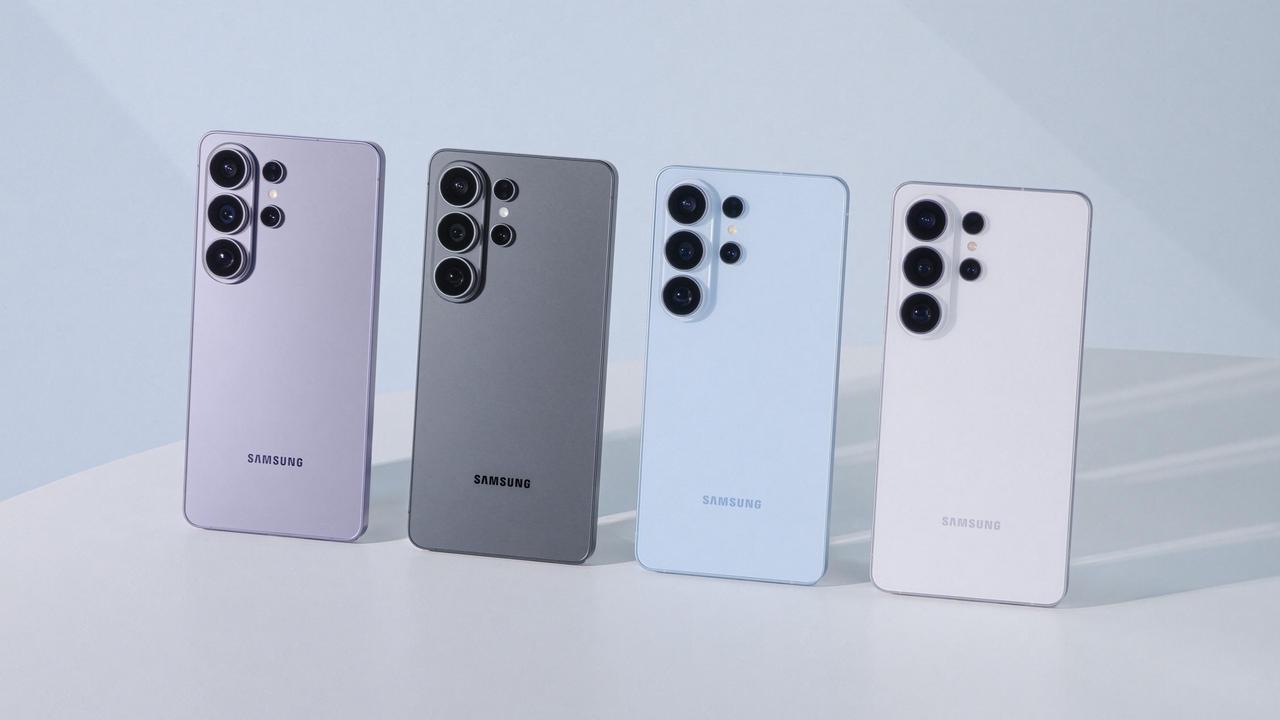
Every year the same thing happens with an almost millimeter precision and a devotion to Moore’s Law that stands out unequivocally: The new generation of a mobile phone is presented, with a similar design, with better cameras and more powerful processors following due (and gradual) obedience to the aforementioned law. But some generations mark a conceptual leap: when they not only improve numbers, but redefine not what the cell phone does, but what we can do with it. The new Samsung Galaxy S26 series wants to be one of those moments.
Officially presented yesterday, the S26 line arrives in a context in which artificial intelligence (AI) stops being a buzzword and becomes a central piece of the mobile experience and a need for brands to make clear what they aspire to. Samsung has not only upped the ante in power or design: has placed AI as the main protagonist of how we interact, create and solve problems with a smartphone.
Yes, the processor is the latest generation (Snapdragon 8 Elite Gen 5 Mobile Platform for Galaxy), processing power and graphics capacity are increased, new vapor chamber for energy dissipation, fast charging (75% in 30 minutes) and one of the best cameras on the market…What is expected from a latest generation at the top of the market.
But there is more and here comes the interesting part. Better battery management, for example, is powered by AI. The Galaxy S26 recognizes usage patterns and automatically manages resources, such as battery and performance, so you don’t have to worry about saving modes. It improves images even before we press the shutter (analyzes the scene, detects subjects and corrects light, focus and noise predictively). It also suggests relevant actions based on what we are doing: from rearranging the agenda to remembering important details of a message.
In the high-end phone segment, many manufacturers have incorporated basic AI: from voice assistants to advanced photography algorithms. However, what sets the Galaxy S26 apart is that Samsung has managed to integrate AI at multiple levels of the operating system, not just in isolated apps. Added to this is a fundamental section linked to privacy and security: many of the functions can be performed without constantly depending on the cloud. And something interesting is that, just like a web search engine fills the spaces as we type, the S26 has a user contextual prediction system: it learns from our daily use to optimize all the functions that we do not see.
In this context, The S26 is a conceptual leap or, in evolutionary terms, a link. In a few years we will remember it as the smartphone that did not have AI to help us if we asked for it. It will do so without the need for our actions and in the parameters that we select.
Privacy, personalization and security will have to be fine-tuned, but If AI is the technology of the moment and a smartphone is the device we use the most, it is logical that roles should be exchanged.. And that new context is one in which we are going to have to live in a short time.