
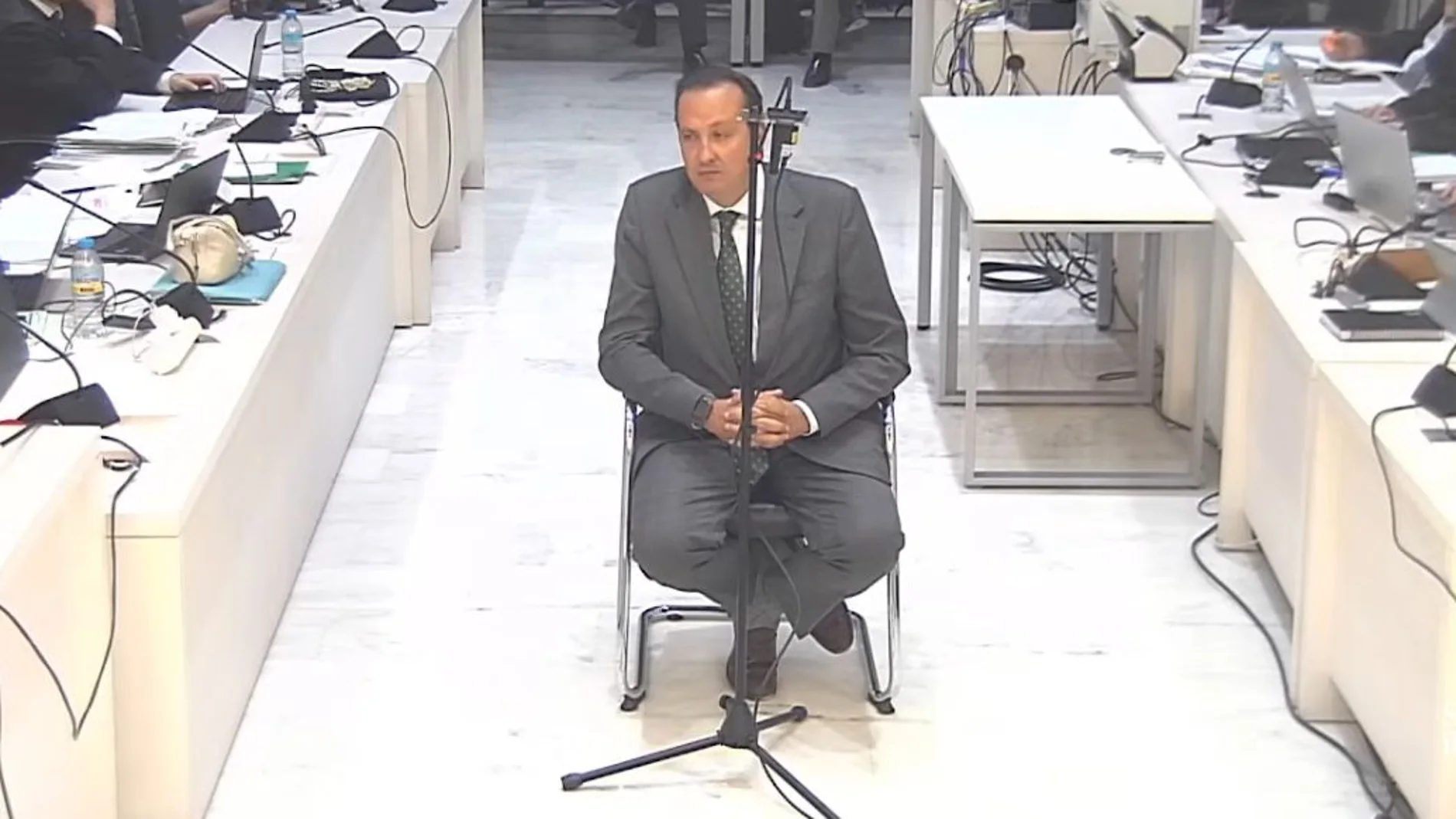
The notary Alberto Vela Rubio-Navarro acknowledged, in the eighth session of the “Operation Kitchen” trial, that he was never able to prove the messages that, according to former Secretary of State for Security Francisco Martínez, came from former Minister of the Interior Jorge Fernández Díaz. «I could never prove that origin»he assured Judge Teresa Palacios, who presides over the Court that is prosecuting the case.
According to his testimony, this is an issue that he already reflected in two notarial minutes that he issued at the time, where he explains that it was the former Secretary of State who told him that it was Fernández Díaz who had sent him the messages in question.
«I had a friendly relationship with Mr. Martínez since university. He came to Mahón – where he had his office – to see me as a friend and took advantage of the visit to ask me to draw up the minutes. I checked the messages and transcribed them. But it is possible to say that they are from another person who does not correspond to what is reflected and furthermore I am not qualified as a notary for this,” he assured. The notary further stated that “There were intermediate messages that the requesting party (Martínez) was not interested in recording.”. That is, the former Secretary of State would have deleted certain communications.
Rubio-Navarre Candle He was initially accused of an alleged crime of violation of secrets as a result of, supposedly, having alerted Francisco Martínez that he was being investigated for the alleged espionage of former PP treasurer Luis Bárcenas. Martínez had gone to Vela Rubio-Navarro in June 2019 to attest that the messages on his mobile phone, dated July 2013 and saved in a contact identified as Fernández Díaz, came from the former minister. The messages in question would support that Fernández Díaz was aware of the alleged parapolice plot orchestrated to spy on Bárcenas.
The case against the notary began when the judge of the National Court, Manuel García-Castellón, who was investigating the “Kitchen case” at that time, saw sufficient evidence to charge Vela Rubio-Navarro and sent the procedure to the investigating courts of Mahón, which was at that time the competent court for it. But, later, this judicial body and, in line with the Prosecutor’s Office, decreed the free dismissal of the casethat is, its definitive file.
Now, and almost four years after that decision, the notary sat before the National Court this Tuesday as a witness to also affirm that he recorded in the notarial act all the documentation that Martínez gave him.
With your statement, This is the second testimony that confirms that it was never possible to prove that the messages came from Jorge Fernández. The first was that of Enrique Augusto Franch, who appeared in court last Thursday, April 16, to affirm that, although he was able to see the conversations of a contact under the name of the former minister, it was never possible to verify that they actually came from the former minister’s phone.
As he explained, he saw a conversation in which someone identified as “JF” warned the Secretary of State of the existence of a spy in the Bárcenas family’s environment. «What Francisco (Martínez) states is that this is a corporate number associated with another number, but I have no idea. “I couldn’t go there anymore,” he said.
“They did not authorize me to give funds to Villarejo”
Agent José Manuel Benavides, who was general secretary of the Deputy Operational Directorate (DAO) of the National Police – held since 2012 by the accused in the Eugenio Pino case – assured as a witness yesterday, before the court trying “Operation Kitchen”, that The then DAO never authorized him to pay funds reserved for retired commissioner José Manuel Villarejo.
As explained before Judge Teresa Palacios, There were two occasions in which Villarejo, also accused in this case, “dispatched with Eugenio Pino to be paid for some travel and maintenance expenses, but I have never paid him anything from reserved funds.”
The agent was at that time responsible for giving the amounts of money to each police unit, which they had previously requested from the Deputy Operational Directorate. But, as he confirmed in his testimony, no reference was ever made, in any document, to the justification of the money required by each unit or each investigation. «No one gave me proof of how the reserved funds had been used. I only distributed them with my units and every month I gave a list with the amount that each one had spent,” he explained.
Regarding the reserved funds that the Central Operational Support Unit (UCAO) could supposedly have used in spying on former PP treasurer Luis Bárcenas, the agent assured that this unit was not a recipient of these amounts and that, therefore, “I assume that it received them from the General Information Commissariat.”
In any case, two agents from this unit did affirm last week that they carried out an information dump of at least two Bárcenas devices and that they subsequently delivered the contents to García Castaño, the chief commissioner of that unit at that time.