
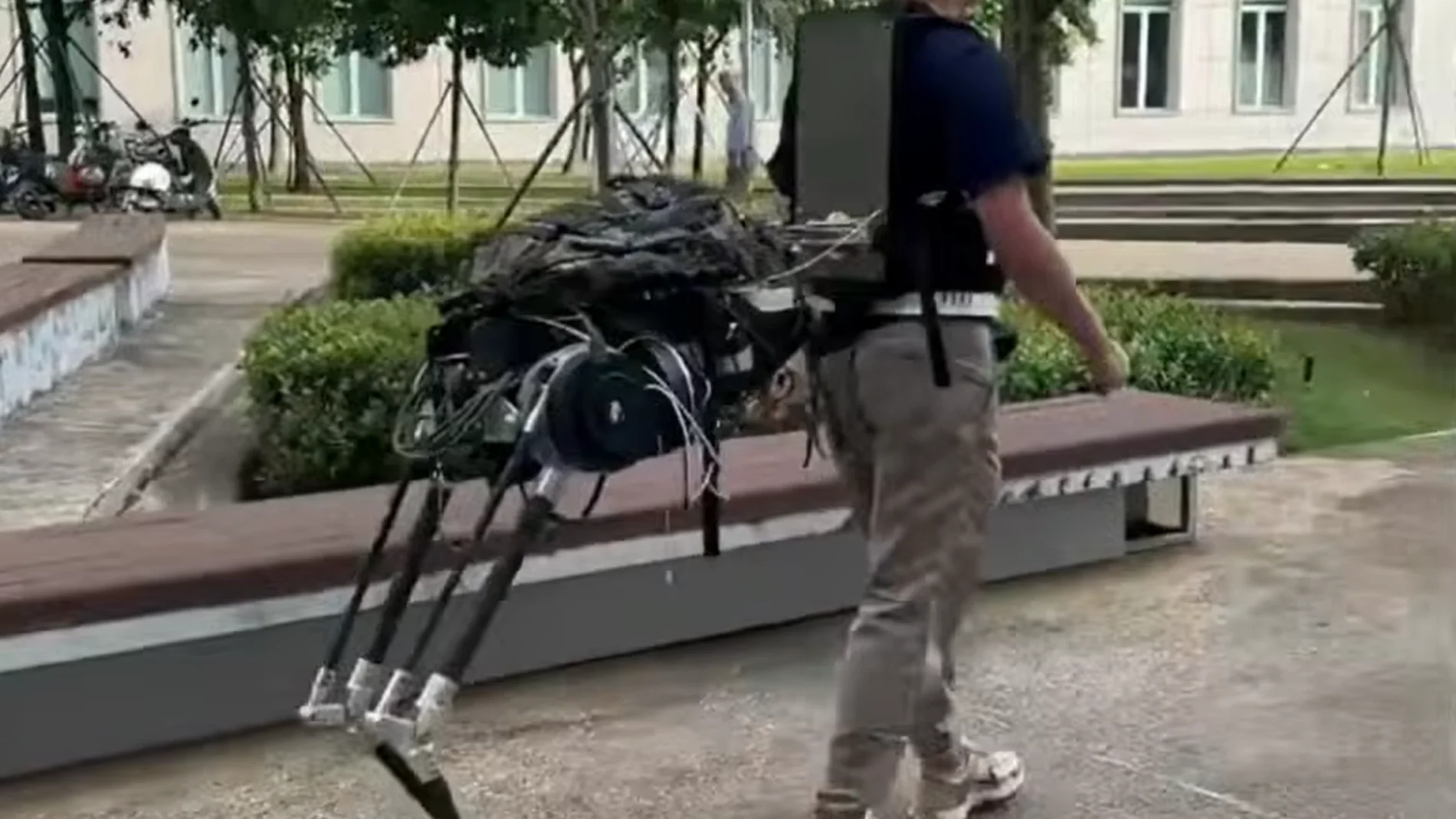
In Greek mythology, centaurs were half-man and half-horse creatures: beings capable of running long distances and carrying enormous weights thanks to the power of their four legs. For centuries, that image belonged exclusively to the world of fantasy.
Now, however, a group of Chinese engineers has developed a technology that is strikingly reminiscent of that myth: a robotic system that adds two mechanical legs to a person, creating a kind of human-machine hybrid capable of walking while carrying large loads.
The device, presented by scientists at the Southern University of Science and Technology in Shenzhen and published in The International Journal of Robotics Research, consists of a pair of robotic legs that connect to the user’s back using a flexible system. Instead of replacing human legs, the robot functions as a second pair of limbs that share the effort of movement, forming a structure reminiscent of a centaur.
Unlike traditional exoskeletons that fit directly to the user’s legs, This system works as an independent robot that walks behind the person, synchronizing its movement with that of the human body.
Through motion control and planning algorithms, The robotic legs detect the user’s direction, speed and pace to adapt in real time. This allows the system to cooperate with the person when walking, climbing stairs or traversing uneven terrain.
Experimental tests show that the device can significantly reduce physical effort. In experiments with loads of about 20 kilograms, the system decreased the user’s energy expenditure by approximately 35% and reduced pressure on the feet by more than half. In other words, the robot does not walk for the human: it walks with him.
The technology was initially designed for cargo transportation assistance, which could Be useful in logistics, rescue or industrial jobs where workers must transport heavy objects over long distances.
Those responsible for the advance, led by Chenglong Fu, point out that autonomous robots (such as the robotic dogs used by some armies) still have difficulties navigating complex environments or carrying large weights without consuming enormous amounts of energy.
The hybrid human-robot solution could avoid those problems: the human provides intelligence, balance and navigation, while the robot provides mechanical strength and carrying capacity. The inevitable question: military use? This type of technology has inevitably sparked speculation about possible military applications.
A soldier equipped with such a system could carry ammunition, sensors or heavy equipment for much longer without becoming exhausted. In combat or military logistics scenarios, that advantage could be significant. Although the current project is oriented towards research and physical assistance, The idea of augmented soldiers or “technological centaurs,” a form of cyborg that combines human mobility with robotic support, seems much closer.
This prototype is part of a broader technological trend known as human augmentation: the development of systems capable of expanding the physical or cognitive capabilities of the body. In recent decades we have seen the emergence of industrial exoskeletons, brain-controlled neural prostheses, and collaborative robots designed to work alongside people. The centaur system represents another step in that evolution.
This does not turn humans into mythological creatures, but it does raise a disturbing and fascinating idea at the same time: that, in the near future, the border between the human body and machines could become increasingly blurred. And maybe, Instead of replacing people with robots, technology ends up creating something different: humans who walk alongside their own machines.