
A former Pentagon advisor has publicly asked Donald Trump to recognize Ceuta and Melilla as “occupied Moroccan territory” and to encourage Morocco to launch a new Green March on the two autonomous cities. The article, published last Sunday in the “American Enterprise Institute”, one of the most influential neoconservative think tanks in Washington, is by no means an isolated outbreak, on the contrary, It is part of an intellectual offensive against Spain that has accelerated at the pace of the worst bilateral crisis with the United States in decades.
Michael Rubin, the author, was a civilian advisor to the Pentagon under George W. Bush and has been questioning Spanish sovereignty in North Africa for years. His proposal goes further than any previous text from a top American analyst: “Trump and Secretary of State Marco Rubio should correct another historical error and formally recognize Ceuta and Melilla as occupied Moroccan territory.”
Three days earlier, another Middle East Forum analyst, José Lev Álvarez Gómez, a veteran of the US Army and the Israeli IDF, had published a piece with a complementary approach, proposing to capitalize on the power imbalance that exists in the Strait of Gibraltar in favor of the North American country. It is important not to lose perspective. These texts are opinions of think tanks, not official positions of the US Government. No serving official has endorsed the idea. But the moment is what matters: They arrive when relations between Madrid and Washington are going through their worst moment since the withdrawal from Iraq in 2004.
It all started on February 28. The US and Israel launched Operation Epic Fury against Iran, the largest US military deployment in the Middle East since the invasion of Iraq. Spain refused to participate and closed the military bases of Rota and Morón to offensive operations.
The Minister of Defense, Margarita Robles, was categorical: “No type of assistance, absolutely none, has been provided from the Rota and Morón bases.” The Government invoked the 1988 Defense Cooperation Convention, whose article 24(1) guarantees the “full sovereignty and control of Spain over its territory and airspace.” Trump’s response, on March 3, was a bomb. “Spain has been terrible,” he said from the White House with German Chancellor Merz. «I have told Scott to cut all deals with Spain. We are going to cut all trade with Spain. “We don’t want anything with Spain.” He added, on the bases: “We could use their base if we wanted… We could just land and use it. “No one is going to tell us not to use it.”
Aircraft movement data recorded the departure of at least 15 US military aircraft from Rota and Morón, including nine KC-135 tankers. Four B-2 Spirit bombers crossed Spanish airspace during their return to Missouri after hitting Iran. The Government maintained that the airspace remained open due to international obligations, but denied operational use of the bases. A distinction that generated criticism from all sides.
What makes Rubin’s statements more than an editorial extravaganza is the context of the relationship between Washington and Rabat. Trump reaffirmed in August 2025 the recognition of Moroccan sovereignty over Western Sahara. Security Council Resolution 2797, of October 2025 and promoted by the United States, took for the first time the Moroccan Autonomy Plan as the basis for negotiations on the Sahara, without mention of the referendum. Mohamed VI described it as a victory. The American ambassador in Rabat, Duke Buchan III (who was ambassador to Spain between 2017 and 2021), has described Morocco as “a pillar of stability and an essential element in US national security.”
What if the play is repeated?
The Sahara precedent is what worries in Madrid. Trump recognized Moroccan sovereignty over that territory in December 2020 with a simple decree, as a bargaining chip for the normalization of Morocco-Israel relations. Could you repeat the play with Ceuta and Melilla to punish Spain?
Washington’s historical position has been one of well-measured neutrality. But that neutrality has cracks. In 2002, during the Perejil Island crisis, the then Minister of Defense Federico Trillo revealed that the United States offered Morocco the Chafarinas Islands and the Peñón de Vélez de la Gomera (Spanish) in exchange for its withdrawal.
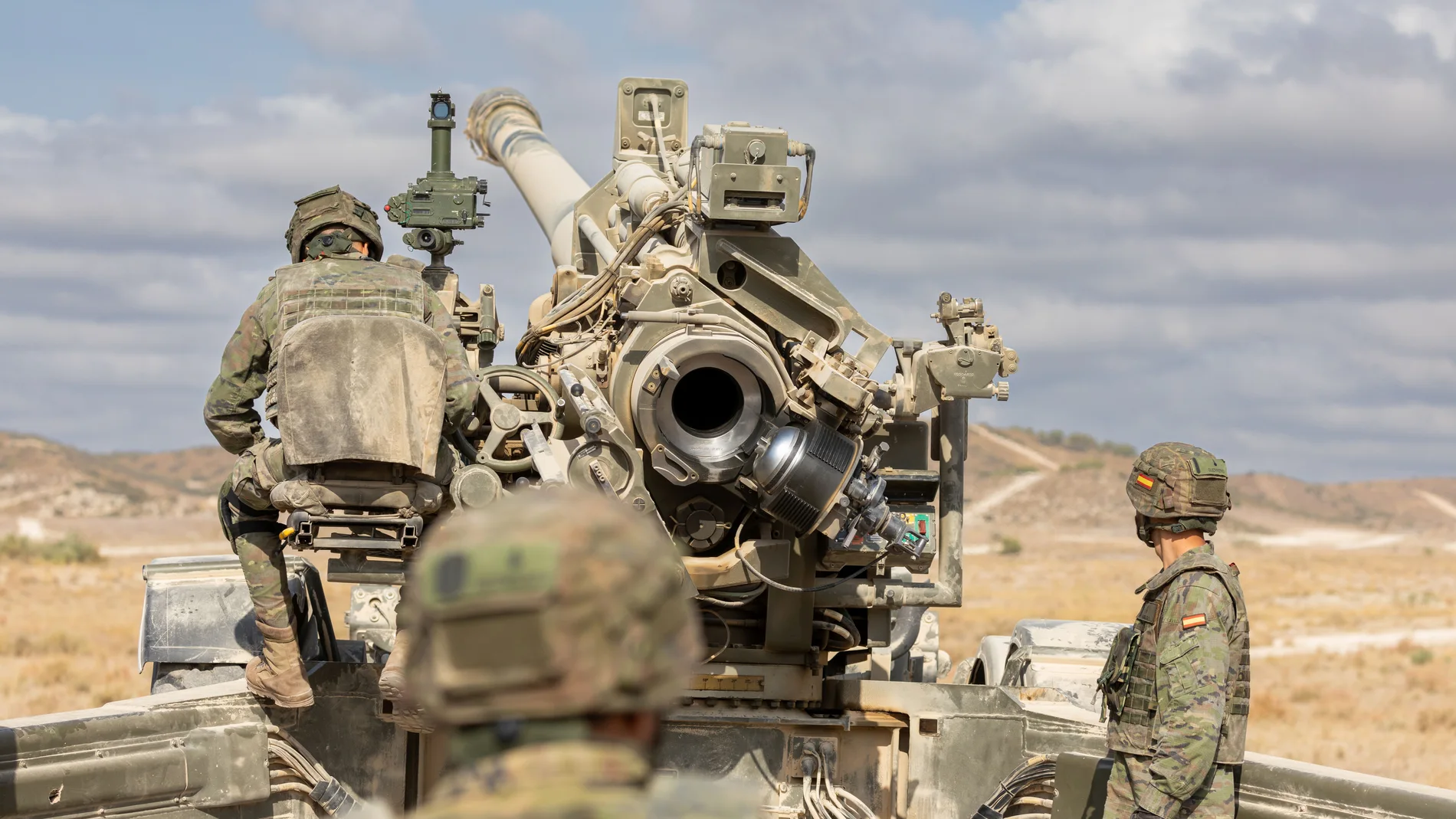
Can Spain defend its cities? Yes. At least today. Spain maintains substantial garrisons in both places: the 2nd Third of the Legion and the Group of Regulars No. 54 in Ceuta; the 1st Third of the Legion, the Group of Regulars No. 52 and the “Alcántara” Cavalry Regiment No. 10 (with Leopard 2 tanks) in Melilla. About 3,000 soldiers per city.
The reinforcement capacity is considerable. The Marine Corps (about 6,000 troops), based in San Fernando (Cádiz), has the strategic projection ship Juan Carlos I and is receiving 34 new amphibious combat vehicles. The Navy operates five Álvaro de Bazán-class Aegis frigates and the S-81 submarine, fully operational since 2025. The 11th Wing in Morón deploys Eurofighter Typhoon, superior to any Moroccan fighter in service. Spanish air and naval superiority is very extensive. But on land it is more complex, since Morocco has a large number of battle tanks and a somewhat larger army. But the gap is closing. Moroccan military spending as a percentage of GDP quadruples historical Spanish spending.
No serious security analyst today would contemplate a Moroccan military invasion of Ceuta or Melilla in the short term. Spain maintains military superiority, the cities are EU territory protected by Article 42(7), and the legal basis of Spanish sovereignty is solid: it predates the existence of the modern Moroccan state by centuries. Ceuta has been Spanish since 1415. Melilla, since 1497.
The real risk is another. It is slow erosion: commercial strangulation, instrumentalized immigration pressure, influence campaigns in Washington, demographic transformation and, now, the appearance of voices in American “think tanks” willing to convert sovereignty over both cities into diplomatic currency.
Rubin’s article in the AEI is not state policy. But the Western Sahara precedent shows that decisions on territorial sovereignty can be made in Washington quickly and without multilateral consultations. What differentiates Ceuta and Melilla from the Sahara is that both cities are territory of the European Union, with 170,000 European citizens, protected by treaties that the UN has never questioned.
Spain has increased its defense budget by 43% and reinforced its garrisons with Operation Reinforced Presence. What remains pending is what experts consider most urgent: activating the European dimension as a guarantee of security and building an international narrative that presents Ceuta and Melilla for what they are.
Not as “colonial enclaves”, which is the terminology already used by the “think tanks” aligned with Rabat, but as democratic European cities whose sovereignty predates the State that claims them by half a millennium.