
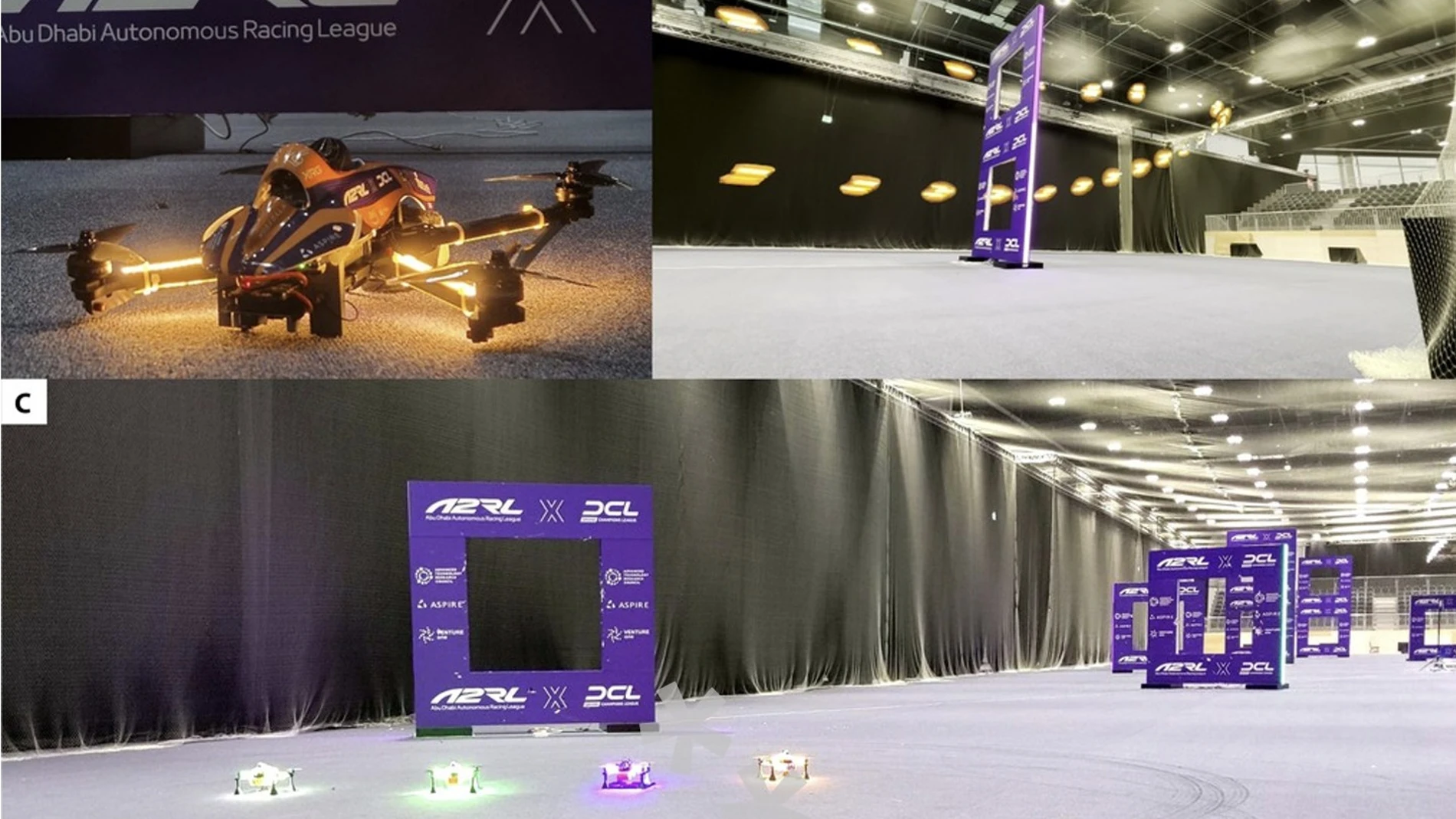
A camera, a handful of sensors and artificial intelligence capable of reacting in milliseconds. That’s all MonoRace needed to beat three world drone racing champions in a competition held in Abu Dhabi in April 2025. The system reached speeds of up to 100 kilometers per hour and demonstrated that a machine can compete at the highest level without resorting to external tracking systems. which until now facilitated autonomous navigation at high speed. The study describing the development is published in Science Robotics.
Autonomous drone racing is a much more complex technological challenge than it seems. The device must recognize the circuit, calculate its position, anticipate the necessary movements and adjust the thrust of its motors while passing through doors and making sharp turns. All of this at high speeds, when the movement of the aircraft itself distorts the images and the forces it supports can saturate its sensors.
Until now, some of the most advanced autonomous systems used stereoscopic cameras, capable of obtaining depth information from two points of view, and external motion capture systems to precisely know the position of the drone. MonoRace dispenses with these aids. Its perception depends on a single monocular camera with a rolling shutter (which records different parts of the image at slightly different times) and an inertial measurement unit, or IMU, which measures accelerations and rotations.
The challenge is not only to see, but to interpret what you see quickly enough to act before it is too late. To achieve this, The system uses a neural network that identifies the circuit gates in the images and combines that information with a mathematical model of the drone’s movement. Because the organizers provided the dimensions and layout of the doors, the team was able to take advantage of that known geometry to improve position calculations and adjust the camera calibration based on data collected during the flight.
The second decisive element is control. Instead of calculating a trajectory and letting several conventional controllers execute it, MonoRace uses a neural network that directly converts the estimate of the drone’s state into commands for the motors. The system operates at 500 hertz: it updates its instructions 500 times per second, that is, every two milliseconds, a reaction 100 times faster than the of Formula 1 drivers. Trained through reinforcement learning in simulations, the network learned to adjust flight and then transferred that strategy to the real thing.
The test took place on April 11 and 12, 2025, on an indoor track in Abu Dhabi with eleven square gates. The main challenge was to complete two laps in the shortest time possible. In the tournament of direct confrontations between humans and machines, the elite pilots were able to practice beforehand with the same drone model used in the competition, which made it possible to compare their performance in more equivalent conditions.
MonoRace won the main autonomous challenge and successively beat three world champion-level human pilots in the knockout rounds. His best recorded time to complete the course was 16.56 seconds. On the track it reached a maximum speed of 28.2 meters per second, equivalent to about 101 kilometers per hour.
The result does not mean that the machine has surpassed humans in all piloting skills. The test evaluated a very specific task, on a known circuit and with a defined device and conditions. But if demonstrates that artificial intelligence can execute high-speed maneuvers with a response capacity comparable to or superior to that of the best pilots in that scenarioeven with limited perceptual resources.
The system also had to face unexpected problems. Intense vibrations and accelerations could push the IMU to its measurement limit, while electrical interference corrupted part of the camera images. To reduce errors, the team combined visual observations with predictions from a dynamic model of the drone and discarded data that didn’t fit the expected motion. In the tests described, the device was able to complete the circuit even when half of the frames were damaged. However, there is still an important limitation: MonoRace does not have a system to detect and avoid other drones in mid-flight. This deficiency was evident in a test with several aircraft, in which he finished in third position after colliding with another aircraft.
The authors believe that the technology could have applications beyond racing. Fast and efficient autonomous navigation could expand the possibilities of drones in inspection, transportation or search and rescue tasks. To get there it will be necessary to adapt the system to unknown environments, moving obstacles and more varied flight conditions.
For now, MonoRace demonstrates something more concrete, but significant: a machine that sees the world through a single camera can interpret a circuit, react in milliseconds and defeat elite drivers. The next challenge will not only be to fly faster, but to do so safely when the world in front of you is no longer a perfectly familiar runway.