
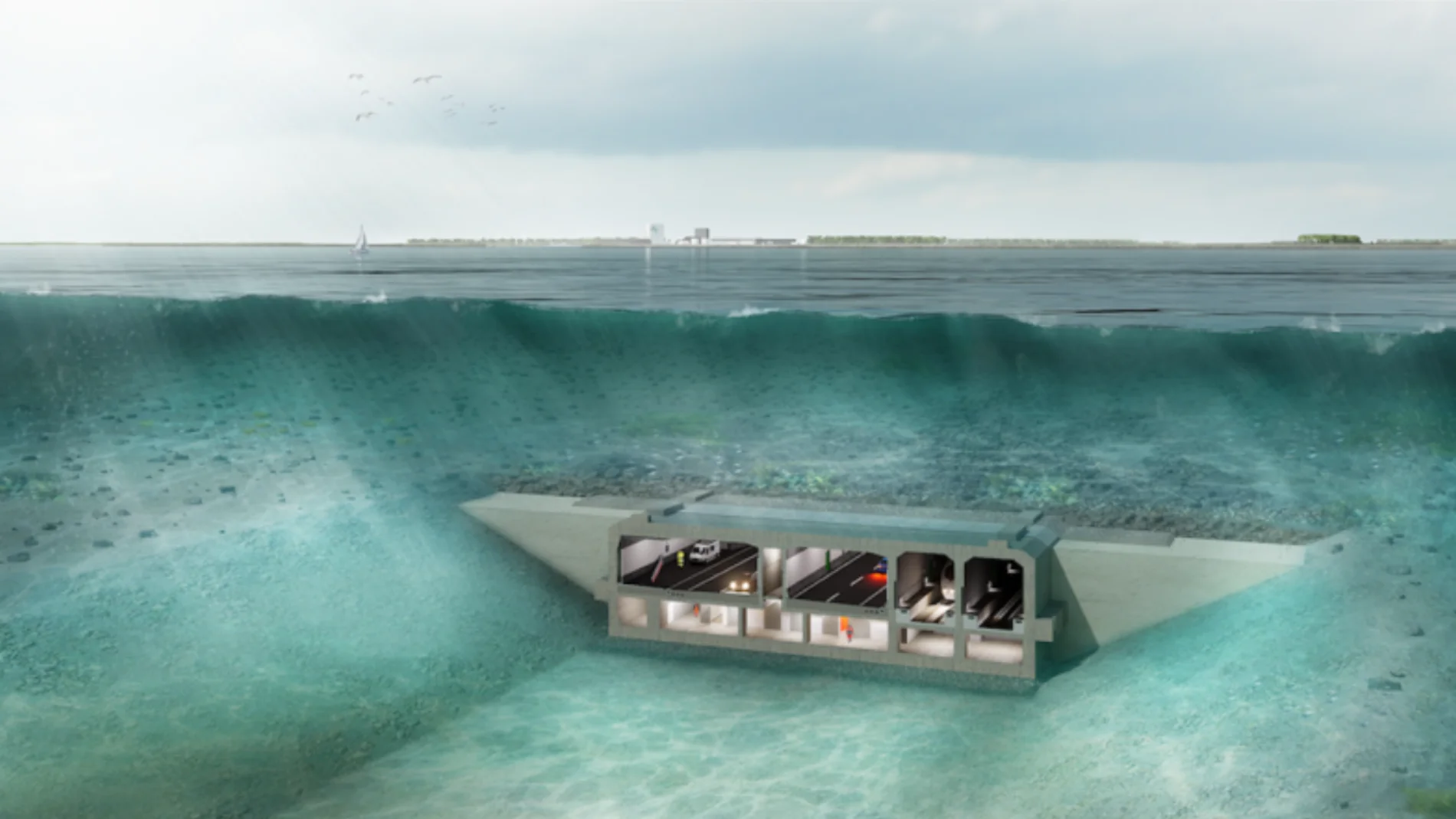
There are engineering works that start with a drilling machine and others that require something much more similar to a boat factory. The tunnel that will link Denmark and Germany under the Baltic Sea belongs to this second category. To build it, you are not digging a gallery through the rock or advancing with a tunnel boring machine under the seabed. The engineers have chosen a different solution: Manufacture huge hollow reinforced concrete structures on land, transport them by water and submerge them in a prepared trench on the seabed. A kind of gigantic underwater puzzle whose pieces weigh more than 73,000 tons.
The Fehmarnbelt project will connect the Danish island of Lolland with the German island of Fehmarn through an 18 kilometer tunnel. When it enters service, it will be the longest submerged tunnel in the world and It will allow you to cross the strait in about ten minutes by car or seven by train. Inside there will be a highway with two lanes in each direction and two electrified railway tracks. The infrastructure is part of the European Scandinavia-Mediterranean corridor, which aims to improve connections between the north and the center of the continent.
The first great peculiarity is on land. In Rødbyhavn, on the Danish coast, a gigantic factory has been built dedicated exclusively to producing the elements that will make up the tunnel. They are manufactured there 79 standard pieces and another ten special ones, which incorporate a lower level intended to house technical installations. Each conventional element measures 217 meters longthe equivalent of two football fields, and weighs about 73,500 tons. Five ducts are distributed inside: two for vehicles, two for trains and a central one for facilities and services.
Production works almost like an industrial assembly line. Each standard element is built from nine segments of about 24 meters. The concrete is poured into molds inside large air-conditioned warehouses, where manufacturing conditions allow quality control and reduction of variations between pieces. The segments are joined together until a structure is completed that can take around nine weeks to manufacture. The factory has several production lines and its own concrete plants, capable of supplying hundreds of cubic meters per hour. But manufacturing a piece of such size is only half the challenge. Before moving it, the ends are closed with large watertight bulkheads, so that water cannot enter inside. Thus, the structure can float during transport. Ballast tanks are then installed and concrete is added to increase its weight. The objective is to ensure that the piece stops behaving like a boat and can descend in a controlled manner to the seabed.
Meanwhile, a trench approximately 18 kilometers long has been dug in the strait. For this, a tunnel boring machine has not been used, but rather a fleet of dredgers and specialized vessels that They have removed nearly 15 million cubic meters of sand, rock and sediment (enough to fill 6 million dump trucks). The bottom is then prepared with a layer of gravel that serves as support and allows each element to be placed in the planned position. Once installed, it will be covered with protective materials to keep it stable and protect it from currents and activities that may take place on the seabed.
After the transfer, comes the immersion, another operation of extraordinary precision. Tugboats carry each structure from the factory to the installation area, where special pontoons hold it in place and control its descent using cables and ballast systems. The piece must be placed in the trench and aligned with the previous one with a margin of error of just a few millimeters. To achieve this, measurement, positioning and control systems are used, as well as underwater equipment that supervises the maneuvers.
The union between two elements also has some hydraulic engineering. Once faced, the ends are separated by a temporary chamber delimited by watertight bulkheads. When water is extracted from that space, The external pressure pushes the two structures against each other, compressing a special gasket that guarantees watertightness. The temporary barriers are then removed and the two sections become part of a single continuous structure. It is a solution that takes advantage of the water’s own pressure to achieve an airtight union.
The operation has already stopped be a project on paper. The first element was submerged in May 2026 and, by the end of September, four pieces had already been installed, totaling nearly 900 meters of tunnel. The next major operation will be the placement of the first special element, which It incorporates an additional technical level and reaches approximately the height of a four-story building. The manufacturing of the remaining structures continues in parallel.
The calendar, however, has suffered delays. Difficulties with specialized equipment to submerge the pieces and environmental and administrative restrictions in German waters have complicated the work. In addition, the rail connection on the German side is accumulating delays. Therefore, Those responsible for the project have proposed an opening in two phases: first the road would come into operation and, later, the railway. The final date will depend on the evolution of the works and the land installations.
When completed, the tunnel will replace the current ferry journey between Puttgarden and Rødby, which takes around 45 minutes, with a journey of just a few minutes. But its importance goes beyond saving time. It will make it possible to strengthen rail transport of goods and passengers between Scandinavia and the rest of Europe, reducing detours and providing an alternative to airplane and road transport.
The Fehmarnbelt shows that to cross the seabed it is not always necessary to drill through it. Sometimes it is more efficient to build the tunnel in daylight, piece by piece, and then carry it to its final location. The difficulty It is not about excavating kilometers of rock, but about getting dozens of gigantic concrete structures under water.fit together with almost no margin for error and remain united for more than a century.