
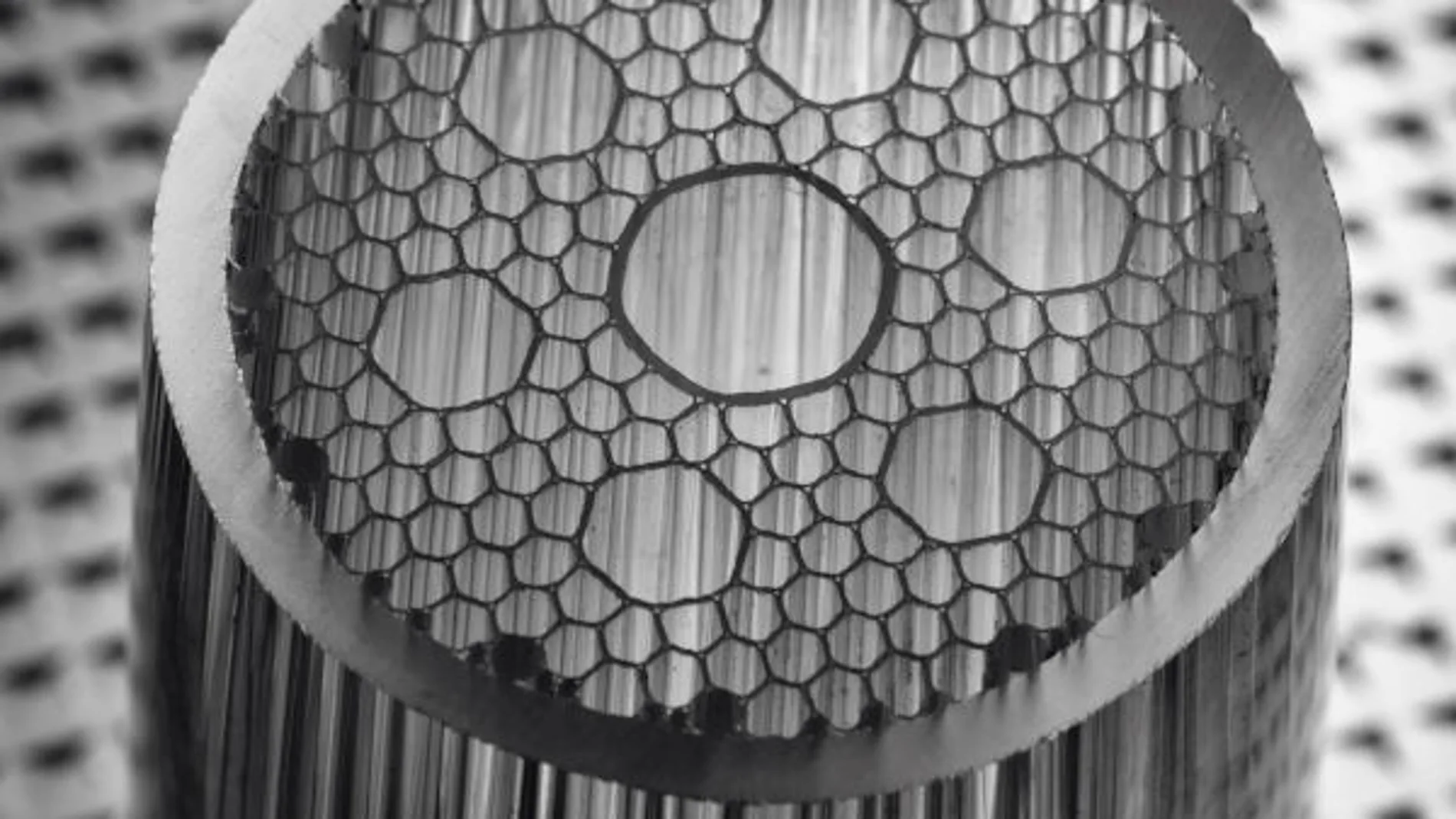
Just a few days ago the Chinese state company Information and Communication Technologies (CICT)based in Wuhan, announced that it had transmitted 3.2 petabytes of data per second through a single strand of fiber optics.
A new world record
A petabit It is equivalent to one thousand terabytes, or one million trillion byts. To understand the magnitude of this figure, in 2007, the entire world population stored approximately 2,360,000 petabits of data. At 3.2 petabits per second, a single fiber optic cable Chinese could have transferred all this global digital information in just over 12 minutes.
The experiment, carried out with the laboratory Peng Cheng in Shenzhen and the Sino-Japanese company FiberHome Fujikuraexceeds by almost a 30% the record previous world championship, which the same team had since last March, with 2.5 petabytes per second.
How have they done it?
A optical fiber conventional contains a single glass corea transparent fiber that carries pulses of light that encode information. His current physical limit is around 0.1 petabytes per second.
The Chinese engineers’ solution was to integrate 24 of these cores in a single thread conductor and design the geometry meticulously so that the signals did not interfere with each other from one core to another. Within each of these nuclei, light is channeled through three color ranges different: the S, C and L bands of the infrared spectrum, each divided into hundreds of channels. In total, several thousand light paths that run in parallel inside a cable just a few millimeters in diameter, along 10.3 kilometers.
This system works with coherent optical modules commercially availablethat is to say, hardware that the industry already knows how to mass produce. No sophisticated laboratory prototyping or signal post-processing is required.
What is the next objective?
Ten kilometers are equivalent to size of a university campus or the distance between two neighboring data centers. So, for this technology to really serve national networks and, subsequently, international, it will be necessary to overcome barriers of several orders of magnitude, redesign amplifiers, connectors and splicing techniques. Although, above all, demonstrate that his cost is sustainable on a large scale.
For the moment, the multicore fibers They are still highly sophisticated pieces of engineering, but the CICT team has no intention of stopping there: has already set the goal of reaching a new milestone of 10 petabytes per second next year. That is to say, triple the record current.