
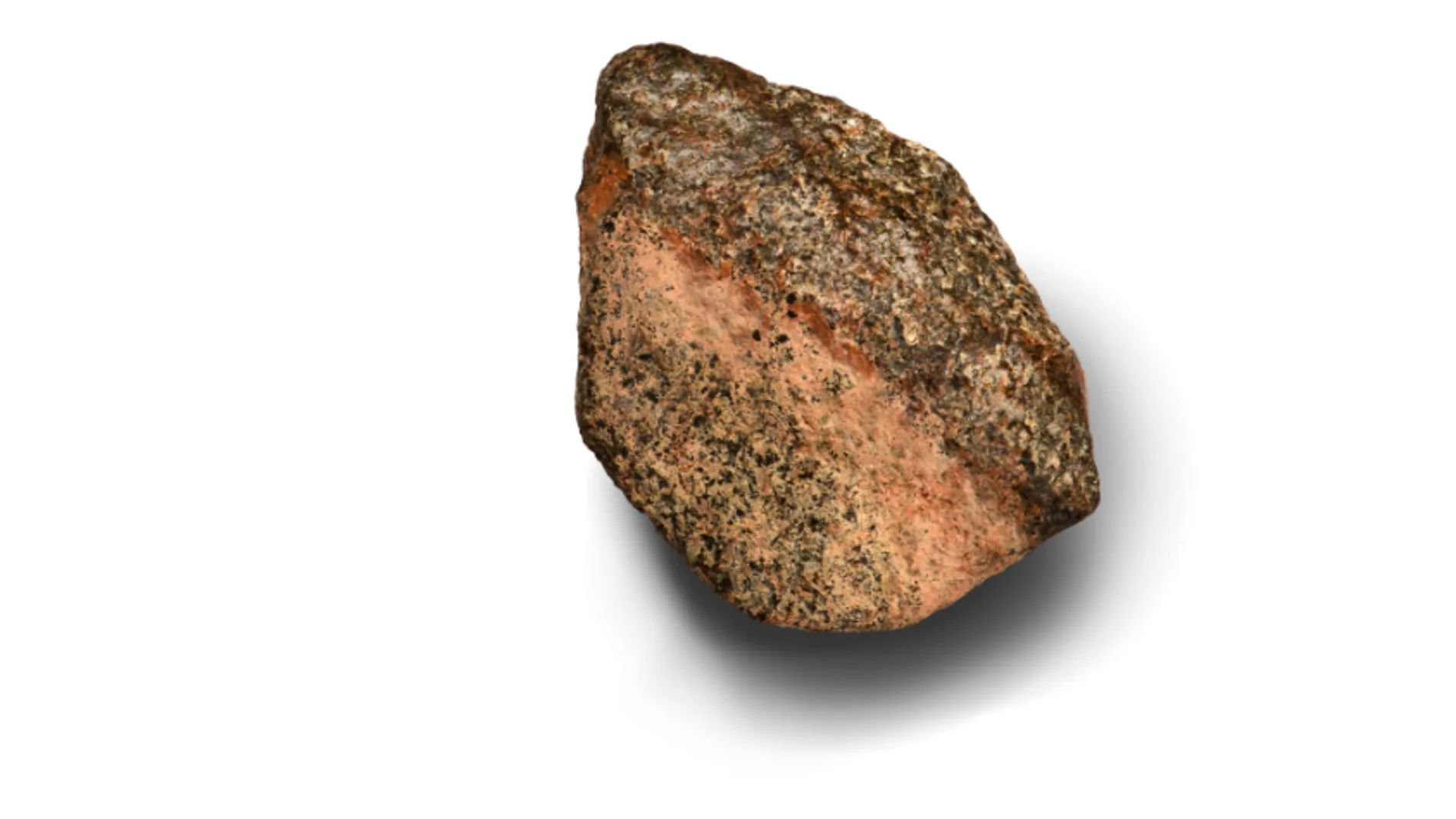
It is a rock of just 800 grams, the weight of 5 medium oranges, but it has traveled from the early days of Mars to a terrestrial laboratory to tell a story of more than 4.1 billion years. His name is Teghaza 001, a meteorite found in the Sahara in 2022, but its true importance was not known until scientists studied its minerals. What looked like just another stone turned out to be an exceptional sample of the primitive Martian crust, formed when the planet was still defining its structure and water interacted with its rocks.
The discovery, described in Scienceallows us to peer into a remote stage of the evolution of Mars. Most of the Martian meteorites identified so far come from much younger rocks. Teghaza 001, on the other hand, belongs to a time when the planet had a very different geology from today. Its composition and texture offer clues about how its first rocks were formed and what happened later, when water altered some of its minerals.
The first challenge was determining its age. The authors of the study, led by Yang Liu, found small crystals of zircon in the rock, a mineral especially valuable for geology because it can preserve information about the time when it was formed. By analyzing its isotopes, Liu’s team established that the meteorite originated at least 4.1 billion years ago. To get an idea of that time distance, the Earth was then also at a very early stage in its history, just a few hundred million years after the formation of the solar system.
But age is not the only thing that makes Teghaza 001 special. The rock contains a combination of igneous minerals (formed from the cooling of magma) that allows us to reconstruct part of the evolution of the Martian crust. Its composition corresponds to a rock known as gabbroic diorite, rich in minerals that crystallized from molten material. Unlike other ancient Martian meteorites, which bring together fragments of different rocks, this sample preserves a type of rock that offers a more direct reading of that geological environment.
The story does not end when the magma cools. Some of the minerals from Teghaza 001 show signs of later alteration by fluids that circulated through the rock. The chemistry and isotopes studied point to an interaction with Martian water about 4.1 billion years ago. This is not proof that there was life, but rather evidence that water participated in the geological processes that transformed part of the planet’s crust.
The sample could also help reveal regions of Mars that have not yet been directly studied. With this in mind, Liu’s team compared its mineralogy and chemical composition with observations made from orbit by the Mars Reconnaissance Orbiter. The result was a list of 13 possible provenance zones, several of them located in the ancient highlands of the southern hemisphere, a region hit hard by impacts and that preserves part of the planet’s earliest history. However, it is not possible to identify with certainty the exact place from which the rock was thrown.
According to a NASA statement, the authors consider that future research will be able to extract more information from the sample, whose analysis has only just begun. Its composition may help guide the search for other ancient rocks and select sites of interest for future missions.. It also offers a reference with which to interpret the data obtained by vehicles exploring the Martian surface.