
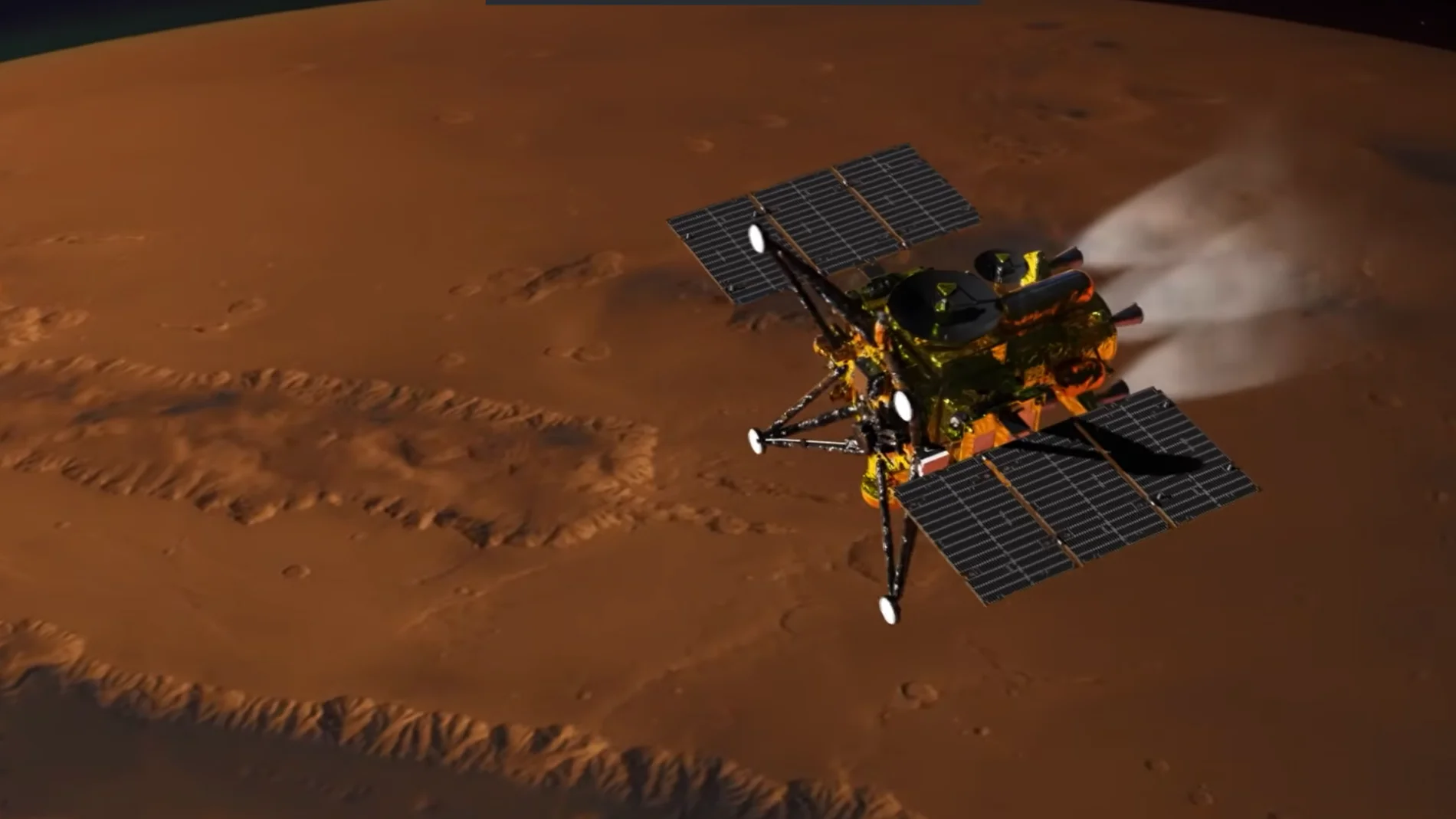
Mars has two moons, but we still don’t know exactly where they come from. Phobos and Deimos could be asteroids trapped by the red planet’s gravity or the remains of a gigantic collision that spewed Martian material into space. Solving this enigma requires more than observing them from afar: you have to touch their surface, collect fragments and analyze them on Earth. That is the ambition of MMX, the Japanese mission that plans to take off today, October 19, to bring back the first samples from a Mars moon. There will be a live broadcast that can be followed from one hour before the launch, starting at 8:45 p.m. peninsular time.
The Japanese space agency JAXA ship will travel aboard an H3 rocket from the Tanegashima Space Center. If the schedule holds true, it will reach the vicinity of Mars in August 2027 and An exploration campaign will begin that will last for years. Its return is scheduled for 2031, when a special capsule will deposit at least ten grams of material collected on Phobos on Earth. It is not a spectacular amount, but its scientific value can be enormous.
The first challenge will be to figure out what kind of world Phobos is.. About 20 to 30 kilometers in diameter, this irregular moon orbits just about 6,000 kilometers from the Martian surface and completes about three orbits of the planet each day. Despite the number of probes that have visited Mars, its satellites remain little explored territories. The available observations have not allowed us to resolve its origin, an issue that also affects our understanding of how the bodies of the solar system formed and evolved.
If Phobos is a captured asteroid, its composition could offer clues about the materials that circulated in the early solar system and how substances such as water were distributed. If it was born from the remains of a major collision with Mars, however, it would retain information about the planet’s conditions at an early stage in its history.. Additionally, for billions of years, impacts on Mars have ejected rocks into space. Some of that material could have ended up deposited on the surface of its moons. A sample from Phobos could therefore contain small pieces of Martian history.
MMX won’t just collect dust. The spacecraft will study Phobos from different orbits and deploy Idefix, a small exploration vehicle jointly developed by the French space agency CNES and the German Aerospace Center (DLR). With about 25 kilos of mass, the rover will have to move in an environment where gravity is so weak that its weight would be approximately equivalent to that of 15 grams on Earth.. Your job will be to analyze the texture and characteristics of the surface and help prepare landing and sample collection operations.
The collection will combine two techniques. A pneumatic system will use pressurized gas to lift surface material and convey it to a container; another device will drill the ground up to about two centimeters deep. The objective is to obtain material from two points on the surface. It may seem like a modest operation, but landing and maneuvering on Phobos requires extraordinary precision: too intense a push could cause the ship to bounce or move away from the moon.
Herein lies one of the great advantages of bringing samples home. A probe must carry instruments that are compact, resistant and capable of operating autonomously over millions of kilometers. In terrestrial laboratories, however, scientists will be able to use much larger and more sensitive equipment to measure chemical and mineralogical composition, search for organic compounds and compare the material with meteorites and samples from other celestial bodies. And they will be able to repeat the analyzes as the techniques improve. As JAXA explains, “a returned sample can continue to offer discoveries long after the mission has ended.”
The project is also a technology demonstration. MMX will be the first mission to return to Earth after visiting the Martian system and the first to bring back samples from a moon other than our own. The capsule will pass through the atmosphere and land in Australia; Afterwards, the material will be transferred to Japan for extraction, cataloging and distribution among scientific teams. The mission brings together JAXA with NASA, ESA, CNES and DLR, a collaboration that provides instruments, communications and expertise in navigation and planetary exploration.
Phobos is also a natural laboratory to prepare future missions to the red planet. Understanding its terrain, its gravity and the behavior of ships in its vicinity will help design more complex operations in the Martian system. But the most lasting reward might be locked in those few grams of dust and rock. Sometimes, To reconstruct the history of an entire planet, it is enough to bring home a small fragment from one of its neighboring worlds.