
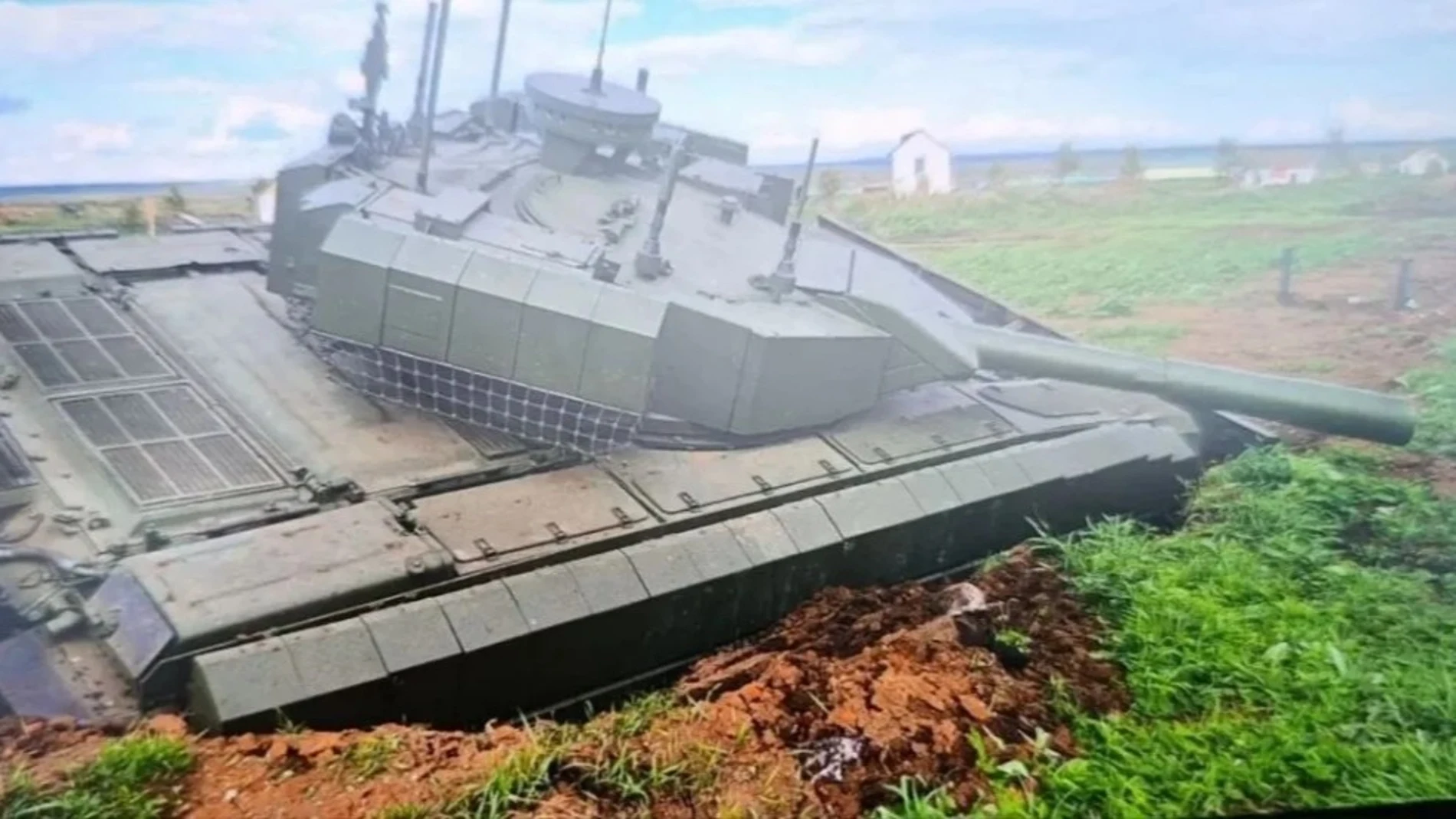
The war in ukraine The robotization of the battlefield continues to accelerate and one of the latest examples has been seen in the maneuvers Tsentr-2026held between September 28 and October 3 at the Chebarkul training camp, in the Chelyabinsk region, although not without setbacks. There, the Russian Army tested the use of unmanned armored vehicles, based on the T-72B3M tank, to provide fire support to assault unitsaccording to TASS.
During tests, these vehicles made brief stops to fire at targets and then moved to new firing positions. However, one of them ended up stuck in the mud on the penultimate day and in the presence of Vladimir Putinaccording to Russian sources collected by Defense Blog. Precisely, the presence of the president that day made the robot tank It will have a human pilot controlling it, but it was not enough. In addition, interruptions between communications between the vehicle and the control vehicle were constant according to the media.
The demonstration included two configurations with different combat modules, one tank type and one BMPT typethe Russian name for tank support combat vehicles. TASS does not relate them to the robotic assault armored program Shturmalthough the Ukrainian media does.
The Russian authorities estimated the participation at more than 47,000 soldiers and about 700 units of military material were used, more than 600 drones and more than 60 robotic systems. These are They were in charge of transporting ammunition, providing logistical and fire support and helping to overcome obstacles, while the FPV drone teams and anti-drone groups acted.
The Shturm program
The Shturm program is based on work that the Russian tank manufacturer Uralvagonzavod unveiled in 2018, according to Army Recognition. The project takes advantage of the platform T-72 to be able to send heavy remotely controlled vehicles to dangerous positions while their operators remain in another protected armored vehicle.
The projected family of vehicles includes one with 125mm cannon shortened and another equipped with two 30 mm automatic cannons. It also includes a vehicle equipped with Shmel thermobaric launchers and another armed with 220mm thermobaric rocketsalthough it is not confirmed that the four participated in these maneuvers.
The version armed with a cannon has a D-414 smoothbore, an automatic loader 22 projectilesa front shovel and reinforced protection. Your tube has been shortened to about four meters to facilitate maneuvers through narrow streets and among debris, as it protrudes less from the vehicle. Besides, the design requirements collected by Russian media demand retain combat capability after 10 to 15 hits from anti-tank grenade launchers and a mine explosion.
Along with those four combat configurations, the program requires a manned command vehiclealso on a T-72 family chassis, from which to control several armored vehicles up to about three kilometers away. Russian information mentions a speed of about 40km/h under remote control and the conservation of conventional controls to be able to drive them from within when necessary.
These are not autonomous tanks, since human operators maintain control of movements and the use of weapons. This dependency makes communications an essential elementbecause its interruption can prevent the armored vehicle from completing its mission, even if it remains intact.
The Russian Ministry of Defense assures that the system uses several control channels and is resistant to interference, with duplication of especially vulnerable componentsbut according to Russian weapons expert Andrei Tarasenko it is not enough. Quoted by Defense Blog, he points out that “the idea of this vehicle seems unwise to me: it depends on a command post that has to be 3 or 4 kilometers away and in direct line of sight. Without adequate communications such as Starlink, or something similar, a vehicle like this makes no sense.”