
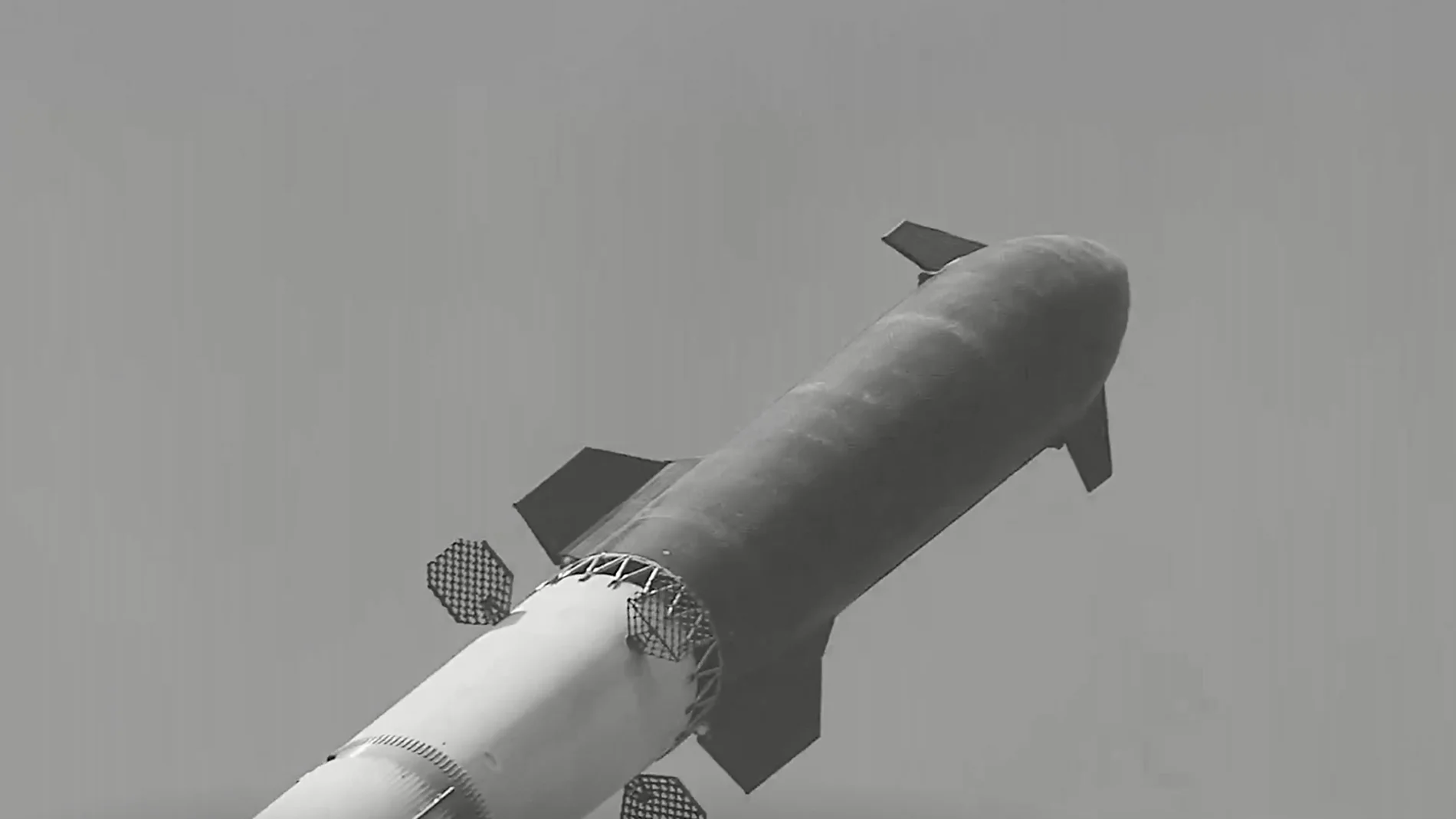
The mega rocket Starship of SpaceX completed its first orbital flight this Monday, deploying 26 satellites Starlink V3 and ditched its two stages in a controlled manner. The fourteenth test flight of the vehicle has fulfilled its main objectives, although the company has had to advance the return to Earth of the second stage Starship, also known as ship. His flight, of about ten hours planned to make six trips around the planet, has been reduced to just over three after a failure in one of the six Raptor engines that propel it and which questioned whether it would even reach orbit.
The launch took place from the facilities of starbasein Texas, at 2:49 p.m. in peninsular Spain. The propellant Super Heavy landed in the Gulf of Mexico around 2:56 p.m., while the ship Starship He did it in the Pacific, north of Hawaii, around 5:57 p.m., after three hours and eight minutes of flight.
Liftoff of Starship! pic.twitter.com/40D8bXSkr2
— SpaceX (@SpaceX) September 28, 2026
Starship’s Raptor engines ignite during hot-staging separation. Super Heavy boosted back towards its splashdown site in the Gulf of America pic.twitter.com/0DcBz1wayt
— SpaceX (@SpaceX) September 28, 2026
Previous flights had followed suborbital trajectories that returned it to the atmosphere without completing a return to the Earth and lasted approximately one hour. This time, about 25 minutes after takeoff, has managed to place itself in orbit at about 275 kilometers high, propelled by one of its Raptor engines.
Orbit entry has been in doubt after one of Ship’s six engines shut down during ascent. Controllers have checked their status before finally authorize the maneuverwhich required maintaining enough backup systems to later execute the necessary power-up to return. This circumstance is what has led SpaceX to shorten the duration of the flight, which is still the longest that the enormous rocket has ever carried out.
Starship performs its orbital insertion burn and enters orbit of Earth for the first time pic.twitter.com/LodrSTnEnl
— SpaceX (@SpaceX) September 28, 2026
The @Starlink team has made contact with all 26 satellites https://t.co/qiAubuhytS
— SpaceX (@SpaceX) September 28, 2026
The deployment of the 26 operational satellites was completed just over an hour after takeoff. Each Starlink V3 is designed to provide one terabit per second of capacity to the network and three of them incorporated cameras to observe Starship’s heat shieldan inspection that will help prepare for future returns to base.
After ditching in a controlled manner and turning off the engines, Super Heavy has exploded in a non-accidental wayit was SpaceX testing the flight termination system.
Ship, for its part, has overcome reentry and completed its descent with a splashdown that was also controlled but more abrupt than on the last occasion. Moments after landing in the water, it overturned and exploded, unlike what happened last July with Flight 13..
Super Heavy has splashed down in the Gulf of America! pic.twitter.com/pEIjC2Aae1
— SpaceX (@SpaceX) September 28, 2026
Splashdown confirmed. Congratulations to the entire SpaceX team on the first orbital flight of Starship! pic.twitter.com/urjmiwnvNl
— SpaceX (@SpaceX) September 28, 2026
So, Starship remained floating intact for several weeksso that it could be towed to Australian waters next to Christmas Island. After a first analysis and collection of samples from the heat shield, it was loaded into the Fortea semi-submersible vessel that sank its deck to place the ship on top and raised it again. The ship left on August 28 for Texas so SpaceX can continue studying it.
Starship has now been loaded onto a semi-submersible ship to begin the several month journey back to Starbase. Congratulations to the entire SpaceX Recovery team for battling through challenging conditions to give our engineers access to a wealth of data to continue rapidly… pic.twitter.com/YSWcJvfIwz
— SpaceX (@SpaceX) August 27, 2026
From the tenth test in August 2025, the upper stage chains five flights that reach landing without getting lost during climb or reentry. This streak does not mean that there were no incidents, because Super Heavy suffered return problems and abrupt landings on flights 12 and 13. The booster, on the other hand, has already been captured upon its return to the launch tower on three occasions, on flights 5, 7 and 8.
Today’s has been the third flight of the third generation of Starship. The largest rocket ever built measures 124 meters highequivalent to a building 40 plantsby nine in diameter and uses 39 Raptor engines33 in Super Heavy and six in the ship, fueled by liquid methane and oxygen.
SpaceX’s design includes transporting more than 100 tons to Earth orbit and completely reuse both stages. To achieve this, the company must perfect the return to base and the capture with the arms of the launch tower, an operation that Musk announced weeks ago that it would be done for the first time with Ship on this flight, but was finally scrapped and did not appear in the mission program.