
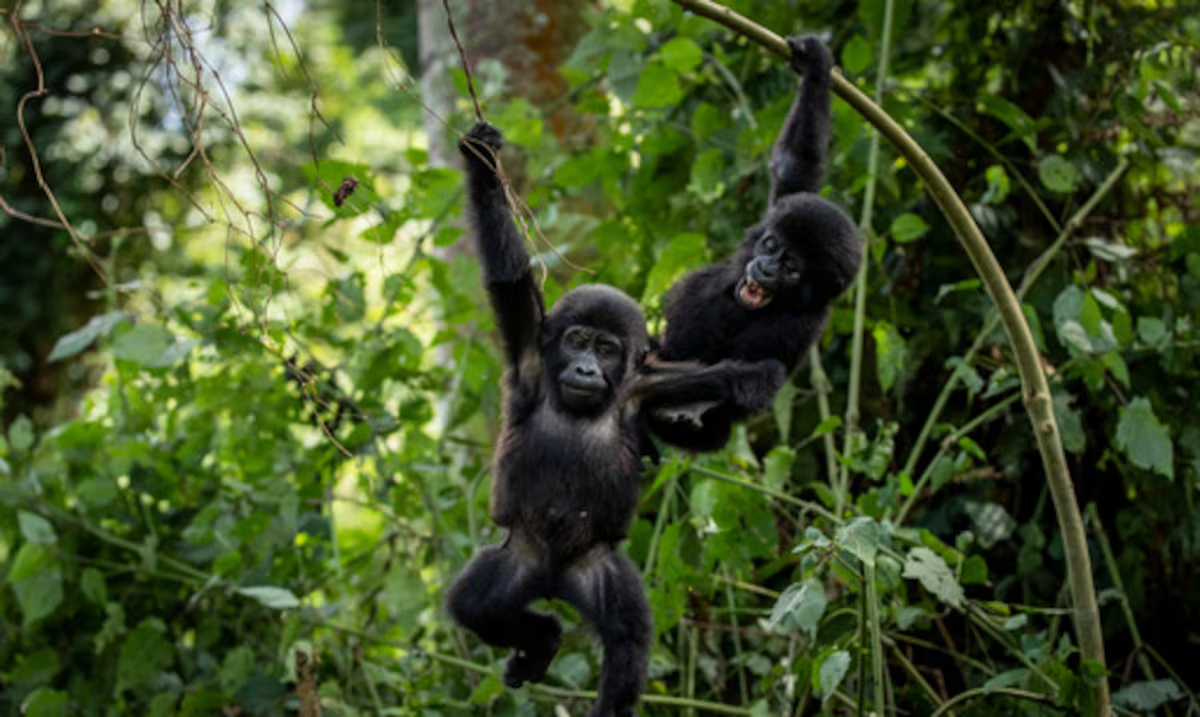
BWINDI, Uganda — In the thick vegetation of a Ugandan national park, mountain gorillas sit impassively among the leaves as tourists wander into their forest home.
Many families of gorillas are accustomed to human presence, but, although their population is growing, the forest area available to them is not.
Communities have planted trees for medicinal, firewood and craft purposes along the boundary of Bwindi Impenetrable National Park, aiming to reduce pressure on gorilla habitats.
The idea is simple: If residents can find the trees they need outside the park, they will have less reason to cut them down inside the forest.
The Bwindi forest is home to around 450 mountain gorillas, which is almost half of the remaining world population. A study carried out in 2018 placed the global population above 1,000 individuals, which represents a significant recovery for a subspecies that once faced possible extinction.
“As a resident of the park, I understand that the number of gorillas is increasing, but the forest habitat is not growing,” said Christina Katushabe, founder of Change a Life Bwindi.
His organization supplies useful trees, rehabilitates degraded land and, at the same time, improves biodiversity. Katushabe explained that members of the Batwa, an indigenous community that has collaborated in guiding the project, select the species that are used for medicinal purposes, for the production of wood and as firewood.
The Uganda Wildlife Authority distributes seedlings, including medicinal trees that people might otherwise go looking for inside the park.
Joseph Muhindo, deputy head of tourism and hospitality at the authority, said residents can collect what they need in their communities “without disturbing the gorilla habitat.”
The International Union for Conservation of Nature classifies mountain gorillas as “endangered,” an improvement from their previous classification as “critically endangered.”
Tourism has contributed to that recovery. Visitors tour the forest to observe gorilla families that have become accustomed to human presence, generating jobs and income for nearby communities. Residents also sell locally made crafts.
Eunice Owembabazi, a member of a women’s craft group, said planting trees near the park means “neither we nor the gorillas bother each other.”
The campaign has been extended to surrounding schools, where students plant trees that their families can use.
“Now we are going to protect the forest, so that our gorillas can continue to be well,” said Davis Musinguzi, a student at Ruhijja Seed Institute.
This story was translated from English to Spanish with an artificial intelligence tool and was reviewed by an editor before publication.