
According to the World Health Organization (WHO), this is one of the most important problems facing global health. Starting in 2050, it will take the lives of 10 million people annually and its cost to the global economy will be very high if we do not manage to change the forecasts. To this we must add that resistance to antibiotics has a dangerous paradox: while bacteria learn to avoid them in a “short time,” discovering and developing new drugs requires years of research. An alternative is to look at the drugs that already exist in a different way. Perhaps among them there is one that, in addition to what it was designed for, hides a second use.
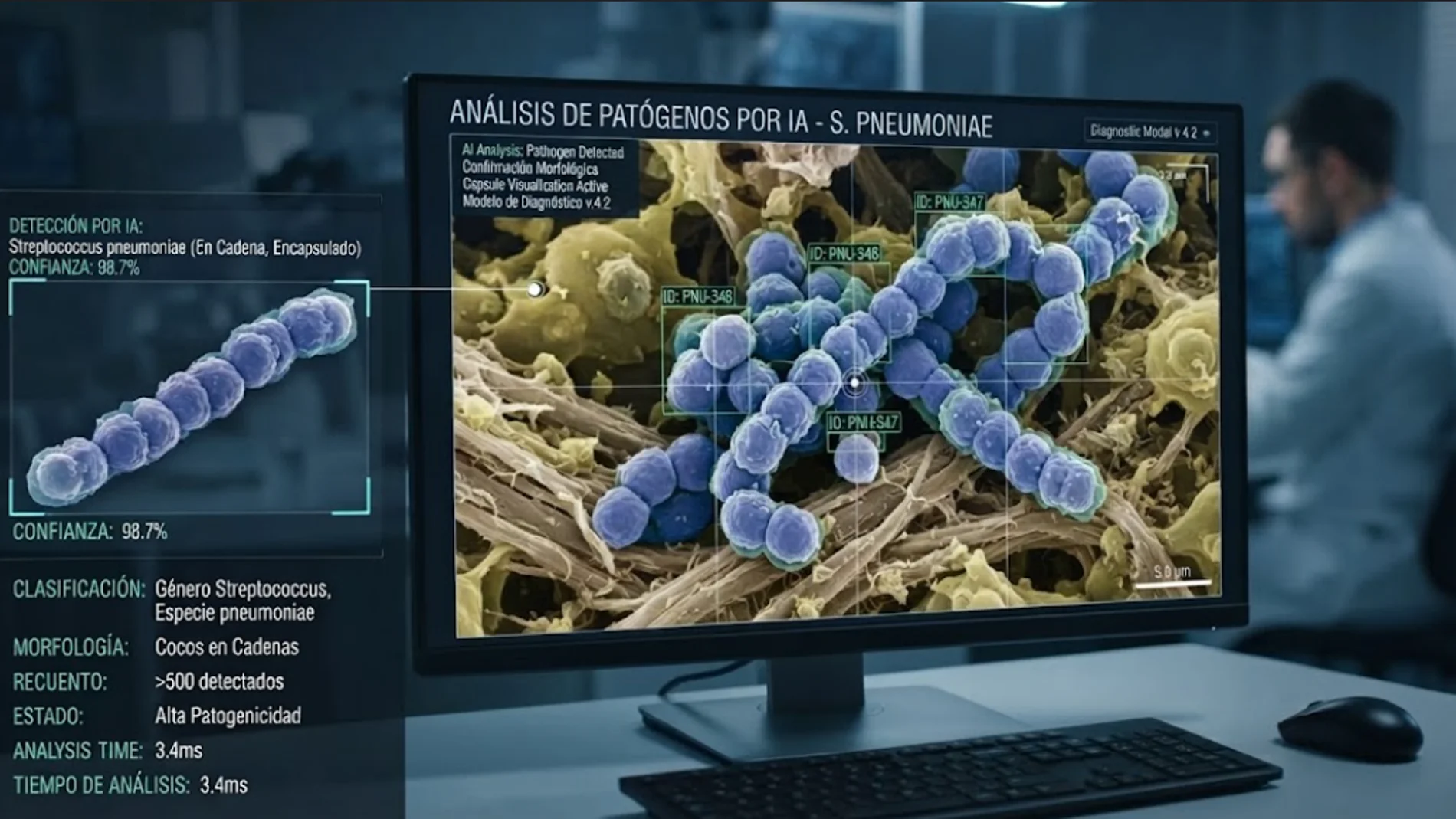
That is precisely what scientists at Imperial College London have done with the help of artificial intelligence. The objective was Streptococcus pneumoniaea bacteria responsible for infections as common as pneumonia and otitis, but also from serious diseases such as meningitis and bacteremia. The problem is that some strains have developed resistance to several antibiotics, to the point that the World Health Organization includes this species among its development priorities of new treatments.
The strategy is known as drug repositioning: instead of discovering a molecule from scratch, a new application is sought for a drug that has already been studied. This can save time and resources and, in principle, allows starting from compounds whose safety profile is already known. But finding those new properties among thousands of molecules remains a huge task. That’s where artificial intelligence comes in.
In a study published in Sciences Advancesthe authors, led by Pedro Ballester, built a data set with 1,849 molecules that had already demonstrated activity against pneumococcus and 34,503 that did not. With them they trained three different types of models: sets of decision trees, neural networks that analyze molecules as connected structures, and transformer models, an AI architecture previously trained with hundreds of millions of molecules. They then used the three systems together to screen a library of 6,747 drugs for candidates that could stop the bacteria.
The machine narrowed that huge list down to 11 candidates. And then came the part that no artificial intelligence can replace: the laboratory. Ballester’s team experimentally checked whether the selected compounds were really capable of preventing the growth of S. pneumoniae. Nine of them did so with considerable potency, with mean inhibitory concentrations of 0.4 micrograms per milliliter or less. And, among them, Two molecules stood out especially: thiostrepton and ceftiofur. The first reached an inhibitory concentration of just 0.0001 micrograms per milliliter and the second 0.0004. Furthermore, thiostrepton maintained high activity against multidrug-resistant strains of pneumococcus.
That does not mean that these drugs can start being used against pneumonia tomorrow. The results correspond to experiments carried out in the laboratory and it would still be necessary to determine, among other issues, whether the necessary concentrations can be safely achieved in the body and whether the balance between efficacy and toxicity allows them to be used clinically. The discovery is, for now, a signal to continue investigating them.
The novelty is also in the way of searching. Ballester’s team did not ask the AI to find a completely new molecule, but rather to learn from previous experiments which structures were associated with the antibacterial effect and use that knowledge to find hidden possibilities among existing medications. And they combined three different approaches because each one can capture different characteristics of the molecules.
“Drug reuse guided by AI has become a powerful strategy to combat antimicrobial resistanceparticularly for pathogens for which some active molecules are already known and which can be used as a training or fine-tuning data set,” concludes Ballester.
This type of advance is especially useful when some molecules active against a pathogen are already known, because this data can be used to train or adjust artificial intelligence models. In a field where each new effective treatment can become a tool to buy time against resistant bacteria, this combination of chemical memory and experimentation could open an unexpected avenue: Sometimes the next antibiotic won’t have to be invented. Maybe we just have to figure out what else one that already exists is good for.