
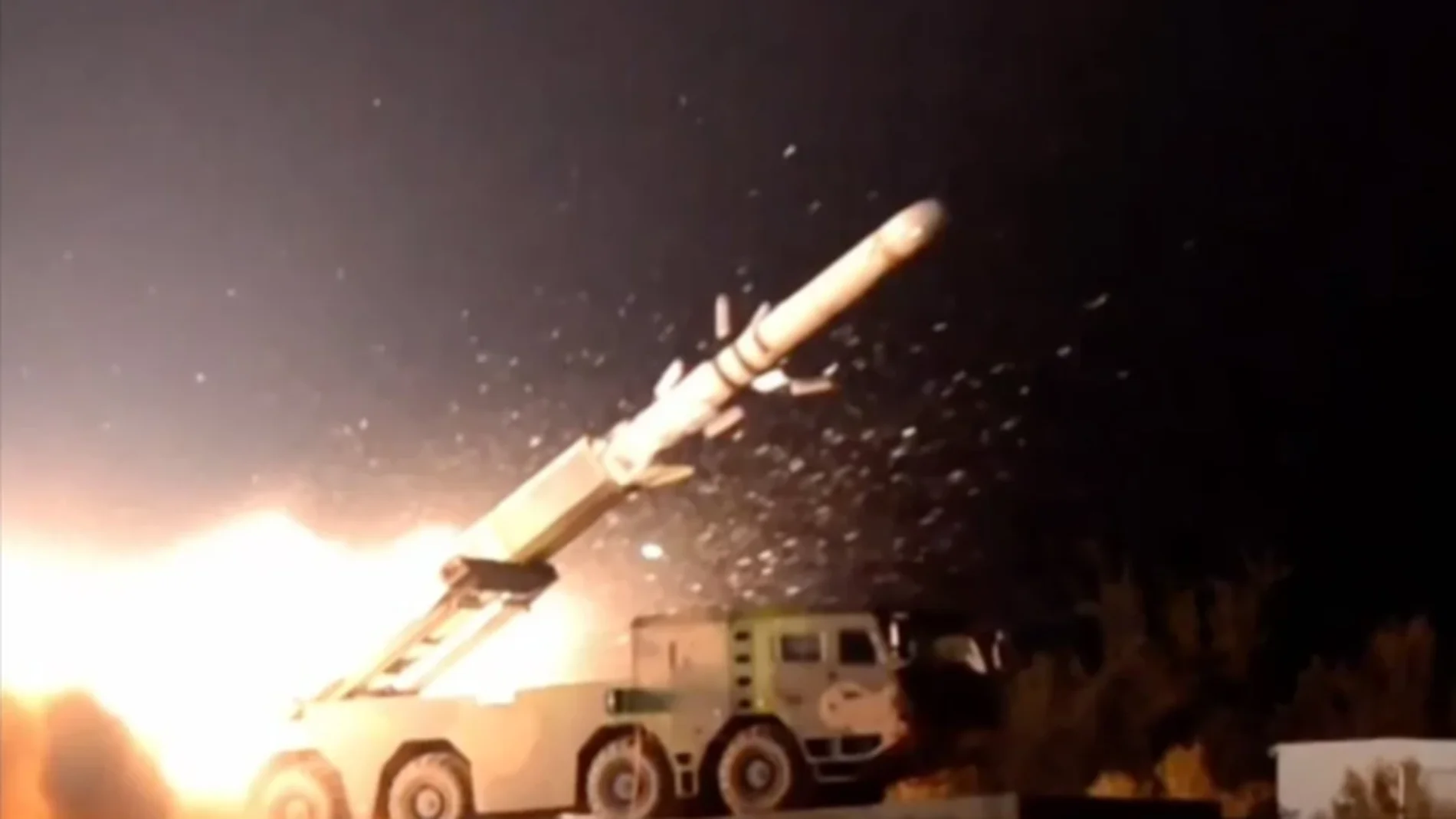
For years, the DF-17 hypersonic glider has been one of the most enigmatic weapons in the Chinese arsenal. It had been seen in military parades and appeared frequently in Western intelligence reports, but it had never been shown at the most critical moment of any mission: the launch. That has changed now. Chinese state television has broadcast for the first time images of the takeoff of this system during military maneuvers. More than a simple propaganda video, many analysts interpret it as a carefully calculated message: Beijing wants to demonstrate that one of its most advanced strategic weapons has reached a high degree of operational maturity.
But what is so special about this vehicle? Why does it attract so much attention among defense experts? The answer lies not only in its enormous speed, but in something much more difficult to combat: its ability to continually change trajectory during flight. When we think of a missile, we usually imagine a trajectory similar to that of a stone thrown into the air. The rocket accelerates, ascends to a high altitude, and then descends in a predictable arc toward the target.
This behavior makes it easier for radars to calculate quite precisely where it will be at any given moment and allows anti-missile systems to prepare for a possible interception. The DF-17 works differently. Actually, the missile only acts as a booster. Its mission is to raise an independent vehicle to high speed: the hypersonic glider. Once it reaches the appropriate altitude, the two separate. This is when the really new part of the system begins.
Instead of following a ballistic trajectory, the glider takes advantage of the upper layers of the atmosphere to travel at speeds above Mach 5 while constantly modifying its altitude and direction of flight. For a defense system, this unpredictability is much more problematic than speed itself. Although the term “hypersonic” is usually associated with speed, specialists agree that The main challenge is not to reach extreme speeds (something that ballistic missiles have been able to achieve for decades), but to retain the ability to maneuver while flying at those speeds.
If a ballistic missile can be compared to an arrow launched towards a target, a hypersonic glider behaves more like a bird of prey that continually corrects its trajectory before launching itself at its target. Each change of direction forces the radars to recalculate where it will be a few seconds later. That margin, which may seem insignificant, is decisive when everything happens at several kilometers per second.
Current anti-missile systems were designed, to a large extent, to deal with relatively predictable trajectories. A hypersonic vehicle introduces a completely different variable. By flying within the atmosphere and modifying its route during the journey, reduces the time available to detect it, calculate its destination and launch a response.
That does not mean that it is impossible to intercept it, but it does require the development of much more sophisticated sensors, radars and defense systems. Precisely for this reason, the United States, China and Russia have for years maintained an intense technological race to develop this type of weapons, while other countries, such as Japan, France or the United Kingdom, are also researching similar systems. The publication of these images also has an obvious political dimension. Publicly displaying the launch of a strategic system conveys confidence in its level of development and constitutes a message addressed to both allies and potential adversaries.
Various analysts consider that the estimated range of the DF-17 (between about 1,800 and 2,500 kilometers, according to different estimates) would allow it to cover a good part of the so-called first island chain of the Western Pacific, a region where some of the main points of friction between China and the United States are concentrated, including Taiwan, Japan and the Philippines. In that context, Teaching how a weapon that until now had barely been seen takes off is a way to reinforce deterrence without having to use it. The images released now remind us of what its main function continues to be: being part of the new generation of long-range attack systems.
The arms race is no longer just about making faster missiles. The real goal is to build vehicles capable of traveling thousands of kilometers while forcing the adversary to wonder, second after second, what their next move will be. And perhaps that is the greatest revolution of hypersonic gliders. They not only challenge the limits of speed; They challenge the human ability to anticipate the future of an object that travels faster than any defense can afford to ignore.