
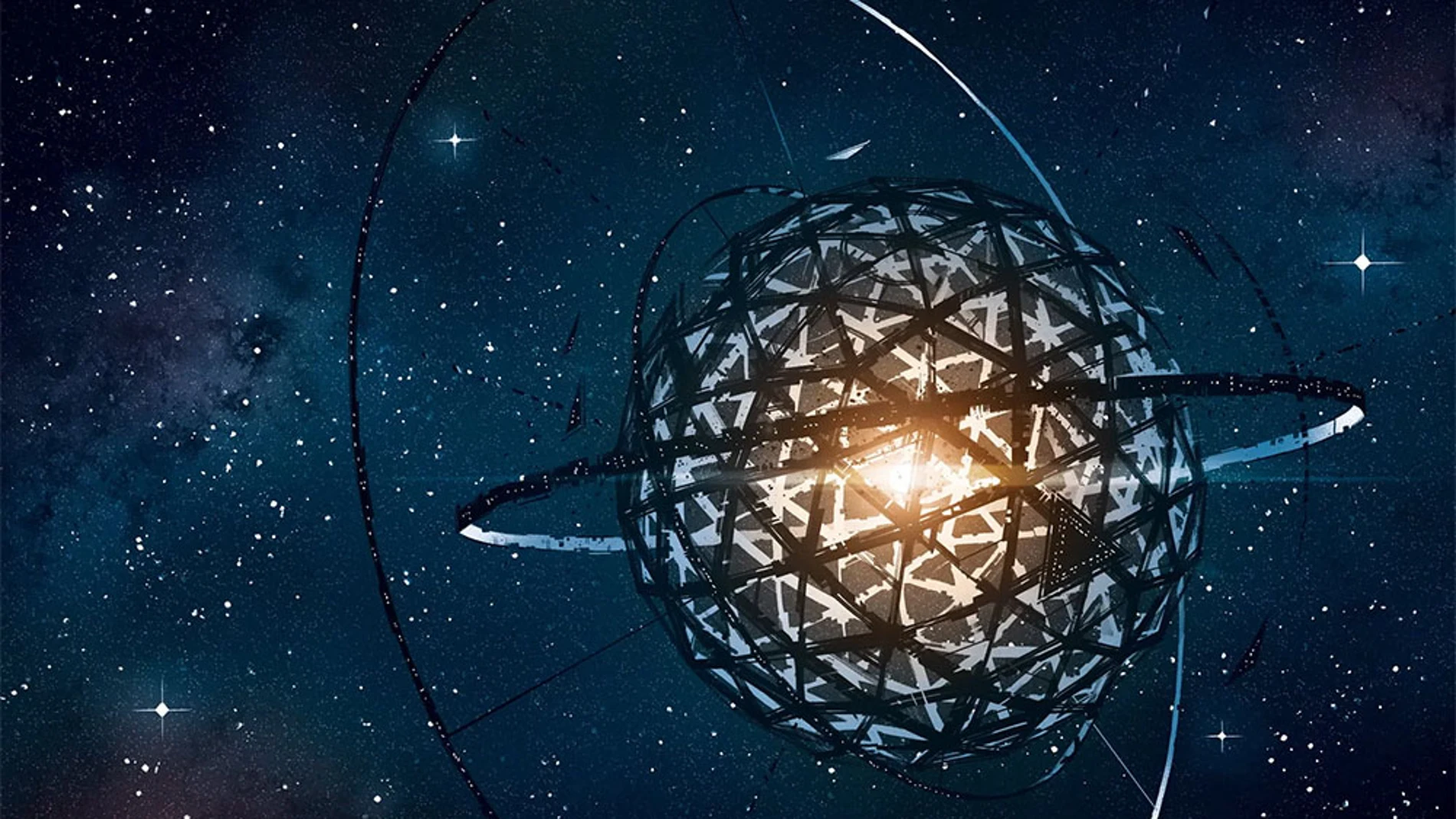
It is, without a doubt, one of the most audacious ideas in modern astronomy: the search for Dyson spheres, hypothetical megastructures that an extremely advanced civilization could build around a star to harness almost all of its energy. When talking about a Dyson sphere, it is easy to imagine a gigantic metallic shell completely enveloping a star, an image popularized by novels and video games. However, that was not exactly what proposed the physicist Freeman Dyson in 1960.
His approach was much simpler and, at the same time, more revolutionary. If a civilization continues to grow for thousands or millions of years, there will come a time when the energy on its planet will no longer be sufficient. The next logical step would be directly harness the energy of its star through millions of satellites, solar stations or collectors distributed around itforming an immense artificial cloud capable of capturing a significant part of its light.
It would not be a solid sphere, but a gigantic swarm of infrastructure orbiting the star. But how could we detect a similar construction hundreds or thousands of light years away? The answer is not in engineering, but in thermodynamics: it does not matter how efficient a machine is. It always transforms part of the energy it uses into heat.
In Dyson’s own words: “If intelligent extraterrestrial beings exist and have reached a high level of technological development, it is likely that a byproduct of their energy metabolism is the large-scale conversion of starlight into far-infrared radiation. It is proposed that “The search for sources of infrared radiation will accompany the recently initiated search for interstellar radio communications.”
In other words, a Dyson sphere would not be especially bright in visible light, but it would emit excess infrared radiation, a signature that telescopes like the James Webb Space Telescope (JWST) can detect with enormous sensitivity. The results? They are already part of a study published in Arxiv. The authors, led by Erik Zackrisson, have discovered that two of the best known candidates did not hide extraterrestrial engineering, but something much more familiar: extraordinarily bright distant galaxies in the infrared. And that difference changes how we will look for intelligent life in the future.
The results showed that the stars were “innocent” and Those responsible for the mysterious infrared glow were two galaxies located much further away, whose light appeared mixed with that of stars in previous observations.. One of them houses enormous amounts of dust heated by a supermassive black hole at its center. The other is going through an intense episode of star formation. Both processes produce large amounts of infrared radiation, enough to mimic the signature you would expect from a Dyson sphere.
But far from closing the search, the study makes it more solid because if until now, astronomers knew what signal they were looking for, now they also know what natural phenomena can imitate it. When a detective learns to distinguishing an authentic fingerprint from a fake does not distance the culprit. On the contrary: it reduces the number of false suspects. The JWST just did the same thing.
For decades, Dyson spheres belonged almost exclusively to the realm of speculation. Today the situation is different since For the first time we have telescopes capable of individually analyzing the best candidates and separate a possible technological signature from the numerous natural phenomena that the universe produces.