
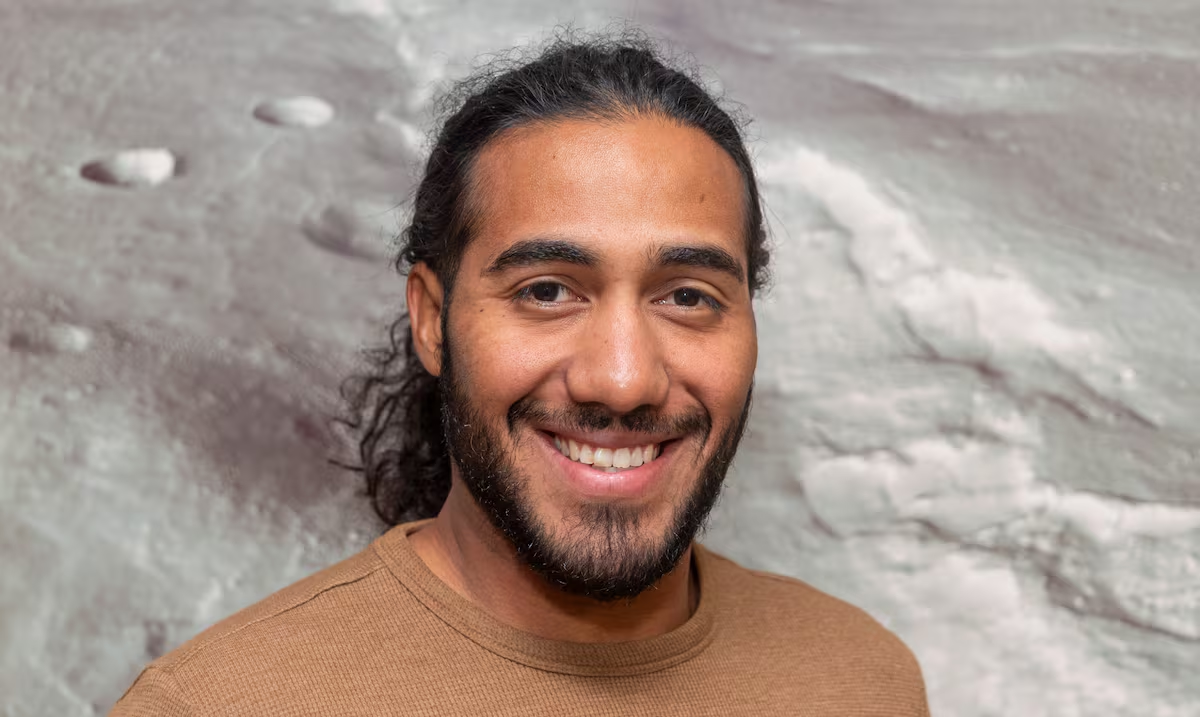
For years, Andy Lopez Oquendo has studied asteroidsthose bodies that move millions of kilometers from Earth and hold clues about the origin of the solar system. A few weeks ago, however, one of them ended up forever linked to his own story.
The Puerto Rican scientist was in Poznań, Polandparticipating in the international conference Asteroids, Comets, Meteors when the time came to announce the recognitions of the International Astronomical Union (UAI). The 29-year-old from Humacao listened attentively without suspecting that his name would soon be one of those called.
Then, he learned that the asteroid (20095), until then known as 1994 PG35, would be renamed “ANDYLOPEZOQUENDO” in honor of his scientific contributions to the field of astronomy.
“I didn’t expect it”the doctor said in a telephone interview with The New Day.
“At that moment it was too much emotion. Disbelief would be the word to describe it”he expressed when reflecting on that moment he lived almost three weeks ago.
The recognition, considered one of the most special that an astronomer dedicated to the study of these bodies can receive, is not requested by the scientists nor does it depend on them submitting a nomination. The UAI evaluates the significant and permanent contributions made within the field.
López Oquendo assured that it took him several days—perhaps weeks—to begin to understand what it meant for an asteroid to bear his name.
“One works for years focused on doing good science, not really thinking about receiving any recognition. It is because of the love, because of the passion that one has for this field”he expressed.
After the announcement, he called his relatives in Puerto Rico. Since then, his parents and other loved ones have been responsible for spreading the news throughout his hometown and other communities in the east.
“There is no person in Humacaowhich is where I’m from, don’t know about this news. “It’s just my parents and my relatives spreading it.”he said between laughs.
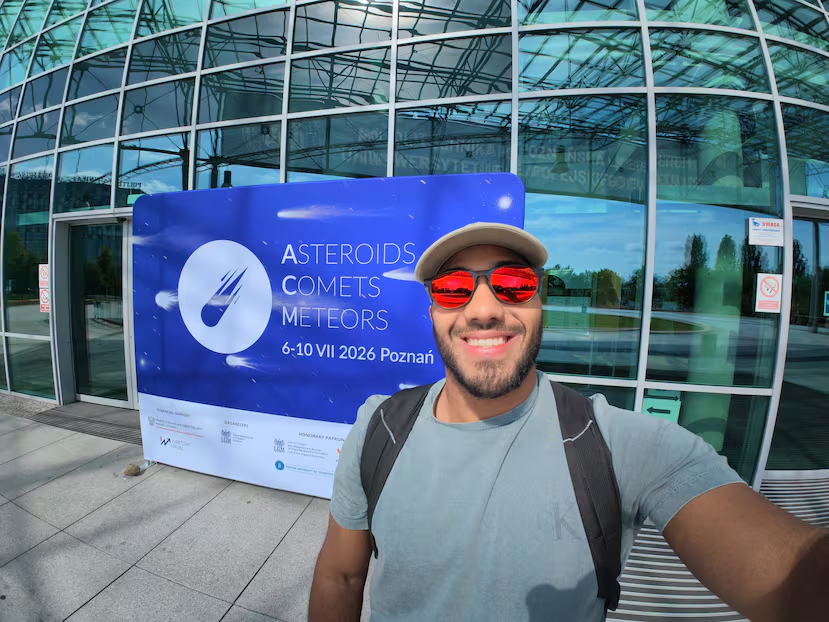
For the scientist, the distinction not only represents his individual achievements, but also the sacrifices of the people who accompanied him during his training.
“This recognition not only represents me. Behind all these sacrifices is the family, there are friends, teachers and professors who played crucial roles”held.
An asteroid millions of kilometers away
The asteroid ANDYLOPEZOQUENDO is located about 2.86 astronomical units, equivalent to approximately 433 million kilometers, within the asteroid belt between the orbits of Mars and Jupiter.
An astronomical unit represents the average distance between the Earth and the Sun, so the object is almost three times that separationexplained the Puerto Rican scientist, who also collaborates on missions with the National Aeronautics and Space Administration (NASA, in English).
According to López Oquendo, it is estimated that the asteroid measures between five and seven kilometers in diameter. Some data suggest that it could contain carbonate materials, although its precise composition is not yet known.
Document of the asteroid that was named in honor of Puerto Rico by El Nuevo Día
Its distance, size and position make it difficult for it to be studied in greater detail. To observe it, scientists must wait for a favorable geometry to occur between the object, the Earth and the Sun.
One of those opportunities will arrive in August 2057when a window will open to study it using optical and infrared telescopes.
López Oquendo does not rule out that, when that time comes, he may personally investigate the body that will bear his name for millions of years.
“Yes, definitely,” he responded when asked if he would like to study it when conditions allow.
Your first steps in Humacao and Arecibo
López Oquendo’s path in science began at the University of Puerto Rico in Humacao, where he completed, in 2019, a bachelor’s degree in Physics Applied to Electronics and a minor concentration in Mathematics.
It was during that stage that he began to work on the study of asteroids and collaborated with the planetary radar group of the radio telescope of the Arecibo Observatory.
That same year he moved to Arizona to pursue his doctoral studies at Northern Arizona University, where he specialized in the physical and chemical characterization of near-Earth asteroids.
In 2024, he earned a PhD in Astronomy and Planetary Sciences, after spending five years developing techniques to quickly characterize objects that could pose an impact risk.
The scientist also assumed the leadership of MIRSIa mid-infrared camera installed at the NASA Infrared Telescope Facility, which allows measuring the thermal flows of asteroids and estimating their size.
Knowing the dimensions of these bodies is essential to determine the danger they could represent and develop planetary defense strategies.
López Oquendo highlighted the importance of having this technology after the collapse of the Arecibo radio telescope, because there are few instruments in the world capable of carrying out this type of measurement.
Towards Jupiter’s Trojan Asteroids
Currently, the Puerto Rican works as a postdoctoral scientist on NASA’s Lucy mission, launched in 2021 to closely study the Jupiter Trojan asteroids, considered remnants of the early stages of the solar system.
These objects orbit alongside Jupiter and, due to their great distance and very dark surfaces, little is still known about their composition and evolution.
“What they are today was what they were at least 4.6 billion years ago during the formation of those gas giants”explained López Oquendo.
In August 2027, Lucy will fly by the Trojan asteroid Eurybates, which will allow detailed images and data of its composition to be obtained for the first time.
As part of the mission, López Oquendo helps plan flybys, determining when and from what angles the spacecraft’s instruments should collect information.
“In basic words, we do a ‘flyby’ and there are sequences where we tell the instrument: ‘Look, you’re going to get data here,’” he explained.
The meeting with Apophis
López Oquendo also collaborates with OSIRIS-APEX, the continuation of the OSIRIS-REx mission, which brought the first sample of the asteroid Bennu to Earth.
The new mission will study Apophis during its extraordinary approach to Earth. Apophis will be the first asteroid of its size to pass this close in the history of human civilization.
Although it does not represent an impact risk, its passage will allow scientists to analyze how Earth’s gravity modifies the structure and evolution of an asteroid.
The Puerto Rican will participate in the characterization of the object from Earth and in the analysis of scientific data when the ship reaches its destination.
“Nothing is impossible”
The scientist grew up in Puerto Rico in a family that he described as “extremely humble”. Although his career took him from Humacao to some of NASA’s main space missions, he assured that he never began his career with the sole objective of working for the agency.
His goal, he said, was always to do good science and contribute to society, regardless of where he ended up working.
The route was not free of obstacles either. He recalled that, at the beginning of his training, mastery of English represented a barrier that he decided to face.
Discipline, responsibility and consistency, he stated, were the tools that allowed him to continue moving forward.
Now he recognizes that there are young Puerto Ricans who see him as a reference. Therefore, he understands that the name placed on the asteroid also belongs, in some way, to the country that formed it.
“There is much more behind this. It is not just for me, but for all those Puerto Ricans who are seeing that there really is a Puerto Rican name on an asteroid that will be there millions and millions of years”, he stated.
His message to those who want to pursue science is that where a story begins does not determine how far it can go.
“Nothing is impossible. You set a goal, no matter where you are born or how difficult the path is.”he stated.
“You always have to stay curious,” concluded the scientist.