
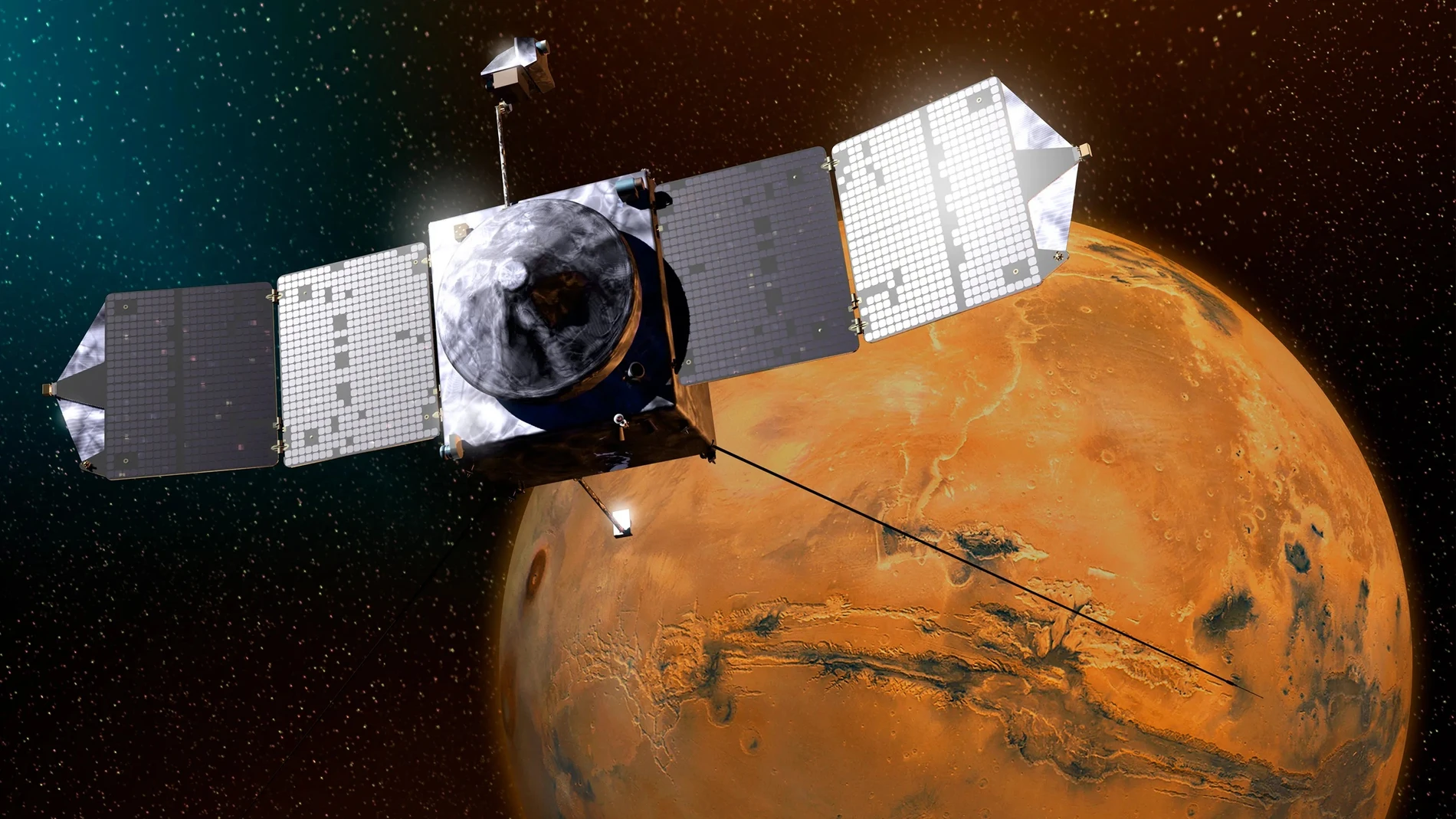
The POT declared the orbiter officially dead this week MAVENwho had been studying the atmosphere of Mars. Last December, after passing through the hidden side of the red planet, it began to spin uncontrollably and stopped communicating despite repeated attempts to contact him. Six months later, the space agency announced that the probe was in a ‘unrecoverable state’ after exhausting his energy and has ended his mission. The causes that led to this outcome remain under investigation.
Although NASA had not foreseen this end for a mission that has lasted a decade longer than initially plannedits fate will not vary from what it would have had if those responsible had been able to shut down the orbiter in a controlled manner.
Mike Moreauhead of the MAVEN project at the Goddard Space Flight Center of NASA, in Greenbelt, Maryland, said this Wednesday in a press conference that ‘the nominal plan to retire the spacecraft at the end of its mission was simply in leaving it in that nominal orbit, where it would remain for a period of between 50 and 100 years before entering the Martian atmosphere. So the spacecraft is basically in a configuration, in an orbit, very similar to what it would have been in if the mission had nominally ended.’
And this is the usual destination of many orbiters. They generally follow hanging around for half a century or moreuntil the planet’s atmosphere drags them down and they end up burning or impacting against the surface. The end may come sooner, if they are unlucky enough to collide with one of their peers or, in this case, with Phobos either Deimosthe two moons of Mars. In fact, MAVEN had to carry out a maneuver in February 2017 to avoid a possible collision with Phobos.
Mars, graveyard of probes, rovers, helicopters and landers
Since 1971, 16 orbital missions have successfully reached Mars and some of these probes could have already fallen. They are these:
- Mariner 9NASA, arrival in November 1971.
- Mars 2USSR, November 1971.
- Mars 3USSR, December 1971.
- Mars 5USSR, February 1976.
- viking 1NASA, June 1976.
- viking 2NASA, August 1976.
- Phobos 2USSR, January 1989.
- Mars Global SurveyorNASA, September 1997.
- Mars OdysseyNASA, October 2001.
- Mars ExpressEuropean Space Agency, December 2003.
- Mars Reconnaissance Orbiter o MRO, NASA, March 2006.
- Mars Orbiter MissionIndia, September 2014.
- MAVENNASA, September 2014.
- ExoMars Trace Gas Orbiter o TGO, ESA, October 2016.
- Emirates Mars Mission o Hope, United Arab Emirates, February 2021.
- Tianwen 1China, February 2021.
Only Mars Odyssey, Mars Express, MRO, TGO, Hope and Tianwen 1 They are still operational today, which means that The orbital cemetery can contain up to a dozen ‘bodies’. Tracking dead spacecraft in Mars orbit is difficult, so it’s generally unknown which of the dead ones are still up there.
There are also a Martian cemetery on the surface. Among the robots that are being buried by Martian dust are the rovers Spirit and Opportunity from NASA, the helicopter Ingenuity and the lander Pathfinderthe same as the fictional astronaut Mark Watney found and used in the book and movie ‘The Martian’in addition to Zhuronga rover that was part of the Chinese Tianwen 1 mission.
Only two surface vehicles are still operating on Mars, the rovers Curiosity and Perseverance from NASA, which landed in August 2012 and February 2021, respectively.
Sooner or later, MAVEN will be part of that Martian cemetery, having provided greater knowledge of the planet that the United States now wants to colonize with Elon Musk at the helm. Data collected by the probe has helped scientists to better understand the drastic transition that Mars underwent in the past, from being a relatively warm and humid world to the frozen desert we know today.
This change occurred because Mars lost most of the dense atmosphere it had. Its air now reaches the 1% of the density of the Earth at sea level. Thanks to MAVEN, we know that That loss was driven by the solar wind and occurred between 4.2 billion and 3.7 billion years ago.around the time when life was beginning to emerge here on Earth.