
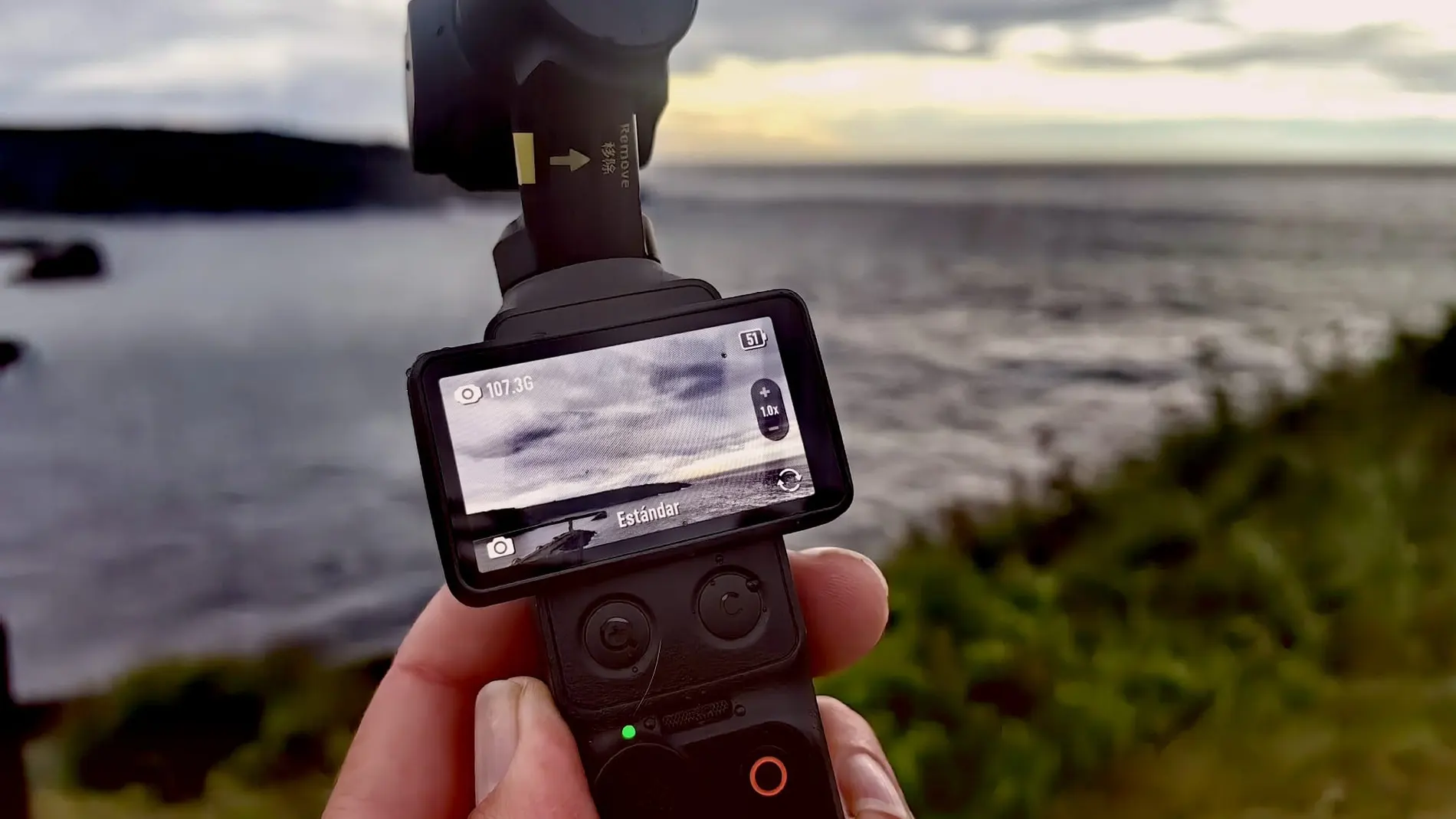
There are devices that seem designed to solve a technical problem. And then there are those who try to solve a human discomfort. The DJI Osmo Pocket 4 clearly falls into the second category: the frustration of wanting to record something beautiful and discover that the most powerful camera you have is also the one you decided to leave at home due to weight, size or laziness.
For years, cameras were trapped in a kind of physical contradiction: the better the quality, the larger and more complex the tool became. DJI has been trying to break that logic with the Pocket family for some time, but The Pocket 4 is probably the moment when the idea fully matures.
And that is noticeable from the first second. The Pocket 4 retains that almost absurd “mini camera on a stick” shape, but behind it there is a three-axis stabilized system that eliminates much of the sudden movements when walking. It is not digital stabilization: There are small physical motors correcting the movement in real time. The difference is immediately noticeable. The video stops looking like it was recorded with a camera and starts to look like a floating glance.
The interesting thing is that DJI hasn’t tried to reinvent everything. And perhaps that is precisely the right decision. Many users expected a spectacular leap compared to the Pocket 3: dual lens, 8K or radically new sensors. But the Pocket 4 plays another game. It refines more than it revolutionizes. And in real use that matters more than it seems.
The most obvious improvement appears in automatic tracking. The new ActiveTrack 7.0 achieves something that a few years ago seemed like science fiction– Have a tiny camera follow you as you move without getting lost even among obstacles, turns or changes in distance. In practice, recording yourself stops being an uncomfortable choreography and becomes something almost natural. You place the camera, make a pre-established signal, start walking and the device understands that you are the center of the scene and begins to follow you.
And here appears one of the great virtues of the Pocket 4: it does not require too much thinking. It starts almost instantly, fits in a pocket and can be operated with one hand. It seems silly, but most cameras fail precisely there. They are so good that they end up being difficult to use in real life, but this does not apply to the Pocket 4.
Image quality also improves, although perhaps not in the most spectacular way on paper. It maintains the 1-inch sensor, but DJI has worked on the dynamic range, color and behavior in low light. The result is less “vitaminized mobile video” and more cinematic aesthetics. Especially when The D-Log profile is used, designed for those who edit the color later. The Pocket 4 records in true 10-bit D-Log. What does this mean? When a camera records video, it is actually recording information about color and light. The difference between 8 bits and 10 bits is basically how much information you can hold about each color.
A “normal” 8-bit video can represent about 16 million colors, but a 10-bit one can represent more than a billion colors. Translated into something everyday, on a sunset, in 8 bits, the sky can go from orange to blue in visible “jumps”, like bands of color. In 10 bits, the transition is much smoother, continuous and natural. The gradients look real.
Other sections to highlight and that determine the use (and even the “need”) of the Pocket 4 have to do with its practicality: it goes from 0 to 80% battery in almost 15 minutes (and DJI increased its battery by 20% compared to the previous generation). No memory card needed: 107 GB internal storage (hour and a half at maximum quality and up to 5 hours at 1080) and finally, it can be used for live streaming.
Finally, due to its size, the Pocket 4 has an emotional aspect that we rarely see in technology: it is less invasive, less intimidating. And that has a huge effect on trips, impromptu interviews or everyday scenes. Many times you don’t get better images because you have better technology, but because the presence of the camera stops altering the scene. It is, in short, a guest eye, more than a camera.
If we add to that that the box comes with a microphone receiver, a wind protector, tripod, light for night shots (its effect is more natural than it appears) and a wide-angle lens… The set becomes a Swiss army knife of travel and content creation.
Verdict:
When it comes to investing in recording content (for networks, documentaries or your own passion), more expensive does not mean better. The Pocket 4, starting at 400 euros, weighs less than many mobile phones (barely 200 grams), takes up less space and has excellent quality. Its stabilization is professional, high-quality recording and its battery life make it a must-have for travel.