
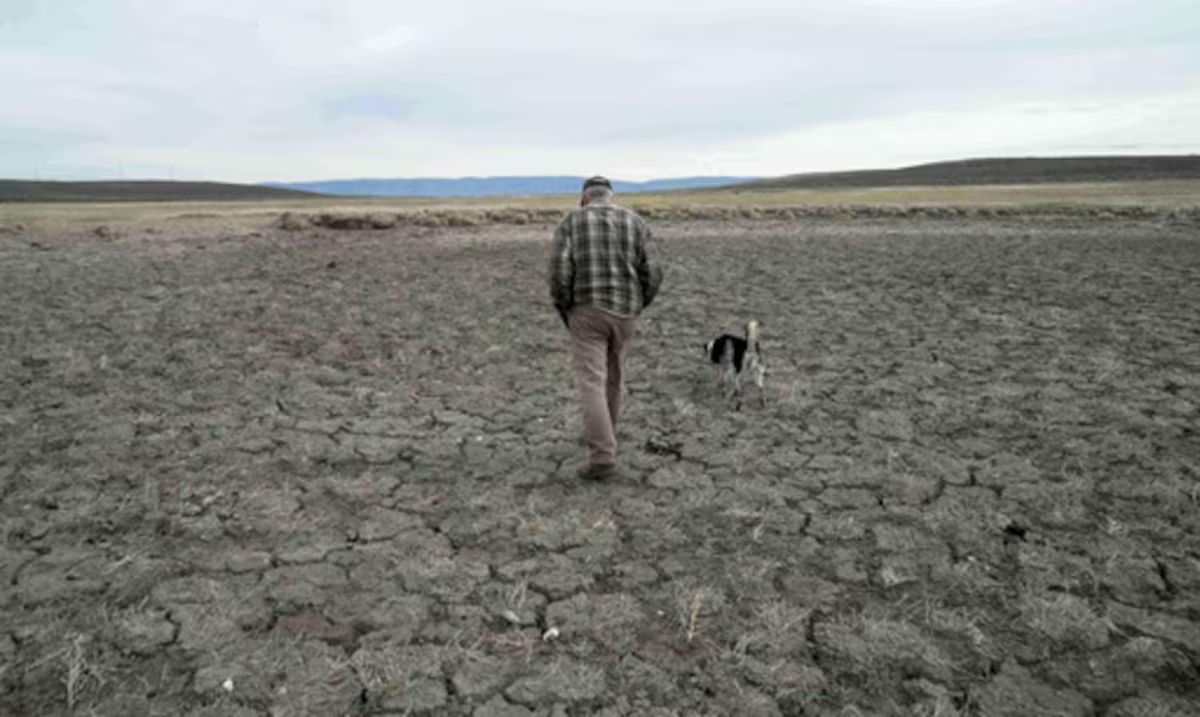
The drought in the United States adjacent has reached record levels for this time of year, weather data shows. Forecasters say it’s a bad sign for the upcoming wildfire season, food prices and water problems in the West.
More than 61% of the Lower 48 states are in moderate to exceptional drought – including 97% of the Southeast and two-thirds of the West – according to the Drought Monitor of the United States. These are the highest levels for this time of year since drought monitoring began in 2000.
The Palmer Drought Severity Index National Oceanic and Atmospheric Administration (NOAA, in English) Not only did it reach its highest level in March since records began in 1895, but last month was the third wettest on record regardless of time of year. It was only inferior to the famous months of July and August 1934.
Because of the record heat, much of the West has had exceptionally low levels of snow in the early months of the year, which is normally how the region stores water for the summer. According to Brian Fuchs, a climatologist at the National Drought Mitigation Center, another drought, related to the jet stream that keeps storms farther north, has caused the South, from Texas to the East Coast, to suffer a different drought that coincides with that of the West.
It would take 19 inches of rain in a month to break the drought in East Texas and more than a foot of rain to address the deficit for most of the Southeast.NOAA calculated.
“Right now, 61% of the country is in drought, and the number has not stopped increasing throughout the year,” says Fuchs. “We haven’t seen too many years where this amount of the country has been in this state.”
A highly technical but crucial measure of the “sponginess” of the atmosphere – that is, how much moisture hot, dry air absorbs from the earth it’s baking – sticks out like a sore thumb. It’s called the vapor pressure deficit. It’s 77% above normal and more than 25% above the previous January-March record in the West, according to UCLA hydroclimatologist Park Williams.
That level of soil moisture absorption “would not have seemed possible” until now, Williams said.
Drought usually peaks in summer, not spring, and that’s what worries meteorologists.
“Fire tends to respond to heat and drought exponentially,” Williams said. “For each degree of warming, a greater explosion in terms of fires is obtained than that obtained with the previous degree of warming.”
In Arizona, cacti are blooming months ahead of schedule and concerns about water have already begun, says Kathy Jacobs, director of the Center for Climate Adaptation Science and Solutions at the University of Arizona.
1 / 15 | Hundreds of people evacuated: this is what the burning wildfire in California and Oregon looks like. Thousands of homes in the wine country of Northern California and Central Oregon received evacuation orders and warnings last Sunday. -Noah Berger
“Those of us who depend on the Colorado River, of course, are very concerned that we do not have a negotiated path forward in the midst of what appears to be possibly the worst drought year we have all experienced,” Jacobs said. “We have many reservoirs that are not full.”
Jeff Masters, a meteorologist at Yale Climate Connections, says that What worries him most is what the drought could do to agriculture and, consequently, to food prices. If the United States has a poor harvest due to drought, it could be a global problem. A strong natural meteorological oscillation is expected The Childwhich often reduces crop yields in other places on the planet, such as India.
UCLA’s Williams explained that drought and increased heat are due to both natural variability and human-caused climate change.
“It’s affected by climate change all the time,” says Jacobs, of Arizona. “There is no time that is divorced from climate trends. But this extreme event is extreme in the sense we expected: extreme heat waves, intense drought.”