
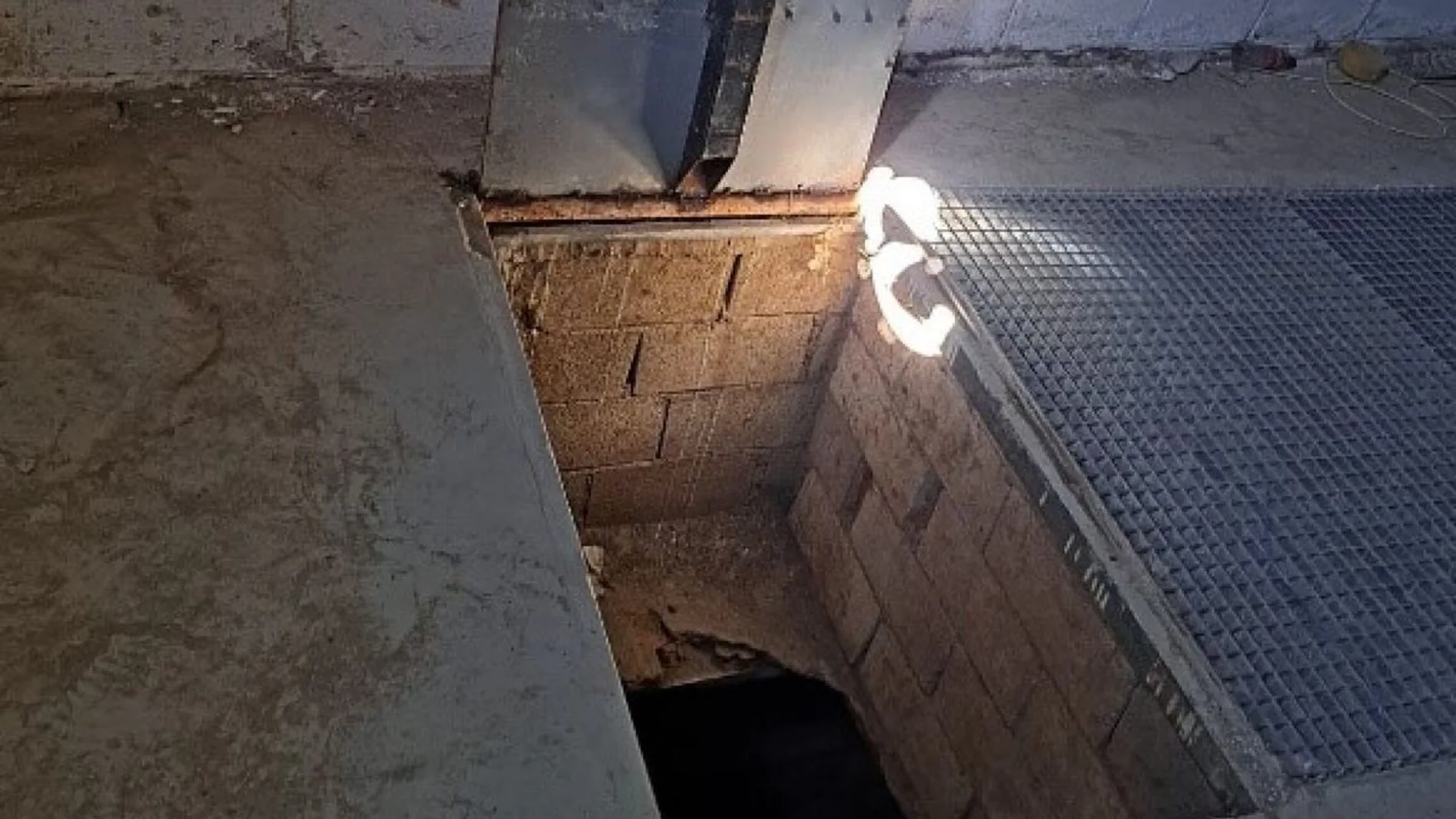
The discovery of a second drug tunnel that connects Ceuta with Morocco keeps the National Police and the Civil Guard somewhere between surprised and bewildered. The first feeling comes from the complexity of the facility, which even had rails with which to transport enormous quantities of hashish – the investigations have not found, for the moment, that other types of narcotics were introduced, although suspicions are increasing. And perplexed because they do not know how long these conduits have existed and, worst of all, if there are more.
This new way to introduce drugs into Spain was known for the first time in February of last year. The Civil Guard, in “operation Hades” dismantled an infrastructure with a depth of 20 meters that connected an industrial warehouse in Spain with a house on Moroccan military land. In parallel, the Drug and Organized Crime Unit (Udyco) was carrying out another parallel investigation. In the wiretaps included in the summary, the agents deduced that there was another connection below the road surface intended for the same purpose: bringing large amounts of money into the national territory and then distributing them in trucks throughout the peninsula.
The main investigator in both cases is Mustapha Chairi Brouzi, who is considered the “owner” of both passages, as he himself acknowledges in the wiretaps of the case, a key part of the investigations. He escaped from the Civil Guard, and was on the run in Morocco, until he finally fell into the hands of the Udyco. On November 8, 2025, Chairi spoke in his Mercedes with a man identified as Hassan. From the conversation it is clear that this person wanted to enter Ceuta, but had problems doing so. But the owner of the drug tunnels had a way to solve it. During the talk, he tells him that he has “about 40 meters left,” from which the agents deduce that his organization was working on the construction of a third access from Morocco to Ceuta to bring in hashish.
Chairi conveyed to Hassan his concern about the situation of “Redouane”, one of the key people in the construction of the other passageways and who was absconding from Spanish justice in a “search and capture” situation. In another conversation, the main piece of the Ceuta drug tunnels confesses to a stranger that this “Hassan” is his uncle, that he only needed to “put him” in the autonomous city and that he was “better than Mumen”, the “person necessary for the creation of the underground infrastructure.”
The conversation continues, and Chairi reveals, according to the National Police, the location of that third alleged drug tunnel: Berrocal. This is an area of Ceuta considered “the most delicate stretch of the border between neighboring countries,” the agents explain. It covers 8.2 kilometers in length, and about 1,500 meters “coincide with the limits of the Berrocal estate.” “That is why, given the evidence obtained throughout the investigation thanks to the investigative measures ordered by His Excellency and added to the idiosyncrasy of said place, it brings together a series of characteristics suitable for the creation of an underground infrastructure that connects both countries, intended for the introduction of large quantities of narcotic substances,” the researchers summarize.
Coincidences
The role of Mustapha Chairi Brouzi in the two conduits that have been found so far is not the only coincidence. In both cases there are agents of the State Security Forces and Corps investigated for going to the other side and allegedly being part of criminal organizations. In the first, the Benemérita Internal Affairs Service has so far caught four of its agents and a national police officer. In the second, Udyco has a retired civil guard, Ángel Albarracín, under investigation.
According to Abc, a leader of the former OCON-Sur appears in the wiretaps, an elite unit that fought the mafias in the Campo de Gibraltar area with great results, until the Ministry of the Interior decided to dissolve it. Shortly after, Internal Affairs arrested the group’s leader, Lieutenant Colonel David Oliva, and two other subordinates for alleged crimes of revealing secrets and bribery.
The Police link the organization with thousands of kilos of hashish seized by Udyco. The main stash, 15 tons, cost on June 15 in a tractor that left Nador, a city near Ceuta. The investigation by the Internal Affairs of the Civil Guard has remained with the agents involved, since the discovery of the first tunnel was “accidental”, indicate the sources consulted. Part of this first investigation has been transferred to the Information Service and the CNI in case other illegal goods, such as people or weapons, had been introduced through the original installation.