
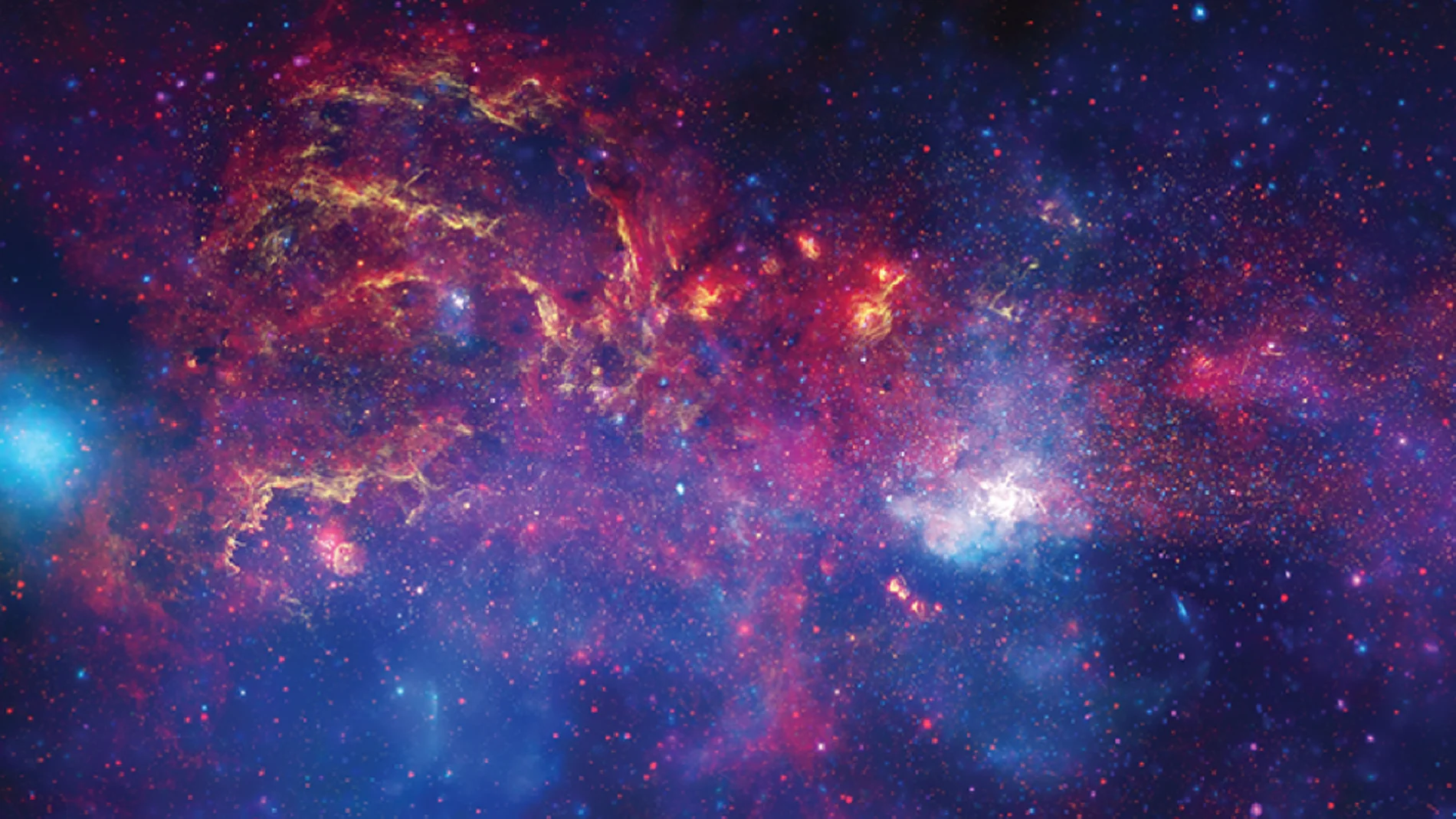
There is something deeply counterintuitive about the idea of “listening” to a black hole. In the vacuum of space, sound cannot propagate. There is no air, there are no vibrations that reach an ear. And yet, in recent years, NASA has achieved something that sounds almost paradoxical: transforming data from the cosmos into auditory experiences.
It’s not that black holes emit sound in the traditional sense. What they do is emit light, radiation, energy at different wavelengths. And that’s where “translation” comes in.. Projects such as the sonifications of the Hubble Space Telescope or the Chandra X-ray Observatory convert these signals (invisible or difficult for us to interpret) into notes, tones and sound textures.
The process is, in essence, a kind of cosmic score. The images are scrolled from left to right, or from inside to outside. The brightness of a region can be translated into volume; the energy of X-rays, in higher tones; denser structures, in deeper or more sustained sounds. It is not a “real” sound in space, but it is a faithful representation of the data.
One of the best-known examples is the Perseus galaxy cluster. There, the scientists They detected pressure waves in the hot gas surrounding a supermassive black hole. Those waves, translated and amplified millions of timesbecame a low, almost disturbing sound. A kind of deep note that, in a certain sense, is the closest thing we have to the “rumor” of a black hole.
The fascinating thing is that this is not just an aesthetic curiosity. Sonification allows us to detect patterns that sometimes go unnoticed in images. Our hearing is extraordinarily good at recognizing rhythms, changes, anomalies. Where the eye sees a diffuse cloud, the ear can perceive a structure.
Furthermore, there is a deeply human component to all of this. The universe, for centuries, has been a visual spectacle: telescopes, photographs, maps of the sky. Converting it into sound adds a different, more intimate, almost corporeal dimension. We don’t look at the cosmos: we listen to it.
And in that gesture there is also a small scientific lesson: What we perceive, whether light or sound, is always a translation. Our senses do not capture reality as it isbut a version adapted to our limitations. NASA is not “sounding” space. It is revealing, through another means, information that has always been there.